
Carrello
0
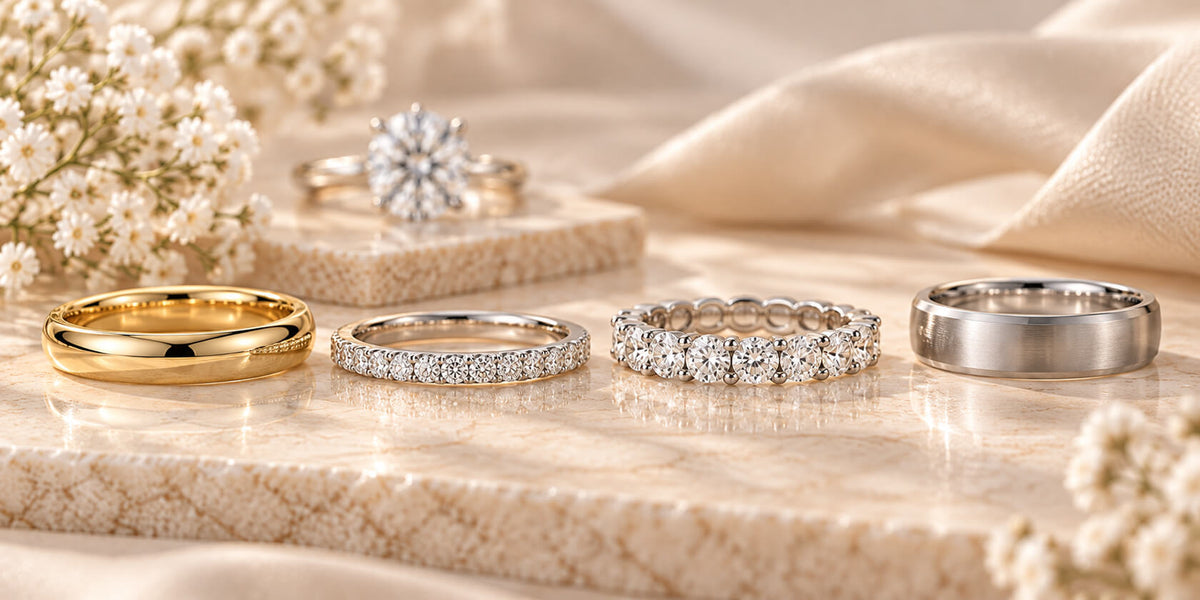
A wedding ring is one of the few pieces of jewelry you may wear every day for decades. While its design may appear simpler than an engagement ring, choosing the right wedding band involves more than selecting a metal and ring size.
Width, profile, precious metal, stone setting, comfort, durability, and how the wedding ring sits beside an engagement ring can all affect how the finished ring looks and feels.
Whether you prefer a classic plain band, a diamond wedding band, a full eternity ring, or a custom design made to complement your engagement ring, this guide explains the most important decisions to consider before choosing your wedding ring.
What Is the Difference Between a Wedding Ring and a Wedding Band?
The terms wedding ring and wedding band are commonly used interchangeably.
Traditionally, "wedding band" often describes a simpler ring with a continuous or relatively understated design, while "wedding ring" is the broader term and can include diamond-set and more decorative styles.
In modern jewelry, however, there is no strict distinction.
A wedding ring may be:
- A classic plain metal band
- A pavé diamond band
- A half-eternity band
- A full eternity band
- A curved or contoured band
- A gemstone wedding band
- A custom-designed matching band
What matters more than terminology is choosing a ring that suits your style, lifestyle, and—if applicable—your engagement ring.
1. Decide Whether the Wedding Ring Will Be Worn Alone or With an Engagement Ring
This should be one of your first decisions.
A wedding band worn alone can be designed entirely around its own proportions and appearance.
If it will be worn beside an engagement ring, however, the two rings need to work together visually and physically.
Consider:
- Band width
- Ring thickness
- Setting height
- Metal color
- Diamond or gemstone placement
- Overall proportions
- Whether the rings sit flush
- Whether either ring rubs against the other
A beautiful wedding band is not necessarily the best wedding band for a particular engagement ring.
The two rings should be considered as a set.

2. Choose a Wedding Ring Style
Wedding rings range from extremely simple to highly detailed.
Understanding the main styles makes the selection process easier.
Classic Plain Wedding Band
A plain precious-metal band remains one of the most timeless choices.
Its strengths are simplicity, durability, and versatility.
Plain bands can still differ considerably depending on:
- Width
- Thickness
- Profile
- Finish
- Metal
- Edge design
A narrow polished band creates a very different appearance from a broad brushed platinum band.
Best for: Timeless design, everyday wear, and minimal maintenance.
Pavé Wedding Band
A pavé wedding band uses small diamonds or gemstones set closely along the surface of the ring.
The result is considerably more sparkle than a plain band while maintaining a refined appearance.
Pavé wedding bands work particularly well beside engagement rings with pavé shoulders, although matching them exactly is not required.
Best for: Buyers who want additional brilliance without using larger individual stones.
Shared-Prong Wedding Band
In a shared-prong design, adjacent stones share prongs.
This reduces the amount of visible metal between stones and allows more of each diamond or gemstone to remain visible.
Shared-prong bands can create a continuous, brilliant appearance and are commonly used for eternity rings.
Because more of the stones may be exposed, construction quality and stone security are particularly important.
Best for: Strong diamond or gemstone presence with minimal visible metal.
Channel-Set Wedding Band
In a channel setting, stones are positioned between two metal walls rather than individually surrounded by traditional prongs.
This creates a smooth, structured appearance.
The edges of the stones are relatively protected, which can make channel-set bands attractive for buyers who prefer a cleaner profile.
Best for: Sleek styling and a more protected stone setting.
Bezel-Set Wedding Band
Bezel-set bands surround individual stones with metal.
The visible metal becomes part of the design, creating a contemporary and often distinctive appearance.
Depending on the design, bezel settings can also offer additional protection around stone edges.
Best for: Modern design and buyers who prefer a more defined metal-and-stone pattern.
3. Understand Half-Eternity vs. Full-Eternity Wedding Bands
This is one of the most important decisions when choosing a diamond wedding band.
Half-Eternity Band
A half-eternity band places diamonds or gemstones across approximately the upper portion of the ring.
Advantages
- Stones are concentrated where they are most visible
- Generally easier to resize than full-eternity designs
- Less stone weight is required
- The underside remains smooth metal
For many buyers, a half-eternity band provides an excellent balance between sparkle and practicality.
Full-Eternity Band
A full-eternity band places stones around the entire circumference of the ring.
This creates continuous brilliance regardless of how the ring rotates on the finger.
Considerations
Full-eternity bands can be:
- More difficult or sometimes impractical to resize
- More expensive because they require additional stones and setting work
- More exposed to contact on the underside of the hand
- Less forgiving if the original ring size is incorrect
The visual effect is beautiful, but the practical differences should be understood before ordering.

4. Choose the Right Stone Size
Larger stones do not automatically create a better wedding band.
Stone dimensions affect:
- Ring width
- Height
- Comfort
- Sparkle
- Durability
- Compatibility with an engagement ring
For example, a delicate pavé band using very small diamonds creates a completely different appearance from an eternity ring using 3 × 4 mm oval diamonds.
When pairing a wedding band with an engagement ring, the goal should usually be visual balance.
A very large eternity band can compete with a delicate engagement ring, while an extremely thin wedding band may visually disappear beside a substantial center stone.
Think about the two rings together rather than evaluating stone size independently.
5. Choose the Right Wedding Band Width
Wedding band width has a major effect on both appearance and comfort.
Common widths can range from very delicate bands around 1.5–2 mm to substantial bands of 5 mm, 6 mm, or more.
As a general visual guide:
1.5–2 mm
Delicate and understated.
Often works well beside fine engagement rings.
2–3 mm
Balanced and versatile.
Suitable for many traditional wedding-ring designs.
3–4 mm
More substantial and visually noticeable.
5–6 mm+
Creates a stronger, bolder appearance and is commonly chosen for wider plain wedding bands.
These are not rules. Finger size, ring profile, stone setting, and personal preference all affect how a particular width looks.

6. Choose the Right Precious Metal
The most common fine-jewelry choices for wedding rings include:
- 14K Yellow Gold
- 14K White Gold
- 14K Rose Gold
- 18K Yellow Gold
- 18K White Gold
- 18K Rose Gold
- Platinum
Each offers a different combination of color, precious-metal content, weight, maintenance, and price.
14K Gold
14K gold contains approximately 58.3% pure gold.
Its combination of durability, precious-metal content, and everyday practicality makes it a popular choice for wedding bands.
18K Gold
18K gold contains 75% pure gold.
It has a higher gold content and, particularly in yellow gold, generally offers a richer gold appearance.
Platinum
Platinum is naturally white and notably dense.
It is a strong choice for buyers who want a naturally white precious metal and appreciate a more substantial feel.
For a more detailed comparison of purity, color, maintenance, and other characteristics, see our Jewelry Metal Guide: Gold, Platinum & More.
7. Should Your Wedding Ring Match Your Engagement Ring Metal?
Not necessarily.
Matching metals create a cohesive and traditional appearance.
For example:
Platinum Engagement Ring + Platinum Wedding Band
or
18K Yellow Gold Engagement Ring + 18K Yellow Gold Wedding Band
But mixed-metal bridal sets can also be intentional and attractive.
A yellow-gold wedding band beside a white-metal engagement ring, for example, creates contrast and allows both rings to remain visually distinct.
There is no design rule requiring both rings to use the same metal.
However, if two rings will constantly rub against each other, their construction, hardness, surface finish, and setting design should also be considered—not just their color.
8. Flush Fit, Gap, or Contoured Wedding Band?
One of the most overlooked issues when purchasing a wedding band is whether it can physically sit beside the engagement ring.
There are three common arrangements.
Flush Fit
The wedding band sits directly beside the engagement ring with little or no visible gap.
This creates a clean, integrated appearance.
Small Gap
Some engagement ring settings prevent a straight wedding band from sitting completely flush.
A small gap is not a defect. Many bridal sets are intentionally worn this way.
Curved or Contoured Band
A curved wedding band follows the outline of the engagement ring.
This can be useful for:
- Low-profile engagement rings
- Large center stones
- Certain halo settings
- Unusual baskets or galleries
The correct solution depends on both the engagement ring structure and the desired appearance.

9. Pay Attention to Ring Profile and Comfort
Width is not the only factor that determines how a wedding band feels.
The cross-sectional shape of the ring also matters.
Common profiles include:
Flat
Creates a clean, contemporary appearance.
Domed
Has a rounded exterior and is common in traditional wedding bands.
Comfort Fit
The inside surface is slightly rounded, reducing the amount of metal pressing against the finger.
Comfort-fit construction can be particularly useful for wider wedding bands.
The wider and heavier the ring becomes, the more important profile and interior comfort can become.
10. Consider Your Lifestyle
A wedding ring is typically worn more frequently than almost any other piece of jewelry.
That makes lifestyle especially important.
Consider:
- Your occupation
- How frequently you work with your hands
- Exercise and sports
- Exposure to chemicals
- Whether you regularly wear gloves
- How much maintenance you are comfortable with
- Whether the ring contains exposed stones
Someone seeking a highly practical everyday ring may prefer a plain or more protected design.
Someone prioritizing maximum brilliance may accept the additional maintenance associated with pavé or eternity settings.
Neither approach is better.
The correct design depends on how the ring will actually be worn.
11. Get the Ring Size Right
Accurate sizing is especially important for wedding bands.
This becomes even more important with:
- Wide bands
- Full-eternity rings
- Intricate designs
- Rings with stones around most of the circumference
A wider band can feel tighter than a narrow ring in the same nominal size.
Full-eternity designs can also be difficult to resize because stones and settings extend around the entire ring.
Whenever possible, confirm the ring size carefully before production rather than assuming resizing will always be straightforward later.
For measurement guidance, see our Ring Size Guide.
12. Think Carefully Before Choosing a Very Thin Band
Ultra-thin wedding bands can look elegant in photographs, particularly when stacked beside a delicate engagement ring.
But visual delicacy should not come at the expense of structural integrity.
A wedding ring is exposed to:
- Repeated impact
- Pressure
- Bending forces
- Surface wear
- Contact with other rings
The appropriate minimum dimensions depend on the metal, finger size, design, stone setting, and construction.
Rather than automatically choosing the thinnest possible band, look for proportions that preserve the desired aesthetic while providing enough structure for everyday wear.
This is particularly important for pavé and eternity designs.
13. Should You Choose Lab-Grown Diamonds for a Wedding Band?
Lab-grown diamonds are well suited to wedding bands.
They have essentially the same chemical composition, crystal structure, and optical and physical properties as natural diamonds.
This makes them suitable for:
- Pavé wedding bands
- Half-eternity bands
- Full-eternity bands
- Shared-prong designs
- Bezel-set bands
- Channel-set bands
Lab-grown diamonds can also make designs involving many individual stones more accessible without requiring buyers to sacrifice the fundamental material properties of diamond.
For more information, see What Are Lab-Grown Diamonds?
14. Can You Use Colored Gemstones in a Wedding Ring?
Yes.
Wedding rings can incorporate:
- Sapphire
- Ruby
- Emerald
- Alexandrite
- Other suitable gemstones
Colored gemstones can be used alone or alternated with diamonds.
However, not every gemstone has the same hardness, toughness, cleavage characteristics, or suitability for exposed everyday settings.
This distinction matters particularly in eternity bands, where stones may extend around the sides and underside of the finger.
Gemstone choice should therefore consider not only color, but also the intended setting and how the ring will be worn.
For a deeper introduction, see What Are Lab-Grown Gemstones?
15. Should Couples Buy Matching Wedding Rings?
Matching wedding rings are optional.
Some couples prefer bands that share:
- The same metal
- Similar widths
- Matching finishes
- Coordinated engraving
- Related design details
Others choose completely different rings based on individual taste.
A useful middle ground is to create coordinated rather than identical rings.
For example, both rings might use platinum and the same engraving while having different widths and profiles.
The rings can share a story without having to share exactly the same design.
16. When Does a Custom Wedding Band Make Sense?
Custom design is particularly useful when an existing engagement ring has unusual proportions or when a standard wedding band does not sit the way you want.
A custom wedding band can be designed around:
- Engagement ring dimensions
- Center stone shape
- Basket or gallery structure
- Desired gap
- Band curvature
- Diamond or gemstone size
- Metal
- Width
- Setting style
- Engraving
For an existing engagement ring, dimensions, photographs, CAD information, or the physical ring itself may help determine the correct contour.
This can produce a bridal set that looks intentional rather than two unrelated rings placed together.
Wedding Ring Comparison
| Style | Appearance | Practical Consideration | Best For |
|---|---|---|---|
| Plain Band | Clean, timeless | Low maintenance | Everyday simplicity |
| Pavé Band | Delicate sparkle | More settings to maintain | Refined brilliance |
| Half Eternity | Stones across visible portion | Generally more resizing flexibility | Balance of sparkle & practicality |
| Full Eternity | Continuous stones | Resizing can be difficult | Maximum continuous brilliance |
| Shared Prong | Minimal visible metal | Stones more exposed | Strong stone presence |
| Channel Set | Smooth, structured | Protected edges | Sleek everyday design |
| Bezel Set | Modern | More visible metal | Contemporary styling |
| Curved Band | Follows engagement ring | Shape-specific | Non-flush engagement rings |
Wedding Ring Buying Checklist
Before ordering your wedding ring, confirm:
- Will it be worn alone or with an engagement ring?
- Plain or stone-set?
- Half eternity or full eternity?
- Stone type and size
- Setting style
- Band width
- Band thickness
- Ring profile
- Precious metal
- Metal color
- Ring size
- Flush, gap, or contoured fit
- Lifestyle requirements
- Resizing possibilities
- Production time
- Shipping time
- Warranty and aftercare
- Customization requirements
For rings that will be worn together, evaluate the engagement ring and wedding band as one system rather than two separate purchases.
Final Thoughts
A wedding ring may look simple, but the best choice comes from balancing appearance with long-term wear.
Consider how the ring fits your finger, how it interacts with an engagement ring, how much maintenance its setting requires, and whether its proportions make sense for everyday life.
A classic plain band may be the perfect choice for one person, while another may prefer a full-eternity diamond band or a custom contoured design.
There is no universally best wedding ring.
The goal is to find the right balance of:
Style + Comfort + Durability + Proportion + Personal Meaning
Because the best wedding ring is not simply the one that looks beautiful on the day you buy it. It is one designed to remain beautiful and wearable as part of everyday life.
Frequently Asked Questions
What is the difference between a wedding ring and a wedding band?
The terms are commonly used interchangeably. "Wedding band" often refers to a simpler ring design, while "wedding ring" can describe both plain and decorative rings, but there is no strict modern distinction.
Should my wedding band match my engagement ring?
It does not have to. Matching metal and design details create a coordinated appearance, while mixed metals or contrasting styles can create an intentional individual look.
What is the difference between a half-eternity and full-eternity wedding band?
A half-eternity band places stones primarily across the visible upper portion of the ring. A full-eternity band continues the stones around the entire circumference. Full-eternity bands provide continuous brilliance but can be more difficult to resize.
Should an engagement ring and wedding band sit flush?
Only if that is the appearance you prefer. Some engagement rings allow a straight wedding band to sit flush, while others naturally create a gap or require a curved or contoured band.
What metal is best for a wedding ring?
There is no single best metal. 14K gold offers a practical balance of durability and gold content, 18K gold provides higher gold content, and platinum offers a naturally white, dense precious-metal option.
Can wedding bands be customized?
Yes. Depending on the design, width, metal, ring size, diamond or gemstone type, stone dimensions, setting style, contour, finish, and engraving can be customized.


