
Carrello
0
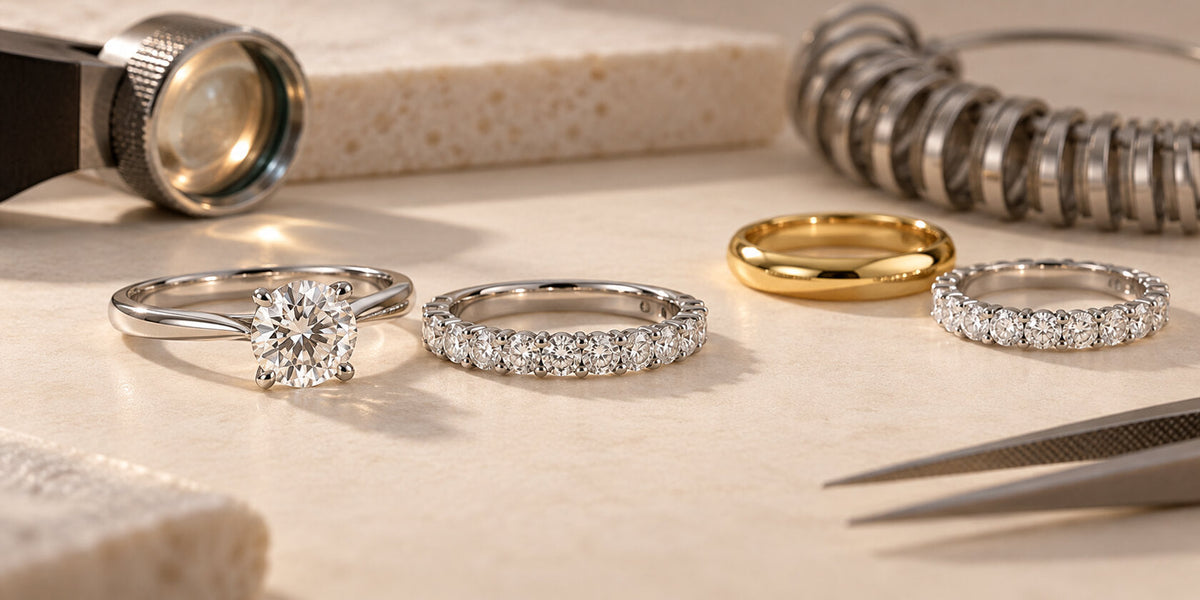
Choosing a wedding band may seem simpler than choosing an engagement ring, but the details matter more than they first appear.
A wedding band is often worn every day and, for many people, alongside an engagement ring. Its width, profile, metal, setting style, stone coverage, and fit can all affect how the ring looks and feels over time.
The right wedding band is therefore not simply the one that looks best on its own. It should work with your personal style, lifestyle, finger proportions, engagement ring, and expectations for long-term wear.
This guide explains the practical decisions that matter most when choosing a wedding band.
1. Start With How You Plan to Wear Your Wedding Band
Before comparing metals or diamond settings, decide how the band will actually be worn.
Ask yourself:
- Will you wear it alone?
- Will you wear it next to an engagement ring?
- Will you wear both rings every day?
- Do you want the two rings to look like a coordinated set?
- Do you prefer contrast between the rings?
- Might you add an anniversary or stacking band later?
These questions influence almost every decision that follows.
A wedding band worn alone can be selected primarily for its own proportions, comfort, and appearance.
A wedding band worn with an engagement ring has another requirement:
The two rings need to work together as a system.
Their heights, widths, profiles, metals, settings, and contact points can affect both appearance and wear.
2. Check How the Wedding Band Fits With Your Engagement Ring
One of the most overlooked parts of choosing a wedding band is physical compatibility.
Some engagement rings allow a straight wedding band to sit directly against the ring. Others have a low center setting, basket, halo, or decorative gallery that prevents another ring from sitting flush.
This can produce three common combinations:
Flush Fit
The wedding band sits directly against the engagement ring with little or no visible gap.
This creates a clean, coordinated appearance and is particularly easy to achieve when the engagement ring was designed with wedding-band clearance in mind.
Natural Gap
A small space remains between the engagement ring and wedding band.
This is not necessarily a design problem. Some ring combinations naturally create a gap, and many wearers prefer the more relaxed, separate appearance.
Curved or Contoured Band
A curved wedding band follows the outline of the engagement ring or center setting.
This can create a closer fit when a straight band cannot sit underneath the engagement ring's setting.
There is no universal rule that says a wedding band must sit flush.
The important question is whether the combination looks intentional, feels comfortable, and avoids problematic contact between settings or stones.
Craft Jeweler Tip
When choosing a wedding band for an existing engagement ring, do not judge compatibility only from top-view photographs.
The side profile of the engagement ring often tells you more about whether a straight wedding band can sit beside it.
3. Choose the Wedding Band Style
Wedding bands range from simple precious-metal rings to diamond-set designs.
Plain Wedding Band
A plain polished or brushed band places the emphasis on the metal itself.
Its simplicity makes it versatile, relatively easy to maintain, and compatible with many engagement-ring styles.
Plain bands can still vary significantly in:
- width
- thickness
- profile
- finish
- edge shape
- metal
Minimal does not mean identical.
Pavé Diamond Band
Pavé settings use small diamonds positioned closely together to create a fine line of brilliance.
They work particularly well when you want the wedding band to visually complement a diamond engagement ring without making the band itself too dominant.
The trade-off is that small stone settings require more care than a plain metal band and should be inspected if they experience impact or noticeable wear.
Shared-Prong Diamond Band
In a shared-prong design, adjacent stones share prongs, reducing the amount of visible metal between them.
The result can be a more prominent line of diamonds with substantial visible brilliance.
The construction and proportion of the prongs matter: the goal is not simply to use as little metal as possible, but to securely support the stones while maintaining a refined appearance. GIA's jewelry-quality guidance similarly emphasizes sound engineering and proper contact between prongs and gemstones.
Channel-Set Band
Channel-set diamonds sit between parallel metal walls.
Because the edges of the stones are surrounded by metal, this setting can offer a smooth, structured appearance and greater protection than more exposed settings. GIA notes that channel settings are commonly used for wedding bands and can be well suited to everyday wear, although resizing can become more difficult when stones extend around the band.
Eternity Band
An eternity band places diamonds or gemstones around the entire circumference of the ring.
It creates uninterrupted sparkle from every angle, but there are practical considerations.
A full eternity ring is generally:
- more difficult to resize;
- more sensitive to exact sizing;
- likely to expose stones and settings on the palm side to everyday contact;
- more stone-intensive than partial-eternity designs.
GIA also notes that eternity and anniversary bands with diamonds around the full band can be particularly difficult to resize.
That is why half-eternity and three-quarter-eternity bands deserve consideration rather than treating full eternity as automatically superior.
4. Decide How Much Diamond Coverage You Actually Need
For diamond wedding bands, one of the most useful decisions is:
How far around the finger should the diamonds extend?
Half Eternity
Diamonds cover approximately the visible upper portion of the ring.
Advantages can include:
- easier sizing and future adjustment;
- less contact between diamonds and hard surfaces;
- lower stone count;
- precious metal on the underside of the finger.
For many everyday wedding bands, this is a practical balance.
Three-Quarter Eternity
Diamonds continue farther around the ring while leaving a smaller plain-metal section underneath.
This gives much of the visual effect of a full eternity band while retaining some practical flexibility.
Full Eternity
Diamonds continue completely around the ring.
The visual effect is continuous, but accurate sizing becomes particularly important because resizing may be difficult or impractical depending on the construction.
The right choice is therefore not simply:
More diamonds = better wedding band.
It is a balance between appearance, comfort, maintenance, sizing flexibility, and budget.

5. Choose the Right Metal
For Craft Jeweler, the core wedding-band choices are 14K gold, 18K gold, and platinum.
There is no single metal that is automatically best for every wearer.
14K Gold
14K gold contains approximately 58.3% pure gold, with the remainder consisting of alloying metals.
Its balance of precious-metal content, durability, and practicality makes it a strong option for jewelry intended for frequent wear.
18K Gold
18K gold contains 75% pure gold.
It offers higher gold content and a richer precious-metal character while remaining suitable for fine jewelry.
Because alloy composition and karat affect the properties of gold, 14K and 18K should not be treated as simply two versions of the same material. GIA notes that both are commonly suitable for everyday rings, while higher-karat gold is generally softer than lower-karat alloys.
Platinum
Platinum offers a naturally white appearance and a noticeably substantial feel because of its density.
It does not require rhodium plating to achieve its natural white color and develops a characteristic patina through wear.
For someone who prefers the appearance of a naturally white precious metal and a heavier feel, platinum deserves serious consideration.
6. Should Your Wedding Band Match the Engagement Ring Metal?
Not necessarily.
Matching metals create visual continuity:
Yellow Gold + Yellow Gold
White Gold + White Gold
Platinum + Platinum
But mixed-metal combinations can also be intentional.
For example:
Yellow Gold Engagement Ring + Platinum Wedding Band
can create a deliberate contrast rather than looking mismatched.
There is, however, a practical issue beyond color.
Two rings worn directly against one another continually make contact. Different metals and exposed stone settings can wear against neighboring surfaces over time. GIA specifically notes that stacked rings made from metals of different hardness can affect one another through wear.
Therefore, when combining different metals or highly exposed diamond settings, consider not only how the rings look together but where they physically touch.

7. Choose the Right Band Width
Wedding band width changes both appearance and comfort.
Common widths can range from delicate bands around 2 mm to much wider designs, but the appropriate width depends on the design and wearer rather than a universal standard.
Narrow Bands
A narrower band generally has a lighter visual presence and can pair naturally with delicate engagement rings.
Medium-Width Bands
A medium width can provide more visual definition while remaining versatile for everyday wear.
Wide Bands
A wider band creates a stronger metal presence and can work especially well when the wedding ring is intended to stand on its own.
But width affects more than appearance.
As a band becomes wider, more of the finger is enclosed by the ring. This can change how tight the same nominal ring size feels.
That is why the correct size for a narrow ring should not automatically be assumed to provide the same fit experience in a substantially wider band.
For detailed sizing guidance, see our Ring Size Guide: How to Find Your Ring Size.
8. Consider Thickness and Structure — Not Just Width
Two wedding bands can both be listed as 3 mm wide and still feel completely different.
Why?
Because width is only one dimension.
You should also consider:
- band thickness;
- inside profile;
- edge shape;
- stone depth;
- setting height;
- overall weight.
An excessively thin ring may look delicate in photographs but lack the structural proportions expected for long-term wear.
At the other extreme, unnecessarily heavy construction can feel bulky.
Good fine-jewelry design seeks balance:
Refined proportions without sacrificing structural integrity.
This is particularly important for diamond bands, where metal must support multiple settings rather than simply form a continuous plain ring.
9. Think About Comfort
A wedding band is one of the few pieces of fine jewelry that may be worn almost continuously.
Comfort therefore deserves as much attention as appearance.
Consider:
Inside Profile
A smoothly finished interior can make a meaningful difference in daily wear.
Band Width
Wider rings create more finger contact.
Diamond Coverage
Full eternity designs place stones and settings against the sides and underside of the finger.
Ring Stack Width
An engagement ring and wedding band that each feel comfortable individually may feel substantially wider when worn together.
Adjacent Fingers
Large stones or exposed settings extending around the sides of a band may be felt between neighboring fingers.
The goal is not simply to find a ring that fits.
It is to find a ring you will be comfortable wearing repeatedly.

10. Choose the Right Ring Size Carefully
Correct sizing becomes increasingly important as the wedding band becomes more complex.
Plain metal bands generally provide greater flexibility for future resizing.
Diamond-set bands can be more restrictive.
Full eternity rings require particular care because altering the circumference can affect multiple stone settings. Pavé and channel-set rings may also be more difficult to resize than plain bands.
For an important made-to-order or custom wedding band, professional sizing is preferable whenever possible.
If you are ordering internationally, providing an accurate inside diameter or circumference in millimeters can also help reduce ambiguity between regional sizing systems.
11. Think About Your Lifestyle
A wedding band should fit your real life—not just your wedding day.
Someone who frequently works with their hands may prioritize:
- simpler settings;
- protected stones;
- practical width;
- fewer exposed surfaces.
Someone who wants maximum brilliance may prefer:
- pavé;
- shared-prong;
- three-quarter eternity;
- full eternity.
Neither choice is universally better.
Setting construction changes the balance between sparkle, protection, maintenance, and flexibility.
For example, channel settings surround stone edges with metal and can provide greater protection, while pavé exposes more small stone-setting details and may require periodic inspection.
The best wedding band is one whose design makes sense for how you actually intend to wear it.
12. Look Closely at Craftsmanship
Wedding bands often appear simple, which makes manufacturing quality particularly important.
For a plain band, look for:
- consistent width;
- balanced thickness;
- smooth edges;
- clean polishing;
- symmetrical profile;
- refined interior finishing.
For a diamond wedding band, also examine:
- stone alignment;
- consistent spacing;
- balanced prongs;
- secure settings;
- even setting height;
- clean finishing around the stones.
With shared-prong, pavé, or eternity designs, small differences in construction can affect both appearance and long-term wear.
GIA's jewelry Quality Assurance Benchmarks likewise emphasize proper stone-setting contact, consistent alignment, finishing, and appropriate engineering rather than appearance alone.

13. Should You Buy a Matching Wedding Set?
A matching engagement ring and wedding band can make the decision easier because the two rings are designed to coordinate.
This can help with:
- fit;
- proportions;
- metal consistency;
- design continuity;
- setting clearance.
But buying a matching set is not necessary.
A separately selected wedding band can create contrast and allow more personal expression.
The important distinction is:
Matching is a style choice. Compatibility is a construction issue.
Your rings do not have to look identical.
They should, however, be comfortable and appropriate to wear together if that is how you intend to use them.
14. Should You Choose a Custom Wedding Band?
Custom design becomes particularly useful when an existing engagement ring has an unusual shape, low profile, large center stone, decorative gallery, or asymmetric design.
A custom wedding band can be created around:
- the engagement ring's profile;
- desired spacing;
- stone shape and size;
- metal;
- band width;
- diamond coverage;
- curved or contoured geometry.
This is different from simply choosing a stock curved band that looks approximately correct.
For more complex combinations, designing the two rings as a coordinated system can produce a cleaner result.
At Craft Jeweler, wedding bands can be made in 14K gold, 18K gold, or platinum, with lab-grown diamonds and gemstones selected according to the design.
A Practical Wedding Band Checklist
Before ordering, confirm:
-
How will I wear it?
Alone, stacked, or with an engagement ring? -
Does it physically fit my engagement ring?
Flush, natural gap, or contoured? -
Which style suits my wear?
Plain, pavé, shared-prong, channel, or eternity? -
How much stone coverage do I want?
Half, three-quarter, or full eternity? -
Which metal fits my preference?
14K gold, 18K gold, or platinum? - What width feels right?
- Is the ring size appropriate for that width?
- Can the design be resized later if necessary?
- Are the settings appropriate for my lifestyle?
- Is the craftsmanship strong enough for long-term wear?
If the wedding band will be worn next to an engagement ring, evaluate the two rings together, not as separate purchases.
Frequently Asked Questions
Does a wedding band have to match the engagement ring?
No. The metals, stone settings, and design details can match for a coordinated appearance or intentionally contrast. More important is whether the rings fit comfortably together and whether their settings or surfaces create problematic contact.
Should a wedding band sit flush with an engagement ring?
Not necessarily. Some engagement-ring settings allow a straight band to sit flush, while others naturally create a gap. A curved or contoured wedding band can provide a closer fit when desired.
Is a full eternity band better than a half-eternity band?
Neither is universally better. Full eternity provides continuous stones around the ring, while partial-eternity designs can offer greater sizing flexibility and less exposure on the palm side. The better choice depends on your priorities.
Can an eternity wedding band be resized?
Full eternity bands can be difficult or sometimes impractical to resize because stones and settings extend around the entire circumference. If sizing flexibility matters, discuss this before ordering.
Is platinum better than gold for a wedding band?
They offer different characteristics. Platinum is naturally white, dense, and develops a patina with wear. 14K and 18K gold provide different balances of gold content, alloy strength, color, weight, and maintenance. The appropriate choice depends on design and personal preference.
How wide should a wedding band be?
There is no universal ideal width. Consider finger proportions, whether the ring will be stacked, desired visual presence, and comfort. Wider bands can feel tighter than narrower bands at the same nominal ring size.
Can Craft Jeweler make a wedding band to fit my engagement ring?
For custom projects, the wedding band can be designed around the engagement ring's dimensions and profile. Accurate measurements, photographs, drawings, CAD information, or access to the original ring design can help determine the appropriate approach.


