
عربة التسوق
0
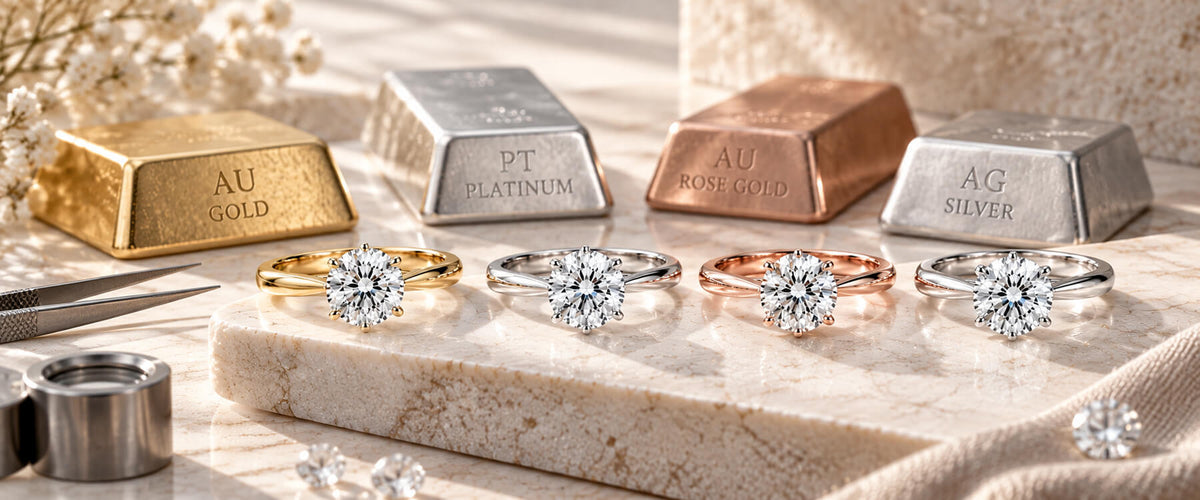
The metal you choose is more than the frame around a diamond or gemstone. It affects how a piece of jewelry looks, feels, wears, ages, and even how securely its stones can be set.
For fine jewelry, gold and platinum remain two of the most important precious metals. Gold offers a wide range of colors and purity levels, including 10K, 14K, and 18K yellow, white, and rose gold. Platinum provides a naturally white appearance, high density, and excellent durability for engagement rings and other jewelry designed for long-term wear.
Other metals—including sterling silver, palladium, titanium, and tungsten—also have their place in jewelry, but each behaves differently.
This guide explains the most common jewelry metals, how gold karats work, the differences between yellow, white, and rose gold, how platinum compares with gold, and how to choose the right metal for your jewelry and lifestyle.
Why Does Jewelry Metal Matter?
When choosing fine jewelry, attention naturally goes first to the diamond or gemstone.
But the metal surrounding the stone is just as important to the finished piece.
Your choice of metal can affect:
- Color and overall appearance
- Strength and durability
- Weight and feel
- Resistance to scratching and wear
- Maintenance requirements
- Skin sensitivity
- Setting security
- Resizing and repair options
- Price
- How the gemstone's color appears
The best jewelry metal is therefore not necessarily the most expensive one.
It is the metal that works best for the design, gemstone, intended use, personal preference, and budget.
What Is Gold Jewelry?
Gold has been used in jewelry for thousands of years because of its beauty, rarity, workability, and resistance to corrosion.
Pure gold has a rich yellow color, but it is relatively soft. For most fine jewelry, gold is therefore combined with other metals to form an alloy.
The metals added to gold can improve strength and hardness while also changing its color and working properties.
This is why most engagement rings, wedding bands, earrings, necklaces, and other pieces of fine jewelry are made from karat gold rather than pure 24K gold.
What Does Karat Mean in Gold Jewelry?
Karat, abbreviated as K, measures the proportion of pure gold in a gold alloy.
The system is based on 24 parts:
24K = essentially pure gold
Therefore:
| Gold Purity | Pure Gold Content | Common Fineness Mark |
|---|---|---|
| 10K Gold | 41.7% | 417 |
| 14K Gold | 58.3% | 585 |
| 18K Gold | 75.0% | 750 |
| 22K Gold | 91.7% | 916 |
| 24K Gold | ~99.9% | 999 |
For example, 18K gold contains 18 parts gold and 6 parts other metals, while 14K contains 14 parts gold and 10 parts other metals.
The remaining portion of the alloy may include metals such as silver, copper, zinc, palladium, or other metals depending on the desired color and physical properties.
Importantly, karat is not the same as carat.
Karat (K) measures gold purity.
Carat (ct) measures gemstone weight.
10K vs. 14K vs. 18K Gold: What's the Difference?
One of the most common questions when buying fine jewelry is whether to choose 10K, 14K, or 18K gold.
There is no single correct choice.
Each offers a different balance of gold content, color, price, and wear characteristics.
10K Gold
10K gold contains approximately 41.7% pure gold.
Because a larger proportion of the alloy consists of other metals, it generally offers good resistance to everyday wear at a lower price than higher-karat gold.
Its gold color is usually less rich than 14K or 18K yellow gold.
10K can be practical for buyers prioritizing durability and budget, although alloy composition matters.
14K Gold
14K gold contains approximately 58.3% pure gold.
It is one of the most widely used gold alloys in jewelry in the United States and offers a strong balance between:
- Gold content
- Durability
- Color
- Price
- Everyday practicality
Jewelers of America identifies 14K as the most common jewelry alloy in the U.S.
For engagement rings and jewelry intended for frequent wear, 14K is often an excellent all-around choice.
18K Gold
18K gold contains 75% pure gold.
Because of its higher gold content, yellow 18K typically displays a richer gold color than lower-karat alloys.
It also has a higher precious-metal content and usually costs more.
Depending on the exact alloy, 18K gold can be somewhat softer than 14K, although both are widely used in high-quality fine jewelry. GIA notes that higher-gold-content alloys generally have richer color and may be somewhat more susceptible to dents and scratches.
For buyers who value higher gold content and a more luxurious gold appearance, 18K is an attractive choice.

10K vs. 14K vs. 18K Gold at a Glance
| Feature | 10K Gold | 14K Gold | 18K Gold |
|---|---|---|---|
| Pure Gold | 41.7% | 58.3% | 75% |
| Fineness | 417 | 585 | 750 |
| Gold Color | Less intense | Balanced | Richer |
| Everyday Wear | Very practical | Excellent balance | Excellent with appropriate care |
| Relative Price | Lower | Moderate | Higher |
| Common Fine Jewelry Use | Yes | Very common | Premium fine jewelry |
Craft Jeweler Tip
For many everyday engagement rings and wedding bands, 14K gold provides an especially practical balance of durability, appearance, and precious-metal content.
If richer gold color and higher gold purity matter more to you, consider 18K.
The right choice depends on the design and how the jewelry will be worn—not simply on which karat number is higher.
Yellow Gold
Yellow gold is the traditional color most people associate with gold jewelry.
It combines pure gold with alloying metals that help improve strength while preserving its warm yellow appearance.
Depending on the alloy formula, metals such as silver, copper, and zinc may be used.
The higher gold content of 18K yellow gold generally produces a richer yellow tone than 14K or 10K yellow gold.
Why Choose Yellow Gold?
Yellow gold works particularly well for:
- Classic engagement rings
- Wedding bands
- Vintage-inspired jewelry
- Warm-colored gemstones
- Yellow diamonds
- Emeralds
- Rubies
- Jewelry with a traditional appearance
Yellow gold also has one practical advantage over white gold:
its yellow color is inherent to the alloy, so it does not rely on a white surface plating to maintain its basic color.
White Gold
White gold is not naturally occurring white gold metal.
It is gold alloyed with white-colored metals to reduce the yellow appearance of pure gold.
Depending on the alloy formulation, white gold may contain metals such as palladium, nickel, silver, zinc, or combinations of these materials.
Many commercial white-gold jewelry pieces are also rhodium plated.
Rhodium creates a bright, highly reflective white surface that gives white gold the crisp appearance commonly associated with modern diamond jewelry.
Over time, rhodium plating can wear away, particularly on rings that receive frequent contact and abrasion.
When that happens, the underlying white-gold alloy may become more visible.
The jewelry can generally be professionally cleaned, polished, and rhodium plated again.
Why Choose White Gold?
White gold is popular for:
- Diamond engagement rings
- Lab-grown diamond jewelry
- Colorless gemstones
- Modern fine jewelry
- Buyers who prefer a bright white-metal appearance
Its neutral color allows the visual focus to remain on the diamond or gemstone.
Rose Gold
Rose gold gets its warm pink or reddish appearance primarily from the copper in its alloy.
The balance of gold, copper, silver, and other alloying metals determines the exact tone.
Rose gold may range from:
soft blush pink → warm rose → deeper reddish gold
depending on the formula and gold purity.
Why Choose Rose Gold?
Rose gold works beautifully with:
- Pink gemstones
- Morganite
- Pink sapphire
- Pink diamonds
- Colorless diamonds
- Romantic and vintage-inspired jewelry
Because the color comes from the alloy itself rather than surface plating, rose gold does not require rhodium plating to maintain its rose color.
However, people with sensitivities to particular alloying metals should consider the actual alloy composition rather than assuming all gold colors behave the same way on skin.
Yellow Gold vs. White Gold vs. Rose Gold
Although all three can contain exactly the same percentage of pure gold at a given karat, their alloy compositions produce very different appearances.
| Feature | Yellow Gold | White Gold | Rose Gold |
|---|---|---|---|
| Appearance | Warm yellow | Bright white | Pink/rose |
| Typical Alloy Influence | Silver, copper, zinc | Palladium/nickel, zinc, others | Copper |
| Rhodium Plating | Usually no | Often yes | No |
| Style | Classic | Modern | Romantic |
| Diamond Pairing | Warm contrast | Neutral/bright | Warm contrast |
| Maintenance | Relatively simple | May require replating | Relatively simple |
There is no universal “best” gold color.
The right choice is primarily about design, skin tone, gemstone color, maintenance preference, and personal style.

What Is Platinum Jewelry?
Platinum is a naturally white precious metal widely used in high-end fine jewelry.
Unlike white gold, platinum does not need to be alloyed simply to create a white appearance.
Jewelry described simply as “Platinum,” “Pt,” or “Plat” in the United States generally contains at least 95% pure platinum. Other platinum alloys can contain different percentages and require appropriate markings or disclosures.
Common platinum jewelry marks can include:
- 950 Platinum / 950 Pt
- 900 Platinum / 900 Pt
- Other properly disclosed platinum alloy markings
Platinum is also significantly denser than gold.
As a result, two rings of approximately the same dimensions can feel noticeably different in weight when one is platinum and the other is gold. Jewelers of America notes that a 90%-platinum piece can weigh substantially more than a comparable 14K gold piece.
This substantial feel is one reason some buyers prefer platinum for engagement rings and wedding jewelry.
Why Is Platinum Popular for Engagement Rings?
Platinum combines several characteristics that work especially well for fine jewelry:
- Naturally white color
- High precious-metal purity
- High density
- Excellent durability
- Good suitability for stone settings
- No need for rhodium plating to remain white
Its neutral white appearance pairs particularly well with:
- Colorless diamonds
- Lab-grown diamonds
- Blue sapphires
- Emeralds
- Rubies
- Many other colored gemstones
Platinum is therefore frequently used for engagement rings, wedding bands, and jewelry intended for long-term wear.
Does Platinum Scratch?
Yes.
Platinum is durable, but it is not scratch-proof.
This distinction matters.
With regular wear, platinum develops small surface marks and changes in finish. Over time, these can create a softer surface appearance often called a patina.
This is not necessarily evidence that the jewelry is failing.
Platinum's wear behavior differs from that of many other jewelry metals, and professional refinishing can restore a brighter polished appearance when desired. Jewelers of America notes that platinum develops a natural patina over time and can be repolished.
So:
Durability does not mean a metal will never scratch.
Every precious-metal ring worn daily will eventually show evidence of wear.
Platinum vs. White Gold
Because both have a white appearance, platinum and white gold are frequently compared.
But they are fundamentally different metals.
| Feature | Platinum | White Gold |
|---|---|---|
| Base Precious Metal | Platinum | Gold |
| Natural Color | White | Gold alloyed toward white |
| Typical Fine Jewelry Purity | Often 90–95%+ platinum | Commonly 14K or 18K gold |
| Density | Higher | Lower |
| Weight | Heavier | Lighter |
| Rhodium Plating | Generally unnecessary | Commonly used |
| Long-Term Surface | Develops patina | Can scratch; plating may wear |
| Maintenance | Polishing if desired | May include rhodium replating |
| Relative Cost | Often higher | Often lower |
Neither is automatically better.
Choose Platinum If:
You prefer:
- A naturally white metal
- A heavier, more substantial feel
- High platinum content
- No routine rhodium replating
- A premium metal for long-term jewelry
Choose White Gold If:
You prefer:
- A bright white appearance
- A lighter ring
- Gold as the underlying precious metal
- A generally lower initial price
- 14K or 18K gold options

Is Platinum Stronger Than Gold?
This question is more complicated than it appears.
Jewelry metals should not be compared using a single word such as “stronger.”
Properties including:
- hardness,
- tensile strength,
- ductility,
- density,
- wear resistance, and
- alloy composition
all influence how a metal performs.
Different platinum alloys also have different working characteristics. GIA notes that platinum alloy combinations have distinct properties and may be better suited to different manufacturing methods.
Likewise, 14K white gold, 18K yellow gold, and 18K rose gold are not mechanically identical simply because they all contain gold.
For consumers, the more useful question is:
Which alloy is appropriate for this particular jewelry design and how I intend to wear it?
What Is Sterling Silver?
Silver is another precious metal commonly used in jewelry.
Pure silver is relatively soft, so jewelry is commonly made from sterling silver.
Sterling silver contains:
92.5% pure silver
and is commonly marked:
925 or S925
The remaining portion consists of other alloying metals.
The FTC states that products described as “sterling” or “sterling silver” should contain at least 925 parts per thousand pure silver.
Sterling silver offers:
- Bright white appearance
- Good workability
- Lower price than gold or platinum
- Broad jewelry applications
However, silver can tarnish through reactions with substances in its environment and generally requires more frequent cleaning than gold or platinum.
For fashion jewelry, earrings, pendants, and certain rings, sterling silver can be an excellent choice.
For high-value engagement rings designed for decades of continuous wear, gold and platinum are generally more common choices.
What Is Gold Vermeil?
Gold vermeil is not solid gold.
In the United States, vermeil refers to a sterling-silver base coated with qualifying gold or gold alloy.
FTC guidance specifies, among other requirements, a sterling silver base, gold of at least 10K fineness, and a minimum equivalent gold thickness of 2.5 microns on significant surfaces.
This makes vermeil fundamentally different from:
- Solid 14K gold
- Solid 18K gold
- Ordinary gold-plated base metal
Vermeil can provide the appearance of gold at a lower price, but the outer gold layer can eventually wear with use.
For buyers, the key is understanding whether a product is:
solid karat gold, gold-filled, vermeil, or gold-plated.
These terms should not be treated as interchangeable.
What About Palladium?
Palladium belongs to the platinum group of metals and has a naturally white appearance.
It has been used both as a jewelry metal and as an alloying component in some white-gold and platinum formulations.
Palladium can provide a lighter white-metal alternative to platinum, although availability, manufacturing practices, and repair considerations vary.
It is less common in mainstream fine jewelry than gold and platinum, so buyers should also consider future resizing and servicing options when choosing palladium jewelry.
What About Titanium and Tungsten?
Titanium and tungsten are popular alternative jewelry metals, particularly for wedding bands.
However, they behave very differently from traditional precious metals.
Titanium
Titanium is lightweight, strong, corrosion-resistant, and available in modern designs.
Its low weight can be attractive for people who do not want the substantial feel of platinum or gold.
Tungsten
Tungsten-based jewelry is known for high scratch resistance and a substantial feel.
However, tungsten is much less malleable than traditional precious metals.
Both titanium and tungsten can also have limitations when it comes to traditional resizing and repair.
For this reason, they should not simply be compared with gold or platinum based on hardness alone.
Which Jewelry Metal Is Best for Sensitive Skin?
There is no single answer because skin reactions can depend on the complete alloy composition, not just the primary precious metal.
Pure precious metals may be well tolerated, but jewelry alloys contain additional metals to achieve desired color, hardness, or manufacturing properties.
For example, some white-gold alloys may contain nickel, while other white-gold formulations use different alloying systems.
Buyers with known metal sensitivities should ask about the specific alloy composition of the jewelry rather than relying solely on labels such as “white gold.”
High-purity platinum is often considered a strong option for people concerned about metal sensitivity, but individual reactions can vary.
Does Metal Color Affect How a Diamond Looks?
Yes.
The color of the setting can influence the overall visual impression of a diamond or gemstone.
White Metals
White gold and platinum create a neutral surrounding and are especially popular with colorless diamonds.
Yellow Gold
Yellow gold provides warmer contrast.
Some designs use yellow-gold bands with white-metal prongs around a diamond, combining the warmth of yellow gold with a neutral-colored setting immediately surrounding the stone.
Rose Gold
Rose gold adds a warm pink tone and can create a strong stylistic contrast with white diamonds.
For colored gemstones, the interaction can be even more noticeable.
An emerald may look very different in yellow gold than in platinum, while a pink gemstone can take on a distinctly warmer character in rose gold.
Metal selection is therefore part of the overall jewelry design—not merely a structural decision.
Which Metal Is Best for an Engagement Ring?
For most fine engagement rings, the main choices are:
14K Gold
Excellent balance of durability, price, color options, and everyday practicality.
18K Gold
Higher gold content with a richer precious-metal character and premium positioning.
Platinum
Naturally white, dense, substantial, and particularly suited to buyers seeking a high-purity white precious metal.
All three can be excellent.
Rather than asking which one is universally best, consider:
Lifestyle
Will the ring be worn every day?
Design
Does the setting have delicate prongs, pavé diamonds, or a wide solid band?
Gemstone
Which metal best complements the stone?
Weight
Do you prefer a substantial or lighter feel?
Maintenance
Are you comfortable periodically replating white gold?
Budget
Would you rather allocate more of the budget to the gemstone, the metal, or both?
Personal Style
Do you prefer warm yellow, romantic rose, or neutral white?
Gold vs. Platinum: Quick Comparison
| Factor | 14K Gold | 18K Gold | Platinum |
|---|---|---|---|
| Precious Metal Content | 58.3% gold | 75% gold | Often 90–95%+ platinum |
| Colors Available | Yellow, white, rose | Yellow, white, rose | Naturally white |
| Weight | Moderate | Moderate | Heavier |
| Everyday Jewelry | Excellent | Excellent | Excellent |
| White-Metal Maintenance | White gold may need replating | White gold may need replating | No rhodium required for basic white color |
| Price | Generally lower | Higher | Often highest |
| Engagement Rings | Excellent | Excellent | Excellent |
| Wedding Bands | Excellent | Excellent | Excellent |
These comparisons are general. Actual performance depends on the specific alloy, jewelry construction, dimensions, finish, and how the piece is worn.
How to Choose the Right Jewelry Metal
There is no universally superior jewelry metal.
The right choice comes from balancing aesthetics, performance, maintenance, and budget.
For a practical everyday engagement ring:
14K gold is difficult to beat for overall balance.
For richer gold color and higher gold content:
18K gold is an excellent premium choice.
For a naturally white, dense, high-purity precious metal:
Platinum is particularly compelling.
For accessible precious-metal jewelry:
Sterling silver offers excellent value, although its maintenance and long-term wear characteristics differ from gold and platinum.
And for alternative wedding bands:
Titanium and tungsten offer distinctive properties, but resizing and repair limitations should be considered before purchase.

Jewelry Metals at Craft Jeweler
At Craft Jeweler, metal selection is treated as part of the jewelry design rather than simply a product option.
For made-to-order and custom fine jewelry, the appropriate metal should be considered alongside:
- Diamond or gemstone type
- Stone dimensions
- Setting construction
- Ring size
- Band width and thickness
- Intended wear
- Desired color
- Finished weight
- Personal preference
Our fine jewelry focuses primarily on precious-metal options such as 14K gold, 18K gold, and platinum, allowing the metal to be selected around the design and gemstone.
For custom jewelry, this is especially important because changing from gold to platinum—or from one gold alloy to another—can affect more than appearance. Metal density, manufacturing behavior, weight, setting construction, and finishing requirements can all influence how the final piece should be made.
Frequently Asked Questions About Jewelry Metals
Is 14K or 18K gold better?
Neither is universally better. 14K contains 58.3% gold and provides an excellent balance for everyday jewelry. 18K contains 75% gold and offers higher gold content and generally richer yellow-gold color. The right choice depends on design, wear, appearance, and budget.
Is platinum better than white gold?
Platinum is naturally white, denser, and generally used at higher precious-metal purity. White gold is a gold alloy and is commonly rhodium plated for a bright white finish. Both can be excellent for engagement rings; the better choice depends on weight, maintenance, budget, and personal preference.
Does white gold turn yellow?
White gold does not literally transform into yellow gold, but rhodium plating can gradually wear, allowing the warmer underlying white-gold alloy to become more visible. Professional replating can restore a bright white surface.
Is platinum scratch-proof?
No. Platinum can scratch and develop a patina with regular wear. It can be professionally refinished if a brighter polished appearance is preferred.
What does 585 gold mean?
585 indicates that the alloy contains approximately 58.5% gold, corresponding to 14K gold.
What does 750 gold mean?
750 indicates 75% pure gold, corresponding to 18K gold.
What does 925 mean on jewelry?
925 generally indicates sterling silver containing 92.5% pure silver.
Which metal is best for a diamond engagement ring?
14K gold, 18K gold, and platinum are all widely used. The best choice depends on the setting, desired color, weight, maintenance preferences, lifestyle, and budget.
Which jewelry metal lasts the longest?
Longevity cannot be determined by the metal name alone. Alloy composition, jewelry construction, thickness, setting quality, wear habits, maintenance, and repair all matter. Properly made gold and platinum fine jewelry can both provide very long service.
Choosing a Metal That Fits the Jewelry—and You
The best jewelry metal is not simply the one with the highest purity or price.
14K gold offers an excellent balance for everyday fine jewelry. 18K gold provides higher gold content and a richer precious-metal character. Platinum offers natural whiteness, high density, and a substantial feel. Sterling silver provides an accessible precious-metal option, while alternative metals serve different design and lifestyle needs.
More importantly, the metal should work together with the gemstone, setting, design, craftsmanship, and intended use.
A beautiful piece of fine jewelry is not defined by a single material. It is the result of choosing materials that work together—and crafting them appropriately.


