
カート
0
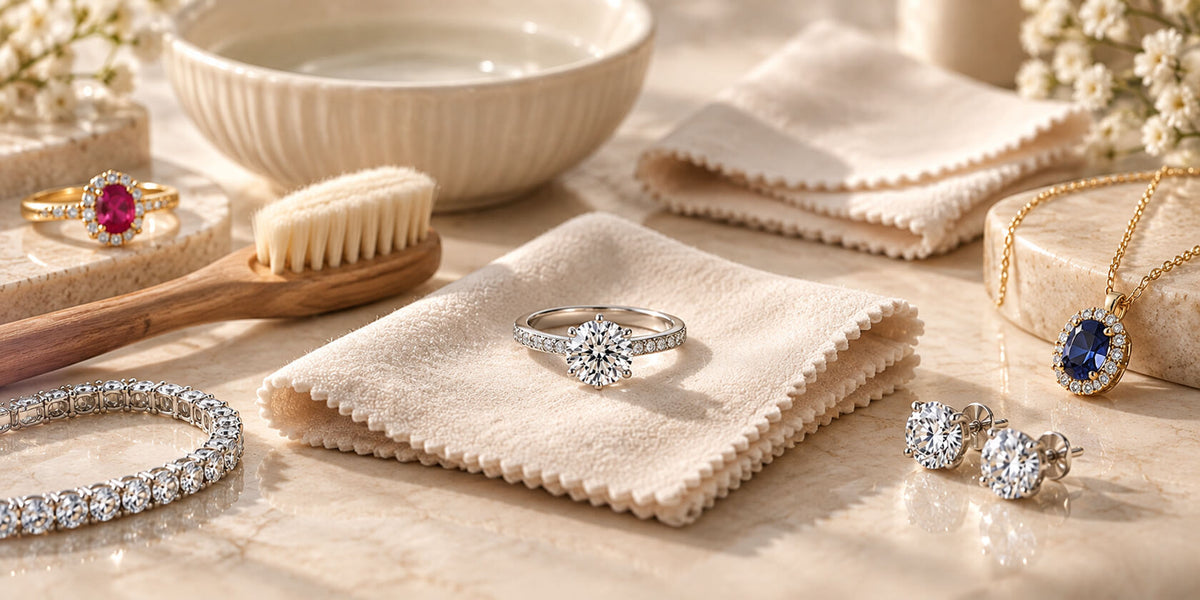
Fine jewelry is designed to be worn, but everyday wear inevitably exposes it to skin oils, cosmetics, dust, moisture, impact, friction, and chemicals.
Proper jewelry care is therefore not about keeping a piece permanently untouched. It is about understanding its materials and construction well enough to clean, store, wear, and maintain it appropriately over time.
A lab-grown diamond solitaire, an emerald ring, a pavé bracelet, and a platinum wedding band should not automatically be cared for in exactly the same way.
This guide explains how to care for gold, platinum, lab-grown diamonds, moissanite, lab-grown gemstones, rings, earrings, necklaces, bracelets, and stone-set fine jewelry, as well as when professional inspection may be appropriate.
1. Why Fine Jewelry Needs Regular Care
Even well-made fine jewelry changes with wear.
Common effects include:
- Skin oils collecting around gemstones
- Lotion and cosmetics building up beneath settings
- Dust accumulating between pavé stones
- Fine scratches developing on metal surfaces
- Prongs gradually wearing
- Clasps loosening
- Chains becoming tangled
- White gold rhodium plating wearing over time
- Platinum developing a natural patina
Some of these changes are cosmetic.
Others can eventually become structural.
The purpose of routine care is therefore twofold:
Maintain Appearance + Identify Problems Early
Cleaning keeps jewelry looking its best.
Inspection helps keep it secure.
2. Know What Your Jewelry Is Made Of Before Cleaning It
This is the most important rule in the entire guide.
Before cleaning a piece, identify:
Metal
- 14K gold
- 18K gold
- Platinum
- Sterling silver
- Other metal
Gemstone
- Lab-grown diamond
- Moissanite
- Lab-grown ruby
- Lab-grown sapphire
- Lab-grown emerald
- Lab-grown alexandrite
- Other gemstone
Setting
- Prong
- Pavé
- Shared prong
- Bezel
- Channel
- Halo
- Eternity
Why?
Because a cleaning method that is suitable for one piece may not be appropriate for another.
A simple diamond solitaire is not the same cleaning problem as an intricate pavé ring or an emerald-set piece.
The safest jewelry-care advice therefore begins with:
Identify the materials first. Clean second.
3. A Safe Basic Cleaning Method for Many Fine Jewelry Pieces
For many durable gold or platinum pieces set with diamonds, a gentle home-cleaning method can be sufficient for routine maintenance.
You will generally need:
- Lukewarm water
- Mild dish soap
- A clean bowl
- A very soft toothbrush
- A soft lint-free cloth
Step 1 — Prepare the Solution
Mix a small amount of mild dish soap with lukewarm water.
Avoid very hot water.
Step 2 — Let the Jewelry Soak Briefly
A short soak can help loosen oils and residue.
The appropriate method depends on the gemstone and construction, so do not assume every gemstone should be soaked.
Step 3 — Brush Gently
Use a very soft brush.
Pay particular attention to areas where residue collects:
- Under the center stone
- Around prongs
- Behind earrings
- Inside galleries
- Between accessible setting details
Do not apply excessive force.
Step 4 — Rinse Carefully
Rinse thoroughly with clean water.
Do not rinse valuable jewelry over an open drain.
Use a bowl or ensure the drain is securely closed.
Step 5 — Dry
Pat dry with a soft lint-free cloth and allow the jewelry to dry completely.
Do not aggressively rub delicate settings.
4. How to Care for Lab-Grown Diamond Jewelry
Lab-grown diamonds have essentially the same chemical composition, crystal structure, and physical and optical properties as natural diamonds.
Diamond is extremely hard and resistant to scratching, but this creates one of the most persistent jewelry-care misconceptions:
Hard does not mean indestructible.
A diamond can still chip or fracture under certain impacts, particularly around vulnerable edges or points.
The setting surrounding the diamond is also usually much softer than the diamond itself.
Routine Care
For many lab-grown diamond pieces:
- Use mild soap and lukewarm water
- Brush gently with a soft brush
- Remove oils from the underside of the diamond
- Rinse and dry carefully
The underside matters because oils and residue can reduce apparent brilliance even when the top surface looks relatively clean.
Avoid
- Abrasive cleaners
- Harsh household chemicals
- Forceful scrubbing
- Impact against hard surfaces
- Attempting to straighten or tighten prongs yourself
If a diamond appears loose, stop wearing the piece and have the setting inspected.
5. How to Care for Moissanite Jewelry
Moissanite is also a durable gemstone suitable for frequent wear.
Over time, oils, soaps, lotions, and cosmetics can accumulate on its surface and around the setting, reducing its crisp appearance.
For routine home care, mild soap, lukewarm water, and a soft brush are generally appropriate for many moissanite jewelry designs.
Pay particular attention to:
The pavilion and underside of the stone.
This is where residue often accumulates.
As with diamond jewelry, the durability of the gemstone does not eliminate the need to care for the metal and setting.
6. How to Care for Lab-Grown Ruby and Sapphire
Ruby and sapphire are both varieties of corundum.
They are durable gemstones and are commonly used in rings and other frequently worn jewelry.
For many uncomplicated lab-grown ruby and sapphire pieces, gentle cleaning with mild soap, lukewarm water, and a soft brush is generally appropriate.
However, always consider:
- Setting construction
- Other gemstones present
- Any treatments
- Overall jewelry condition
A piece containing multiple gemstone types should generally be cared for according to the most sensitive component.
That principle applies throughout fine jewelry care.
7. How to Care for Lab-Grown Emerald Jewelry
Emerald deserves more conservative treatment.
Even though lab-grown emerald is chemically and physically an emerald, emerald as a gemstone species requires different care considerations from diamond or corundum.
Avoid assuming that because a gemstone is laboratory-grown it can automatically tolerate aggressive cleaning.
For routine care:
- Use lukewarm water
- Use mild soap where appropriate
- Clean gently
- Use a very soft cloth or brush
- Avoid sudden temperature changes
- Avoid harsh chemicals
For emerald jewelry, I would not make ultrasonic cleaning the default recommendation.
When in doubt, professional cleaning is the safer option.
This is exactly why jewelry-care instructions should be based on the gemstone material rather than simply whether it is natural or lab-grown.

8. What About Lab-Grown Alexandrite?
Lab-grown alexandrite is another gemstone that can be used successfully in fine jewelry.
Routine care should remain gentle:
- Mild soap
- Lukewarm water
- Soft brush or cloth
- Careful rinsing
- Proper drying
As with all gemstone jewelry, consider the entire piece rather than only the center stone.
If an alexandrite ring also contains delicate pavé diamonds, for example, the condition of the small settings matters when deciding how aggressively the jewelry should be cleaned.
9. How to Care for 14K and 18K Gold
Gold used in jewelry is alloyed with other metals to create different karats, colors, and working properties.
14K Gold
14K gold contains approximately 58.3% pure gold.
18K Gold
18K gold contains 75% pure gold.
Both can develop fine scratches with wear.
That is normal.
Routine Care
- Wipe with a soft cloth
- Use mild soap and lukewarm water when appropriate
- Avoid abrasive cleaning products
- Avoid unnecessary exposure to strong chemicals
Yellow and Rose Gold
Their color comes from the composition of the gold alloy itself.
Normal surface scratches can generally be professionally polished when necessary.
But do not over-polish jewelry simply because tiny scratches appear.
Every polishing process removes a small amount of metal.
Repeated unnecessary polishing is therefore not good long-term maintenance.
10. How to Care for White Gold
White gold deserves separate treatment because many white-gold jewelry pieces are finished with rhodium plating.
Rhodium provides a bright white surface.
With regular wear, that plating can gradually wear away, particularly in high-contact areas.
You may eventually notice a warmer underlying tone becoming visible.
That does not necessarily mean the jewelry is defective.
It can simply mean the rhodium finish has worn and may need to be renewed.
The frequency of replating varies significantly according to:
- Wear
- Skin chemistry
- Jewelry type
- Surface contact
- Desired appearance
A frequently worn white-gold ring will generally experience more surface wear than earrings.
11. How to Care for Platinum Jewelry
Platinum behaves differently from gold.
It is naturally white and does not require rhodium plating to maintain a white appearance.
With wear, platinum typically develops a surface patina.
Some people appreciate this softer appearance.
Others prefer the brighter finish of freshly polished platinum.
Neither preference is wrong.
If desired, platinum can be professionally refinished.
The important point is:
Patina is not automatically damage.
It is a normal characteristic of worn platinum jewelry.
12. Ultrasonic Cleaners: Useful, but Not Universal
Ultrasonic cleaning is often presented online as an easy solution for all jewelry.
That is too simplistic.
An ultrasonic cleaner uses high-frequency vibrations in a liquid solution to loosen contamination.
It can be effective for suitable jewelry.
But it should not be treated as universally safe.
Potential concerns include:
- Sensitive gemstones
- Existing fractures
- Loose stones
- Fragile pavé
- Worn prongs
- Certain treatments
- Complex or delicate constructions
A stone that is already slightly loose may become a bigger problem when subjected to vibration.
Therefore:
Do not use an ultrasonic cleaner simply because the center gemstone itself is hard.
The entire piece must be suitable.

13. Steam Cleaning Is Not for Every Piece Either
Professional steam cleaners can remove residue effectively from suitable jewelry.
But again, suitability depends on:
- Gemstone
- Treatment
- Setting
- Condition
- Construction
Rapid temperature changes and pressure are not appropriate for every material or piece.
The safest consumer principle is not memorizing a long list of machines.
It is:
When you are uncertain about the material or condition, choose the gentler method.
14. When Should You Remove Fine Jewelry?
Fine jewelry is meant to be worn.
It does not need to be removed every time you perform an ordinary task.
But certain activities create unnecessary risk.
Consider removing jewelry before:
Heavy Exercise
Weights and gym equipment can place significant pressure on rings.
Manual Work
Tools, machinery, gardening, and construction can damage both jewelry and the wearer.
Swimming
Pool chemicals and the possibility of jewelry slipping off make swimming an unnecessary risk.
Cleaning With Chemicals
Bleach and other household chemicals can be harmful to some metals, finishes, and gemstones.
Applying Cosmetics
Lotions, sunscreen, perfume, hairspray, and makeup can build up on jewelry.
A useful habit is:
Jewelry goes on last and comes off first.
Apply cosmetics first.
Put jewelry on afterward.
15. Rings Need More Inspection Than Many Other Jewelry Types
Rings experience unusually high levels of:
- Impact
- Friction
- Pressure
- Contact with surfaces
That is why frequently worn engagement rings, wedding rings, and gemstone rings deserve periodic inspection.
Pay attention to:
- Prongs
- Center-stone movement
- Pavé stones
- Shank condition
- Setting alignment
- Signs of bending
If you hear or feel a stone moving:
Stop wearing the ring.
Do not wait until the stone falls out.
16. Pavé and Eternity Jewelry Require Extra Attention
Pavé and eternity designs can contain many small stones and numerous individual setting points.
They are beautiful, but mechanically more complex than a plain band.
For pavé jewelry:
- Avoid forceful brushing
- Watch for missing stones
- Inspect prongs periodically
- Avoid bending or crushing the piece
Full-eternity rings deserve particular care because gemstones and settings extend around the entire circumference.
The underside of the ring therefore experiences direct contact with surfaces during normal wear.
This is not a reason to avoid eternity jewelry.
It simply means:
More setting points = more areas worth inspecting.
17. How to Care for Necklaces and Chains
Chains have different vulnerabilities from rings.
Common issues include:
- Tangling
- Kinking
- Stretched links
- Worn jump rings
- Damaged clasps
Store delicate necklaces separately where possible.
For very fine chains, hanging storage or individual compartments can help reduce tangling.
Before wearing a valuable pendant, occasionally inspect:
- Clasp
- Jump rings
- Chain
- Bail
A secure gemstone pendant is of little benefit if the chain connection fails.
18. How to Care for Bracelets
Bracelets regularly contact:
- Desks
- Tables
- Clothing
- Bags
- Other jewelry
Tennis bracelets deserve particular attention because they combine numerous stones, links, and setting components.
Inspect:
- Clasp
- Safety mechanism where present
- Links
- Stone settings
- Flexibility
If a bracelet suddenly feels unusually loose, stiff, or uneven, inspect it before continuing to wear it.
19. How to Care for Earrings
Earrings generally receive less mechanical impact than rings and bracelets, but hygiene and closures matter.
Regularly clean:
- Posts
- Backs
- Hinges
- Accessible gemstone surfaces
Check that:
- Push backs still grip properly
- Screw backs engage correctly
- Hinged closures lock securely
For valuable earrings, a worn closure can represent a much greater risk than a dirty gemstone.
20. Store Fine Jewelry Separately
This is one of the easiest ways to prevent unnecessary damage.
Diamond is extremely hard.
If a loose diamond or diamond-set piece rubs directly against softer gemstones or polished metal, scratching can occur.
Whenever possible:
- Use separate compartments
- Use soft-lined storage
- Keep chains untangled
- Keep gemstones from rubbing directly against one another
- Close clasps before storage where appropriate
Do not simply place all fine jewelry together in one container.

21. Scratches Are Not Always a Defect
This is important for customer expectations.
Fine jewelry that is worn will develop signs of wear.
Gold scratches.
Platinum develops patina.
Polished surfaces gradually change.
These effects do not automatically indicate poor quality.
The goal should not be to keep frequently worn jewelry looking permanently untouched.
Instead:
Distinguish normal wear from structural damage.
Normal Wear May Include:
- Fine surface scratches
- Platinum patina
- Gradual rhodium wear
- Minor polishing marks
Potential Structural Problems Include:
- Loose stones
- Broken or severely worn prongs
- Cracked metal
- Bent settings
- Damaged clasps
- Broken chain links
The second group deserves professional attention.
22. Don't Over-Polish Fine Jewelry
Professional polishing can restore a bright finish.
But polishing removes a small amount of material.
This is especially important for:
- Thin bands
- Vintage jewelry
- Engraving
- Milgrain
- Fine edges
- Delicate details
Polishing should therefore be used when appropriate—not automatically every time a tiny scratch appears.
Fine jewelry does not need to look factory-new every day to be properly maintained.
23. When Should Jewelry Be Professionally Inspected?
There is no universal inspection schedule suitable for every piece.
Inspection frequency should depend on:
- How often the jewelry is worn
- Setting complexity
- Stone size
- Lifestyle
- Previous repairs
- Signs of wear
Frequently worn engagement rings, pavé jewelry, eternity rings, and valuable stone-set pieces deserve closer attention than jewelry worn only occasionally.
Professional inspection becomes particularly important when:
- A stone feels loose
- A prong looks damaged
- A clasp no longer closes normally
- A ring has been struck hard
- Metal appears bent
- Pavé stones are missing
- The jewelry has undergone significant impact
Do not continue wearing structurally compromised jewelry simply because the gemstone is still present.
24. Jewelry Care by Material — Quick Reference
| Material | Routine Care | Important Consideration |
|---|---|---|
| Lab-Grown Diamond | Mild soap, lukewarm water, soft brush | Protect stone edges and setting |
| Moissanite | Mild soap, lukewarm water, soft brush | Remove residue from underside |
| Lab Ruby / Sapphire | Gentle soap-and-water cleaning | Consider setting and treatments |
| Lab Emerald | Gentle cleaning | Avoid aggressive cleaning by default |
| Lab Alexandrite | Gentle cleaning | Consider entire setting |
| 14K / 18K Gold | Soft cloth, gentle cleaning | Avoid abrasives and over-polishing |
| White Gold | Gentle cleaning | Rhodium may wear over time |
| Platinum | Gentle cleaning | Natural patina develops with wear |
This table should be treated as general guidance.
When a piece combines several materials, follow the care requirements of the most sensitive component.
25. A Simple Fine Jewelry Care Routine
You do not need a complicated maintenance program.
A sensible routine is:
After Wearing
Check for obvious damage and wipe away surface residue where appropriate.
Periodically
Clean suitable jewelry gently and inspect:
- Prongs
- Clasps
- Chains
- Settings
- Small stones
Before Storage
Make sure jewelry is clean and dry.
Store pieces separately.
After Significant Impact
Inspect the jewelry before wearing it again.
When Something Looks Wrong
Stop wearing it and seek professional advice.
This is more useful than following an arbitrary cleaning schedule for every piece.
26. Craft Jeweler Warranty & Aftercare
Jewelry care and warranty are related, but they are not the same thing.
Craft Jeweler provides a 1-year craftsmanship warranty covering eligible manufacturing defects.
Normal wear, accidental damage, misuse, loss, and unauthorized repairs are not manufacturing defects.
Eligible minor repairs may be provided complimentary during the first year, and we offer ongoing aftercare support beyond the warranty period.
Proper care and periodic inspection can help identify ordinary wear before it develops into a more serious problem.
Jewelry Care Checklist
Before cleaning or maintaining a piece, ask:
Identify
- What metal is it?
- What gemstone is it?
- Are there multiple gemstone types?
- What setting does it use?
Inspect
- Are any stones loose?
- Are the prongs intact?
- Does the clasp work properly?
- Is the metal bent?
- Are any pavé stones missing?
Clean
- Use the gentlest appropriate method
- Avoid harsh chemicals
- Avoid abrasive products
- Do not assume ultrasonic cleaning is universally safe
Store
- Separate pieces
- Prevent gemstone-to-gemstone contact
- Keep chains untangled
- Use soft-lined storage
Maintain
- Accept normal surface wear
- Avoid unnecessary polishing
- Inspect frequently worn stone-set jewelry
- Seek professional help for structural problems
Frequently Asked Questions
How often should I clean my fine jewelry?
There is no single schedule for every piece. Jewelry worn frequently may require more regular cleaning than occasional jewelry. Clean when residue begins to affect appearance, using a method appropriate for the gemstone, metal, and setting.
Can I clean lab-grown diamonds the same way as natural diamonds?
In general, lab-grown diamonds have essentially the same material properties as natural diamonds. Mild soap, lukewarm water, and gentle brushing are suitable for many diamond jewelry pieces, but the setting and overall condition must also be considered.
Can I use an ultrasonic cleaner on my jewelry?
Not automatically. Ultrasonic cleaners can be effective for suitable jewelry but may not be appropriate for sensitive gemstones, loose settings, delicate pavé, certain treatments, or damaged pieces.
Can I shower with fine jewelry?
Occasional water exposure does not necessarily damage many durable fine-jewelry materials, but soaps, shampoos, conditioners, and other products can leave residue. Removing jewelry also reduces unnecessary exposure and the risk of loss.
Should I remove my engagement ring at the gym?
Yes, particularly during weight training or activities involving equipment. Pressure from hard objects can deform metal or damage settings even when the diamond itself remains intact.
Why is my white gold becoming slightly warmer in color?
Many white-gold pieces are rhodium plated. As the rhodium gradually wears, the underlying white-gold alloy may become more visible. Professional replating can restore a brighter white finish if desired.
Why does my platinum ring look scratched or dull?
Platinum naturally develops a patina through wear. This does not necessarily indicate damage. It can be professionally refinished if a brighter polished appearance is preferred.
Should I polish my jewelry whenever it gets scratched?
No. Polishing removes a small amount of metal. Fine surface scratches are a normal part of wearing precious-metal jewelry, so polishing should be performed when appropriate rather than excessively.
What should I do if a gemstone feels loose?
Stop wearing the jewelry and have the setting inspected. Continuing to wear a loose gemstone increases the risk of losing it.
Final Thoughts
Good jewelry care is not about keeping fine jewelry permanently untouched.
It is about understanding the difference between normal wear and preventable damage.
Diamonds are hard, but their settings still require care.
Gold is precious, but it will scratch.
Platinum is durable, but it develops patina.
Emerald requires different care from diamond.
And a beautifully set gemstone can still be lost if a worn prong or clasp is ignored.
The most useful jewelry-care principle is therefore simple:
Know the material. Protect the setting. Clean gently. Store separately. Inspect when needed.
Fine jewelry is meant to become part of your life. Appropriate care helps it remain beautiful, wearable, and structurally sound for years to come.


