
カート
0
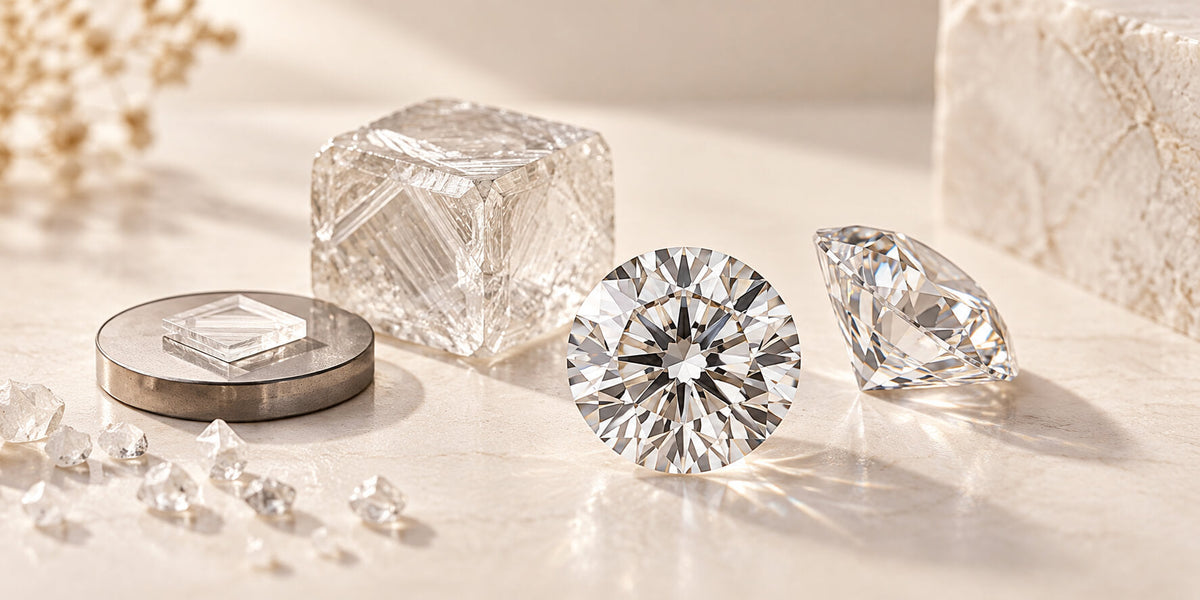
What Are Lab-Grown Diamonds?
Lab-grown diamonds are real diamonds created in controlled laboratory environments rather than formed naturally deep within the Earth. They have essentially the same chemical composition, crystal structure, and physical and optical properties as natural diamonds, but their origin and growth process are different.
Also known as laboratory-grown diamonds or lab-created diamonds, they are produced using two primary technologies: Chemical Vapor Deposition (CVD) and High Pressure High Temperature (HPHT). Once grown, CVD and HPHT diamonds can be cut, polished, graded, and set into fine jewelry just like natural diamonds.
For buyers considering a lab-grown diamond engagement ring or fine jewelry, understanding how these diamonds are created—and how they differ from natural diamonds and diamond simulants—is an important first step.
Are Lab-Grown Diamonds Real Diamonds?
Yes. Lab-grown diamonds are real diamonds.
Diamond is a crystalline form of carbon. Laboratory-grown diamonds have essentially the same chemical composition and crystal structure as diamonds formed naturally within the Earth. GIA likewise describes laboratory-grown diamonds as having essentially the same chemical, physical, and optical properties as their natural counterparts.
This means a lab-grown diamond can exhibit the characteristics people associate with diamond, including exceptional hardness, brilliance, fire, and durability.
The fundamental difference is origin.
A natural diamond forms through geological processes within the Earth, while a lab-grown diamond is produced in a controlled technological environment.
| Lab-Grown Diamond | Natural Diamond | |
|---|---|---|
| Material | Crystalline carbon | Crystalline carbon |
| Crystal structure | Diamond | Diamond |
| Hardness | 10 on Mohs scale | 10 on Mohs scale |
| Optical appearance | Diamond brilliance and fire | Diamond brilliance and fire |
| Origin | Laboratory/factory grown | Formed naturally in the Earth |
| Primary formation method | CVD or HPHT | Natural geological processes |
Lab-grown diamonds should therefore not be confused with diamond simulants such as cubic zirconia.
A simulant is a different material designed to resemble a diamond. A lab-grown diamond is diamond material created through technological growth processes.
How Are Lab-Grown Diamonds Made?
Modern gem-quality lab-grown diamonds are primarily produced through two methods:
CVD — Chemical Vapor Deposition
and
HPHT — High Pressure High Temperature
Both methods start with diamond material that provides a crystal structure upon which additional carbon can crystallize, but they create the necessary growth environment in very different ways. GIA identifies CVD and HPHT as the two principal methods used for gem-quality laboratory-grown diamonds.

What Is a CVD Diamond?
A CVD diamond is a lab-grown diamond produced using Chemical Vapor Deposition.
During CVD growth, diamond substrates are placed inside a controlled chamber containing carbon-bearing gas, commonly involving methane and hydrogen. Energy is introduced to create a plasma and break down the gas molecules.
Carbon atoms are then able to deposit onto the diamond substrate, gradually building diamond crystal material layer by layer.
Unlike HPHT growth, the CVD process does not attempt to reproduce the same extremely high-pressure environment associated with diamond formation deep within the Earth.
GIA reports that CVD diamond growth generally operates at lower pressures and temperatures than HPHT growth.
The simplified process looks like this:
Diamond substrate → Growth chamber → Carbon-rich gas → Plasma → Carbon deposition → Diamond crystal → Cutting & polishing
Modern CVD technology can produce high-quality gem diamonds suitable for engagement rings, wedding jewelry, earrings, necklaces, and other fine jewelry.
Some CVD-grown diamonds may also undergo post-growth treatment, including HPHT treatment, to modify or improve their color. Importantly, CVD describes the diamond's growth method; it does not automatically mean the finished diamond has never undergone additional treatment. GIA reports that many CVD-grown diamonds submitted to its laboratories have undergone post-growth HPHT treatment.
What Is an HPHT Diamond?
An HPHT diamond is a laboratory-grown diamond created using High Pressure High Temperature technology.
HPHT was the first method successfully used to produce gem-quality laboratory-grown diamonds. The process creates extremely high pressure and temperature conditions that enable carbon to crystallize into diamond around a diamond seed.
A typical HPHT growth environment contains:
- a diamond seed;
- a carbon source;
- a metallic growth medium or flux;
- extremely high pressure;
- extremely high temperature.
GIA describes typical HPHT diamond growth conditions as approximately 5–6 GPa of pressure and 1,300–1,600°C, although the precise conditions depend on the process and equipment being used.
Under these controlled conditions, carbon dissolves in the growth medium and crystallizes around the seed, eventually producing a larger diamond crystal.
After growth, the rough HPHT diamond can be cut and polished into a finished gemstone.
CVD vs. HPHT Diamonds: What's the Difference?
Both CVD diamonds and HPHT diamonds are lab-grown diamonds. The distinction refers primarily to how the diamond crystal was grown, not whether one is a “real” diamond and the other is not.
| CVD Diamond | HPHT Diamond |
|---|---|
| Chemical Vapor Deposition | High Pressure High Temperature |
| Grown from carbon-containing gas | Grown using a solid carbon source |
| Uses comparatively lower pressure | Uses extremely high pressure |
| Diamond material grows on a substrate | Carbon crystallizes around a diamond seed |
| Commonly used for gem-quality diamonds | Commonly used for gem-quality diamonds |
Neither growth method alone tells you whether a finished diamond is beautiful or high quality.
A well-grown CVD diamond can be excellent, and so can a well-grown HPHT diamond. Likewise, diamonds produced by either method can vary in color, clarity, cut quality, and other characteristics.
For jewelry buyers, the quality of the individual diamond matters more than simply choosing CVD over HPHT.
Craft Jeweler Tip: Don't choose a lab-grown diamond solely because the listing says “CVD” or “HPHT.” Evaluate the actual stone—especially its cut, color, clarity, carat weight, certification, and visual appearance.
That distinction is important because CVD and HPHT are manufacturing methods, not quality grades.
Do Lab-Grown Diamonds Look Like Natural Diamonds?
To the unaided eye, high-quality lab-grown diamonds and natural diamonds can look essentially the same.
Because both are diamond, both can display the brilliance, scintillation, and fire associated with a well-cut diamond.
That does not mean they are scientifically indistinguishable.
Their different growth environments can leave microscopic or spectroscopic characteristics that trained gemological laboratories can detect using specialized equipment. GIA notes that conventional observation and older diamond-testing methods may not reliably distinguish laboratory-grown diamonds from natural diamonds, while advanced gemological testing can identify their origin and often their growth method.
This is one reason independent grading and identification reports can be valuable when purchasing significant lab-grown diamonds.
Are Lab-Grown Diamonds the Same as Cubic Zirconia or Moissanite?
No.
This is one of the most important distinctions for consumers.
Lab-grown diamond, moissanite, and cubic zirconia are three different materials.
| Gemstone | Diamond? | Main Composition |
|---|---|---|
| Lab-Grown Diamond | Yes | Carbon |
| Natural Diamond | Yes | Carbon |
| Moissanite | No | Silicon carbide |
| Cubic Zirconia | No | Zirconium dioxide |
Moissanite and cubic zirconia can both be used as diamond alternatives, but they are not diamonds.
A CVD diamond or HPHT diamond, by contrast, is diamond.
FTC guidance also distinguishes laboratory-grown gemstones from imitation or simulated stones and requires sellers to accurately disclose the nature of the product being offered.

Are Lab-Grown Diamonds Graded Using the 4Cs?
Yes. Lab-grown diamonds can be evaluated according to the familiar 4Cs of diamond quality:
Cut — how effectively the diamond's proportions and facets interact with light.
Color — the presence or absence of visible body color.
Clarity — the presence and characteristics of internal inclusions and external blemishes.
Carat — the diamond's weight.
These factors can result in substantial visual and quality differences between individual lab-grown diamonds.
This is why the term “lab-grown diamond” describes origin, not quality.
Two 2-carat CVD diamonds, for example, can differ considerably in cut, color, clarity, appearance, and value.
For a deeper explanation, see our Diamond 4Cs Guide: Cut, Color, Clarity & Carat.

Can Lab-Grown Diamonds Be Certified?
Yes.
Independent gemological laboratories can examine laboratory-grown diamonds and issue grading or identification reports.
For example, IGI provides laboratory-grown diamond reports, while GIA also provides laboratory services and identification for laboratory-grown diamonds.
Depending on the laboratory and report format, information may include characteristics such as:
- carat weight;
- measurements;
- color;
- clarity;
- proportions;
- growth origin;
- treatments or other relevant disclosures.
For higher-value diamonds, a reputable independent laboratory report gives buyers an additional layer of information about what they are purchasing.
At Craft Jeweler, certified options are available for qualifying lab-grown diamonds.

Why Choose a Lab-Grown Diamond?
For many buyers, the appeal of lab-grown diamonds comes from the combination of diamond properties, design flexibility, traceable manufactured origin, and value.
Because the material is diamond, buyers do not have to choose a different gemstone simply because they prefer a laboratory-grown option.
Lab-grown diamonds are particularly well suited to:
- engagement rings;
- wedding bands;
- diamond earrings;
- tennis bracelets;
- necklaces and pendants;
- custom fine jewelry.
They also give jewelry buyers greater flexibility when balancing carat size, color, clarity, cut, design, and budget.
However, a lab-grown diamond should not automatically be considered “better” than a natural diamond in every respect. Origin, rarity, pricing, resale considerations, personal values, and emotional preference are different questions.
The better choice depends on what matters to the individual buyer.
Lab-Grown Diamonds at Craft Jeweler
At Craft Jeweler, we work with CVD and HPHT lab-grown diamonds for loose diamonds, engagement rings, wedding bands, fine jewelry, and custom jewelry.
Rather than treating every laboratory-grown diamond as interchangeable, we consider the characteristics of the individual stone—including its cut, color, clarity, proportions, certification, and overall appearance.
For custom jewelry, customers can also select a diamond according to their preferred shape, size, quality, and budget before it is incorporated into the final design.
Our goal is straightforward: help customers understand what they are buying and choose a lab-grown diamond that works for both the jewelry design and their priorities.
Frequently Asked Questions About Lab-Grown Diamonds
Are lab-grown diamonds real?
Yes. Lab-grown diamonds are diamond material with essentially the same chemical composition, crystal structure, and physical and optical properties as natural diamonds. Their primary difference is origin: they are grown in a controlled environment rather than formed naturally within the Earth.
What does CVD diamond mean?
CVD stands for Chemical Vapor Deposition. A CVD diamond is a lab-grown diamond created by depositing carbon onto diamond substrates in a controlled growth chamber.
What does HPHT diamond mean?
HPHT stands for High Pressure High Temperature. An HPHT diamond is grown under extremely high pressure and temperature conditions that enable carbon to crystallize into diamond.
Is CVD better than HPHT?
Not inherently. CVD and HPHT describe two different diamond growth methods. Diamonds produced by either process can vary in quality. Buyers should evaluate the individual diamond's cut, color, clarity, carat weight, appearance, certification, and any disclosed treatments rather than judging quality from growth method alone.
Can a jeweler tell if a diamond is lab-grown?
Not reliably from appearance alone. Advanced gemological equipment and laboratory testing can identify growth characteristics that distinguish laboratory-grown diamonds from natural diamonds.
Are lab-grown diamonds durable enough for engagement rings?
Yes. Because lab-grown diamonds are diamond, they have the hardness and durability expected of diamond and are suitable for everyday jewelry such as engagement rings when properly cut, set, and cared for.


