
カート
0
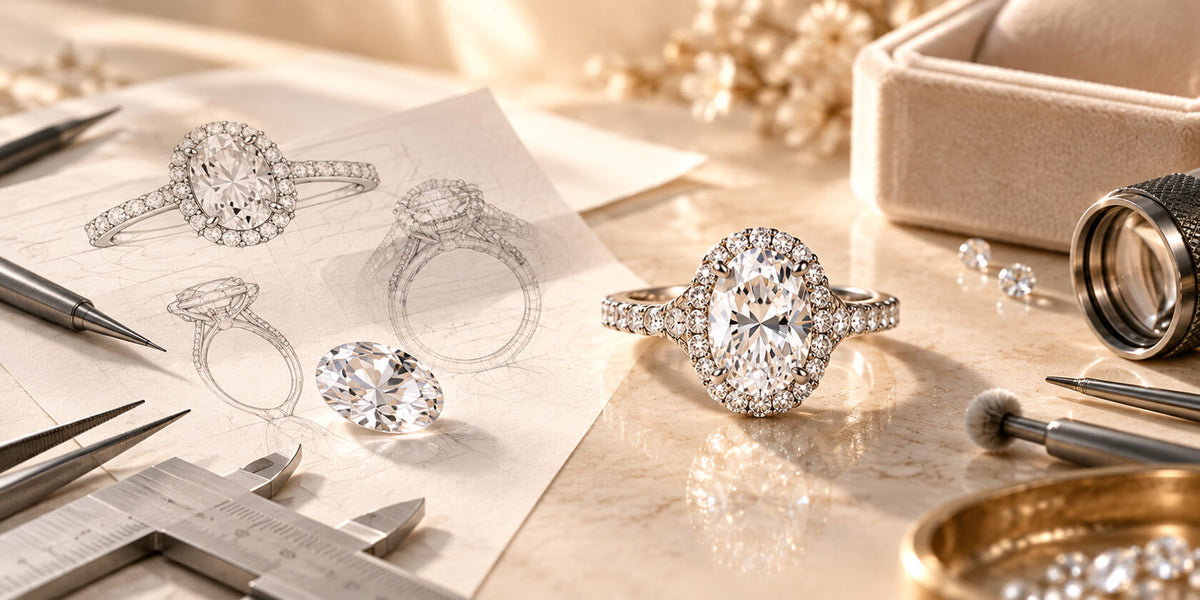
Custom jewelry transforms an idea into a piece created around your preferences rather than asking you to choose only from an existing design.
That idea might begin with a reference image, a sketch, a particular gemstone, an engagement ring you have seen, or simply a description of what you would like to create. From there, decisions about the stone, dimensions, precious metal, setting, proportions, and construction gradually turn the concept into a piece that can actually be made.
But what happens between the first idea and the finished jewelry?
At Craft Jeweler, the custom jewelry process follows five main stages:
Share Your Idea → Choose Your Stone & Details → Review Your Design → Crafted for You → Final Review & Delivery.
Understanding what happens at each stage makes it easier to communicate your preferences, review a design confidently, and know what to expect before production begins. This is also the five-stage process currently used by Craft Jeweler's Custom Jewelry service.
1. Share Your Idea
Every custom jewelry project starts with an idea—but that idea does not need to be fully developed.
You might already know exactly what you want. Or you may only know that you would like an oval diamond engagement ring, an emerald pendant, a gemstone bracelet, or a wedding band designed to fit an existing ring.
Useful starting information can include:
- Reference images
- Hand-drawn sketches
- Jewelry styles you like
- Preferred gemstone
- Stone shape or dimensions
- Precious metal
- Ring size or jewelry dimensions
- Approximate budget
- Details you would like to change from an existing design
Craft Jeweler's custom service accepts reference images, sketches, stone preferences, dimensions, and other design details as starting information.
The more specific your requirements are, the easier it becomes to define the design. But you do not need professional jewelry drawings before contacting a jeweler.
A photograph with notes such as:
“I like this setting, but I want an oval lab-grown sapphire instead of a diamond and a simpler band.”
can already provide useful direction.
Craft Jeweler Tip
When using another piece of jewelry as inspiration, identify what you actually like about it.
Is it the stone shape? Setting height? Band width? Prong style? Side profile? Overall proportions?
This is more useful than simply asking for something that “looks similar.”

2. Choose Your Stone & Design Details
Once the general direction is established, the next step is turning preferences into specifications.
This is where a broad idea such as:
“I want a sapphire engagement ring.”
becomes something much more specific.
For example:
Oval lab-grown blue sapphire
approximately 9 × 7 mm
18K white gold
four-prong setting
hidden halo
approximately 2 mm band
pavé side stones
US ring size 6.5
These details matter because jewelry is built around physical dimensions—not just descriptions.
At Craft Jeweler, this stage can include selecting the lab-grown diamond or gemstone, precious metal, dimensions, setting, and other design details.
Choosing the Center Stone
For gemstone-centered jewelry, the stone often determines much of the design.
Important considerations include:
Gemstone Type
Lab-grown diamond, ruby, sapphire, emerald, alexandrite, moissanite, or another suitable material.
Shape
Round, oval, emerald, cushion, pear, radiant, marquise, Asscher, or another cut.
Dimensions
Length, width, and depth can matter as much as nominal carat weight.
Color and Appearance
Especially important for colored gemstones, where hue, tone, saturation, transparency, and cut can substantially change the appearance.
Proportions
The setting should be engineered around the actual stone rather than assuming every stone of the same stated carat weight has identical dimensions.
For custom jewelry, millimeter measurements are particularly useful because the setting must physically accommodate the stone.
3. Choose the Precious Metal
Metal affects much more than color.
It influences:
- appearance;
- weight;
- structural properties;
- setting construction;
- maintenance;
- how the jewelry feels when worn.
Craft Jeweler custom jewelry can be created in 14K gold, 18K gold, or platinum, depending on the design.
For example, a delicate yellow-gold ring creates a very different visual effect from the same design made in platinum.
Metal selection should therefore happen early enough that it can be incorporated into the design rather than treated as a cosmetic decision at the end.
For a deeper comparison, see our Jewelry Metal Guide: Gold, Platinum & More.

4. Review Your Design
Once the major specifications are established, the design can be reviewed before production.
For custom projects that require it, Craft Jeweler prepares a CAD design so the proportions and details can be checked before manufacturing begins.
CAD stands for computer-aided design.
In jewelry production, a CAD model provides a three-dimensional representation of the piece and helps define important structural dimensions.
Depending on the design, it can help evaluate:
- stone dimensions;
- setting geometry;
- prong placement;
- band width and thickness;
- setting height;
- side-stone layout;
- halo proportions;
- gallery construction;
- overall dimensions.
This stage is especially valuable for jewelry that is being created from scratch.
5. What Should You Check in a Jewelry CAD?
Customers often focus almost entirely on whether the CAD “looks beautiful.”
That is not really its primary purpose.
A CAD is a design and manufacturing tool, not a finished jewelry photograph.
When reviewing one, concentrate on the structure.
Overall Proportions
Does the center stone look appropriately proportioned to the band and side stones?
Setting Height
Is the center stone positioned at the intended height?
For engagement rings, this can also affect whether a wedding band can sit beside the ring.
Band Width and Thickness
Does the ring have the intended visual presence while maintaining appropriate structural proportions?
Prong Arrangement
Are the number and positions of the prongs consistent with the design?
Side and Underside Construction
Do not review only the top view.
The side profile and underside often reveal important information about setting height, gallery design, stone support, and wearability.

6. Why the CAD May Look Heavier Than the Finished Jewelry
This deserves its own section because customers unfamiliar with jewelry manufacturing can misunderstand CAD images.
A CAD rendering may make certain features—especially prongs—appear heavier or more prominent than they will look after the jewelry is finished.
Why?
Because the piece still needs to go through manufacturing, stone setting, finishing, and polishing.
The CAD therefore should not always be interpreted as a photorealistic preview of the final surface finish.
At the same time, this does not mean dimensions shown in a CAD should be ignored.
Important structural measurements still need to be reviewed carefully before approval.
Craft Jeweler Tip
If something looks unclear in a CAD, ask about the actual dimension.
Instead of:
“Does this band look too thick?”
ask:
“What is the finished band width and thickness?”
Numbers often resolve ambiguity more reliably than perspective renderings.
7. Approve the Design Before Production
The design-review stage is where changes should be made.
Depending on the project, this might include adjusting:
- stone dimensions;
- band width;
- setting height;
- prong style;
- halo size;
- side stones;
- engraving;
- metal;
- overall proportions.
Once the design and specifications are confirmed, the project can move into production.
This distinction is important:
Design revisions are much easier before manufacturing than after the jewelry has been made.
That is why the final review should be treated as a real approval stage rather than a formality.
8. Crafted for You: What Happens During Production?
After the design is approved, the jewelry moves from digital or technical design into physical production.
The exact manufacturing route varies by design, but production can involve stages such as:
Model Preparation
The approved design is prepared for manufacturing.
Casting or Metal Fabrication
The main jewelry structure is produced in the selected precious metal.
Pre-Finishing and Assembly
Components are prepared, assembled, and refined as required.
Stone Setting
Diamonds or gemstones are positioned and secured in their settings.
Polishing and Finishing
Metal surfaces, edges, and visible details are refined.
Quality Inspection
The completed piece is checked before delivery.
Craft Jeweler's current custom process specifically describes this stage as including setting, polishing, finishing, and quality inspection after design approval.

9. Final Review & Delivery
Production is not the final step.
Before the jewelry is shipped, the finished piece should be inspected.
Depending on the design, final inspection may consider:
- stone security;
- stone alignment;
- prongs;
- symmetry;
- surface finishing;
- polishing;
- clasp or connection function;
- ring dimensions;
- overall appearance.
Craft Jeweler's published process states that the finished jewelry is inspected before being securely packaged and shipped.
This final review is different from the earlier design review.
Design Review
Are we making the right piece?
Final Quality Review
Was the approved piece made and finished appropriately?
That distinction is worth making clear.
10. How Long Does Custom Jewelry Take?
There is no single production time that applies to every custom jewelry project.
A simple design and a complex multi-stone piece do not necessarily require the same amount of work.
Timing can depend on:
- design complexity;
- whether CAD development is required;
- design revisions;
- gemstone availability;
- custom-cut stone requirements;
- metal and construction;
- stone setting;
- finishing requirements.
For this reason, Craft Jeweler confirms the production time for custom jewelry based on the individual project rather than applying one fixed timeframe to every custom order.
This is better than promising an unrealistic universal production time.
11. How Much Does Custom Jewelry Cost?
The cost of custom jewelry depends on what is being created.
Important factors can include:
Center Stone
Gemstone type, size, quality, shape, and specifications can significantly affect the total price.
Precious Metal
Metal type and the amount required affect material cost.
Design Complexity
A simple solitaire and a complex multi-stone setting require different levels of design and manufacturing work.
Accent Stones
Quantity, dimensions, type, and setting method matter.
Jewelry Dimensions
A wider or heavier ring requires more precious metal than a delicate design.
Rather than assuming that “custom” has one fixed premium, it is more useful to define the design first and evaluate the project based on its actual specifications.
12. Custom Jewelry vs. Made-to-Order Jewelry
This distinction is particularly important on Craft Jeweler because you offer both.
Made-to-Order Jewelry
The core design already exists.
You may be able to select options such as:
- precious metal;
- ring size;
- gemstone;
- stone size;
- certain design variations.
But the underlying design remains substantially the same.
Custom Jewelry
The design is developed around your specific requirements.
This may involve changing:
- proportions;
- setting construction;
- stone arrangement;
- dimensions;
- profile;
- structural details;
- design concept itself.
In simple terms:
Made-to-order personalizes an existing design. Custom jewelry develops the design around your requirements.
This distinction helps customers choose the right service instead of assuming every selectable product option is a fully bespoke project.
13. What Should You Prepare Before Requesting Custom Jewelry?
You do not need everything decided before contacting us.
However, these details can make the process more efficient:
- What type of jewelry do you want?
- Do you have reference images or a sketch?
- Which gemstone or diamond do you prefer?
- Do you know the approximate stone size or dimensions?
- Which precious metal do you prefer?
- Do you know your ring size or required jewelry dimensions?
- Which design details are most important to you?
- Is there anything you specifically do not want?
- Do you have an approximate budget?
If you do not know all of these answers, that is fine.
Part of the custom process is turning preferences into workable specifications.
14. Is Custom Jewelry Right for You?
Custom jewelry can make sense when:
- you cannot find the combination you want in an existing design;
- you already have a specific stone you want to build around;
- you want unusual dimensions or proportions;
- an engagement ring requires a specially fitted wedding band;
- you want to combine elements from several design ideas;
- standard jewelry sizing or construction does not suit your requirements;
- the design has personal meaning that cannot easily be reproduced through a standard product.
But custom jewelry is not automatically necessary for every purchase.
If an existing made-to-order design already provides the stone, metal, size, and appearance you want, customizing an established design may be the simpler route.
15. Start With the Idea, Not the Technical Drawing
The custom jewelry process can look complicated when viewed from the manufacturing side.
For the customer, it does not need to begin that way.
You can start with:
a photograph,
a sketch,
a gemstone,
a measurement,
or simply an idea.
The technical decisions come afterward.
At Craft Jeweler, the process is designed to move from idea → specifications → design review → craftsmanship → final delivery, with the major details confirmed before production.
The goal is not simply to make something different.
It is to create a piece whose design, materials, proportions, construction, and personal meaning belong together.
Start Your Custom Jewelry Project
Frequently Asked Questions
Do I need a drawing to order custom jewelry?
No. A reference image, sketch, gemstone preference, dimensions, or written description can be enough to start the discussion. Craft Jeweler's custom request process accepts these types of information.
Does every custom jewelry project require CAD?
Not necessarily. Craft Jeweler specifies that CAD is prepared for custom jewelry projects that require it. The appropriate design and review process depends on the project.
Can I choose my own gemstone?
Yes. Stone selection is part of the current Craft Jeweler custom process, including lab-grown diamonds and gemstones, along with dimensions, precious metal, setting, and other design details.
Can I make changes after seeing the CAD?
The purpose of the design-review stage is to confirm proportions and details before production begins. Requested changes should therefore be discussed during this stage and approved before manufacturing.
Can you create a wedding band to fit my engagement ring?
A custom band can be developed around the profile and dimensions of an engagement ring when sufficient measurements and design information are available. This is particularly useful when a standard straight band does not provide the desired fit.
Is custom jewelry the same as made-to-order jewelry?
No. Made-to-order jewelry generally starts with an established design and selectable options. Full custom jewelry allows the design itself to be developed or substantially modified around the customer's requirements.
How long does custom jewelry take?
Production time varies according to the individual design and is confirmed for the project before production. Craft Jeweler does not currently publish one universal production time for all custom jewelry.


