
Carrito
0
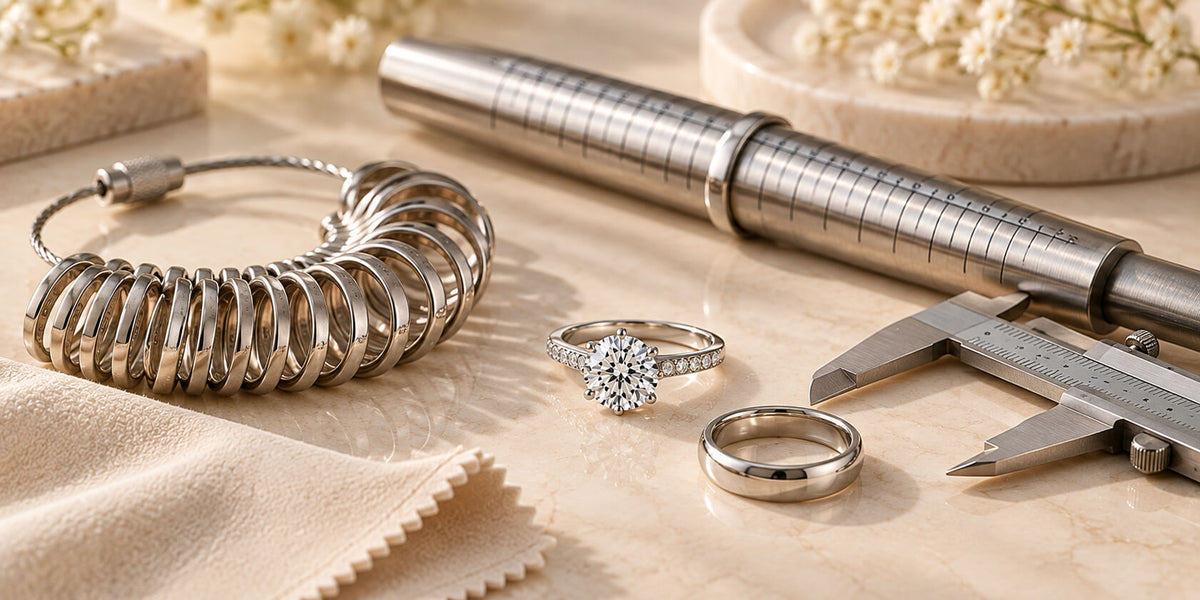
Finding the right ring size sounds simple—until you discover that finger size can change throughout the day, wider bands often fit differently from narrow ones, and measuring an existing ring is not the same as measuring your finger.
For an engagement ring, wedding band, eternity ring, or custom-made piece, getting the size right matters for both comfort and security.
A ring that is too tight can be uncomfortable and difficult to remove. A ring that is too loose may rotate excessively or even slip off.
This Ring Size Guide explains how to measure your ring size at home, how to measure an existing ring, how to use diameter and circumference measurements, how international ring sizes compare, and when professional sizing is the better choice.
1. What Does Ring Size Actually Measure?
Ring size describes the inside dimensions of a finished ring.
Two measurements are especially useful:
Inside Diameter
The straight-line distance across the inside of the ring, measured from one inner edge to the opposite inner edge.
Inside Circumference
The total distance around the inside of the ring.
These two measurements are mathematically related:
Circumference ≈ Diameter × π
For example, a ring with an inside diameter of approximately 17.3 mm has an inside circumference of approximately 54.4 mm.
Ring-sizing systems then translate these measurements into regional sizes such as:
- US sizes
- UK/Australian sizes
- European sizes
- Japanese sizes
This is why simply telling a jeweler “I usually wear a medium” is not precise enough.
2. The Best Way to Find Your Ring Size
If accuracy matters, particularly for a made-to-order engagement ring, wedding band, eternity ring, or custom piece, the best method is to have your finger measured with a proper ring-sizing set.
A professional jeweler can also consider factors that a simple measurement may miss:
- Knuckle size
- Finger shape
- Ring width
- Desired fit
- Stacking
- Ring design
- Resizing limitations
If professional sizing is available, we recommend using it before ordering an expensive or difficult-to-resize ring.
If that is not practical, there are several useful ways to estimate your size at home.
3. How to Measure Your Ring Size at Home
There are two main approaches:
Measure Your Finger
or
Measure a Ring That Already Fits
If you already own a correctly fitting ring worn on the same finger, measuring that ring is often preferable to wrapping something around your finger.
If not, you can estimate your finger circumference.
Method 1: Measure an Existing Ring
Choose a ring that:
- Fits comfortably
- Is worn on the intended finger
- Has a reasonably similar width to the ring you plan to buy
Place it on a flat surface.
Measure the inside diameter only.
Do not include the metal.
For example:
Incorrect:
Outside edge → Outside edge
Correct:
Inside edge → Inside edge
Even a small measurement error can affect the resulting size, so use a ruler with millimeter markings or, preferably, a digital caliper.

Method 2: Measure Your Finger Circumference
If you do not have a correctly fitting ring, you can estimate the circumference of your finger.
Use a thin, non-stretching strip of paper or a suitable measuring strip.
Wrap it around the part of the finger where the ring will sit.
The fit should be:
- Snug
- Not painfully tight
- Able to pass over the knuckle
- Not hanging loosely
Mark the point where the strip overlaps.
Then lay it flat and measure the length in millimeters.
That measurement is an estimate of your finger circumference.
For example:
Approximately 54.4 mm circumference
corresponds approximately to a US size 7.
However, this method has more opportunities for error than measuring with proper ring-sizing tools.
Paper can shift.
String can stretch.
The strip can be pulled too tightly or left too loose.
So repeat the measurement several times rather than relying on one attempt.

4. Should You Use String to Measure Ring Size?
You can, but it is not my preferred method.
String can:
- Stretch
- Compress into the skin
- Twist
- Be pulled too tightly
That can produce an inaccurate measurement.
A narrow strip of non-stretching paper is generally preferable if you do not have a ring-sizing tool.
Better still, use a physical ring sizer.
For valuable made-to-order or custom jewelry:
Do not rely on a single string measurement.
5. When Should You Measure Your Finger?
Your fingers are not exactly the same size throughout the day.
Finger size can be affected by:
- Temperature
- Exercise
- Fluid retention
- Time of day
- Recent physical activity
Cold fingers may temporarily measure smaller.
Very warm or swollen fingers may measure larger.
For a more representative result:
- Measure when your hands are at a comfortable, normal temperature
- Avoid measuring immediately after strenuous exercise
- Avoid measuring when your hands are unusually cold
- Measure more than once
- Consider measurements at different times
You are looking for your normal wearable size, not the smallest or largest measurement your finger can produce.
6. Measure the Correct Finger
This sounds obvious, but it causes real sizing mistakes.
The same finger on your left and right hands may not be exactly the same size.
Your dominant hand may also differ from your non-dominant hand.
Therefore:
Measure the exact finger on the exact hand where the ring will be worn.
Do not assume:
Left ring finger = Right ring finger
or:
Existing right-hand ring = correct size for left-hand engagement ring.
7. Don't Ignore the Knuckle
Finger shape matters.
Some people have relatively straight fingers.
Others have a significantly wider knuckle with a narrower finger base.
If your knuckle is much wider than the place where the ring sits, the ring must be large enough to pass over the knuckle without becoming excessively loose once in position.
In this situation, a simple circumference measurement at the base of the finger may not tell the full story.
Measure both:
Knuckle
and
Finger Base
If the difference is substantial, professional sizing is strongly recommended.
8. How Should a Ring Fit?
A properly fitted ring should generally:
- Slide over the knuckle with some resistance
- Sit comfortably at the base of the finger
- Not feel painfully tight
- Not leave severe indentation
- Not rotate excessively during normal wear
- Not slip off with ordinary hand movement
A small amount of resistance when removing the ring is usually desirable.
A ring that slides off with almost no resistance may be too loose.
But there is no single "perfect feeling" for every person.
Finger anatomy and personal preference matter.
9. Ring Width Can Change How a Size Feels
This is one of the most important points in the article.
A 2 mm band and a 6 mm band in the same nominal ring size may not feel the same.
Wider bands contact more of the finger.
As a result, they often feel tighter.
For wider rings, some wearers may require a slightly larger size than they would choose for a narrow band.
This becomes especially relevant for:
- Men's wedding bands
- Wide wedding rings
- Wide eternity rings
- Cigar bands
- Stacked ring combinations
Do not automatically order every ring in the same size simply because one narrow ring fits.

10. Engagement Ring Sizing
Most traditional engagement rings use relatively narrow shanks, so standard ring sizing is often straightforward.
But the design still matters.
Consider:
- Shank width
- Top-heavy center stones
- Setting height
- Side stones
- Pavé
- Finger shape
A ring with a large center stone may rotate more easily if the fit is too loose.
This does not necessarily mean you should deliberately order an overly tight ring.
The objective is a secure, comfortable fit.
If you plan to wear the engagement ring with a wedding band, think about how the two rings will feel together.
11. Wedding Bands and Ring Stacks Can Fit Differently
Two or three rings worn together cover more of the finger than a single ring.
That can make a stack feel tighter even when each individual ring fits comfortably by itself.
For example:
Engagement Ring + Wedding Band
may feel different from either ring worn alone.
And:
Engagement Ring + Wedding Band + Anniversary Band
may feel tighter still.
If you already know you will wear multiple rings together, consider the combined width during sizing.
12. Eternity Rings Require Extra Sizing Care
This is especially important for Craft Jeweler customers.
A full-eternity ring has gemstones extending around the entire circumference of the band.
That creates a major practical difference:
Full-eternity rings can be difficult—or in some designs impractical—to resize.
Resizing may affect:
- Stone spacing
- Setting geometry
- Shared prongs
- Structural integrity
- Pattern continuity
Therefore, accurate sizing before production is particularly important.
For a custom full-eternity ring, I strongly recommend confirming size with a physical ring sizer rather than relying solely on a paper or string measurement.
Half-eternity and three-quarter-eternity designs generally offer more potential flexibility because part of the shank remains metal-only, although actual resizeability depends on the specific construction.
13. Does Ring Shape Affect Sizing?
The gemstone shape itself—round, oval, emerald, pear, radiant, etc.—does not directly define the finger size.
But the overall ring design can affect how the piece feels.
For example:
- Very large center stones can make a loose ring rotate
- Wide galleries may affect adjacent-finger comfort
- Low-profile designs may sit differently against the finger
- Large halos increase visual and physical presence
- Wide side-stone arrangements can influence comfort
So ring size should not be considered completely independently from ring design.
14. US Ring Size Chart
The following chart is useful as a general reference.
| US Size | Inside Diameter | Inside Circumference |
|---|---|---|
| 4 | ~14.9 mm | ~46.8 mm |
| 4.5 | ~15.3 mm | ~48.0 mm |
| 5 | ~15.7 mm | ~49.3 mm |
| 5.5 | ~16.1 mm | ~50.6 mm |
| 6 | ~16.5 mm | ~51.9 mm |
| 6.5 | ~16.9 mm | ~53.1 mm |
| 7 | ~17.3 mm | ~54.4 mm |
| 7.5 | ~17.7 mm | ~55.7 mm |
| 8 | ~18.1 mm | ~57.0 mm |
| 8.5 | ~18.5 mm | ~58.3 mm |
| 9 | ~18.9 mm | ~59.5 mm |
| 9.5 | ~19.4 mm | ~60.8 mm |
| 10 | ~19.8 mm | ~62.1 mm |
| 10.5 | ~20.2 mm | ~63.4 mm |
| 11 | ~20.6 mm | ~64.6 mm |
| 11.5 | ~21.0 mm | ~65.9 mm |
| 12 | ~21.4 mm | ~67.2 mm |
| 12.5 | ~21.8 mm | ~68.5 mm |
| 13 | ~22.2 mm | ~69.7 mm |
Important: Ring-size conversion charts are useful references, but manufacturing tolerances and regional sizing standards can vary slightly. For custom production, use the sizing system agreed with the jeweler.
15. International Ring Sizes Are Not the Same
Ring-size systems vary by market.
A customer may describe the same approximate ring using:
- US numerical size
- UK alphabetical size
- EU circumference-based size
- Japanese numerical size
For example, a ring around 54–55 mm inside circumference is approximately:
US 7 / EU 54–55 / UK approximately N
But international conversion should be treated as an approximation rather than a substitute for an actual millimeter measurement.
This is why, for international custom orders, one of the most useful pieces of information you can provide is:
Inside Diameter in mm
or
Inside Circumference in mm
rather than only a regional size designation.

16. What If You're Between Two Ring Sizes?
Do not automatically choose the smaller size.
Consider:
Choose Toward the Larger Size When:
- The band is wide
- Your knuckle is prominent
- Your fingers commonly swell
- You plan to stack several rings
The Smaller Size May Work Better When:
- The ring is very narrow
- Your finger base is significantly smaller than the knuckle
- A top-heavy ring rotates excessively
But these are guidelines—not universal rules.
If you are between sizes on an expensive made-to-order piece, particularly an eternity ring, confirm with a physical ring sizer.
17. What If the Ring Is a Surprise?
This is one of the most common engagement-ring problems.
If you cannot measure the recipient's finger directly, try to find a ring they already wear on the correct finger.
Measure its inside diameter.
Be careful:
A ring worn on another finger may not provide the correct size.
You can also ask:
- A family member
- A close friend
- Someone who has previously discussed ring size with them
But avoid guessing from:
- Height
- Weight
- Shoe size
- Hand appearance
These are not reliable methods for determining ring size.
18. Can a Ring Be Resized Later?
Many rings can be resized.
But not all rings are equally resizeable.
Relatively straightforward designs may include:
- Plain bands
- Solitaire rings
- Some half-pavé rings
More difficult designs may include:
- Full-eternity rings
- Intricate pavé
- Continuous engraving
- Certain tension-style constructions
- Rings with stones around most or all of the shank
The amount a ring can safely be resized also depends on:
- Metal
- Construction
- Setting
- Stone placement
- Required size change
Never assume:
"I can always resize it later."
For complex custom jewelry, sizing correctly before production is much better than relying on future alteration.
19. How Accurate Are Printable Ring Sizers?
Printable ring-size guides can be convenient, but they introduce another potential source of error:
Printer scaling.
If a PDF intended to print at 100% is automatically set to:
- Fit to page
- Shrink to printable area
- Scale to paper size
the resulting circles or sizing strip may no longer be accurate.
If you provide a printable sizing guide, it should include a calibration reference such as:
50 mm reference line
or a known-size rectangle.
The user should measure that reference after printing before trusting the sizing tool.
This is a small detail, but it is extremely important.
20. Home Measurement vs. Professional Ring Sizing
| Method | Convenience | Accuracy Potential | Best Use |
|---|---|---|---|
| String | High | Lower | Rough estimate |
| Paper Strip | High | Moderate | Home estimate |
| Existing Ring + Caliper | High | Good when measured correctly | Known fitting ring |
| Physical Ring Sizer | High | Very Good | Final size confirmation |
| Professional Jeweler | Moderate | Very Good | High-value/custom jewelry |
The point is not that home measurement is useless.
It is that:
The higher the cost of getting the size wrong, the stronger the case for professional confirmation.
21. Before Ordering a Made-to-Order or Custom Ring
Before approving production, confirm:
Finger
- Correct hand
- Correct finger
- Knuckle considered
- Measurement repeated
Ring
- Band width
- Engagement ring / wedding band / eternity
- Whether it will be stacked
- Design profile
- Resizeability
Size
- Sizing system
- US / UK / EU etc.
- Inside diameter if available
- Inside circumference if available
- Physical ring-sizer confirmation for difficult-to-resize designs
For custom jewelry, size is not a minor checkout field.
It is part of the engineering specification of the ring.
Ring Size Checklist
Before submitting your ring size:
1. Measure the exact finger.
Do not assume both hands are identical.
2. Measure at a normal hand temperature.
Avoid unusually cold or swollen fingers.
3. Measure more than once.
Do not rely on one reading.
4. Consider your knuckle.
The ring still needs to pass over it.
5. Consider band width.
Wide bands may feel tighter.
6. Consider stacking.
Multiple rings increase total finger coverage.
7. Be especially careful with full-eternity rings.
Future resizing can be difficult.
8. Use millimeters when possible.
Diameter or circumference reduces international sizing ambiguity.
9. Confirm expensive custom orders with a physical ring sizer.
This is the step I would emphasize most strongly.
Frequently Asked Questions
How can I find my ring size at home?
You can measure the inside diameter of a ring that already fits the intended finger or estimate your finger circumference using a non-stretching paper strip. Repeat the measurement and use millimeters whenever possible.
What is the most accurate way to measure ring size?
A proper physical ring-sizing set or professional jeweler measurement is generally more reliable than string or paper methods, especially for made-to-order, custom, wide, or full-eternity rings.
Is ring size based on diameter or circumference?
Ring sizing systems ultimately correspond to the ring's internal dimensions. Inside diameter and inside circumference can both be used to determine the corresponding regional ring size.
Should a ring be tight or loose?
A ring should generally feel secure and comfortable, pass over the knuckle with some resistance, and not slip off easily or cause painful pressure.
Are ring sizes the same on both hands?
Not necessarily. The same finger on opposite hands can differ in size, so measure the exact finger on which the ring will be worn.
Do wide rings need a larger size?
Sometimes. Wider bands cover more of the finger and can feel tighter than narrow bands of the same nominal size. The appropriate adjustment depends on the width and the wearer.
What if I am between ring sizes?
Consider band width, knuckle size, swelling, stacking, and ring design. For expensive or difficult-to-resize jewelry, confirm the fit with a physical ring sizer rather than guessing.
Can an eternity ring be resized?
Some eternity designs may allow limited alteration, but full-eternity rings are generally much more difficult to resize because gemstones and settings continue around the entire circumference. Accurate initial sizing is especially important.
Can I determine someone's ring size from their shoe size?
No. Shoe size, height, weight, and appearance are not reliable ways to determine ring size.
Should I size my engagement ring and wedding band the same?
Often they may be similar, but not always. Band width and the combined width of a ring stack can change how the rings feel when worn together.
Final Thoughts
Finding the right ring size is not simply a matter of matching your finger to a number on a chart.
The correct fit depends on:
Finger Measurement + Knuckle + Band Width + Ring Design + Stacking + Personal Fit
For a simple ring, a careful home measurement may provide a useful estimate.
For a made-to-order engagement ring, wide wedding band, full-eternity ring, or custom design, the consequences of an incorrect size are greater.
In those cases, use a physical ring sizer or professional measurement before production whenever possible.
One final principle is worth remembering:
Measure the finger—but size for the ring you will actually wear.


