
Carrito
0
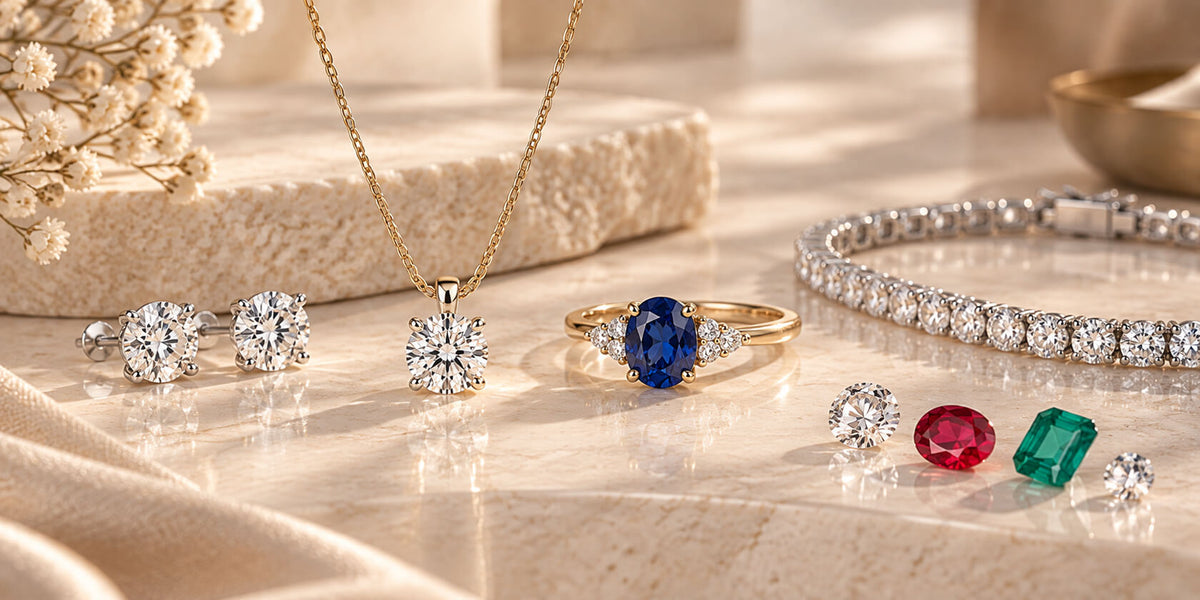
Fine jewelry is more than a beautiful object. A well-made piece brings together precious metals, carefully selected gemstones, thoughtful proportions, secure settings, skilled craftsmanship, and a design suited to how the jewelry will actually be worn.
That makes buying fine jewelry different from simply choosing the piece that looks best in a photograph.
Whether you are considering a diamond necklace, gemstone earrings, a bracelet, an anniversary ring, or a custom-made piece, understanding the materials and construction behind the design can help you make a more informed decision.
This Fine Jewelry Buying Guide explains what to look for when evaluating precious metals, lab-grown diamonds and gemstones, craftsmanship, durability, sizing, certification, care, customization, and long-term wear.
1. What Is Fine Jewelry?
Fine jewelry generally refers to jewelry made with precious metals such as:
- Gold
- Platinum
- Sterling silver
and often set with diamonds or other gemstones.
What separates good fine jewelry from inexpensive fashion jewelry, however, is not simply the presence of a precious metal or gemstone.
A quality piece should be considered as a complete system:
Materials + Design + Construction + Setting + Finishing + Wearability
A beautiful gemstone cannot compensate for poor setting work.
Likewise, substantial precious-metal content does not automatically make a poorly proportioned piece well designed.
When evaluating fine jewelry, look beyond the material description and consider how the entire piece has been made.
2. Start With How You Plan to Wear the Jewelry
Before comparing metals, gemstones, or specifications, ask a more practical question:
How will I actually wear this piece?
Jewelry intended for daily wear has different requirements from jewelry worn occasionally.
Consider:
- How frequently it will be worn
- Whether it will be exposed to regular impact
- Your occupation
- Exercise and daily activities
- Contact with water, cosmetics, or chemicals
- How much maintenance you are comfortable with
- Whether the jewelry needs to coordinate with pieces you already own
For example, a ring typically experiences more direct impact and surface contact than a pendant.
Earrings may face relatively little abrasion, while bracelets can regularly contact desks, clothing, and other surfaces.
This means the same gemstone or construction may be perfectly appropriate for one jewelry category but less suitable for another.
Buy for the way the jewelry will be worn—not just the way it looks in a product photograph.
3. Choose the Right Precious Metal
The metal forms the structural foundation of most fine jewelry.
At Craft Jeweler, the principal precious-metal choices include 14K gold, 18K gold, and platinum, depending on the design.
14K Gold
14K gold contains approximately 58.3% pure gold, with the remainder consisting of alloying metals.
It offers an effective balance of:
- Gold content
- Durability
- Wearability
- Price
For many everyday fine-jewelry designs, 14K gold is a practical choice.
18K Gold
18K gold contains 75% pure gold.
Its higher gold content gives it a more precious composition and, particularly in yellow gold, generally produces a richer gold appearance.
18K gold is widely used for luxury fine jewelry and is available in different colors depending on the alloy composition.
Platinum
Platinum is naturally white, dense, and substantial.
Unlike white gold, its white appearance does not depend on rhodium plating.
Its density also gives platinum jewelry a noticeably different feel from gold jewelry of comparable dimensions.
Platinum is particularly attractive for buyers who prefer:
- Naturally white metal
- Greater weight
- Premium fine-jewelry construction
- A distinctive patina that develops with wear
There is no universally "best" precious metal.
The right choice depends on the design, desired color, weight, maintenance expectations, budget, and how the jewelry will be worn.
For a detailed comparison, see our Jewelry Metal Guide: Gold, Platinum & More.

4. Understand the Difference Between Diamonds, Gemstones, and Simulants
This is especially important when shopping for jewelry online.
Not every transparent or colored stone belongs to the same material category.
Lab-Grown Diamonds
Lab-grown diamonds are diamonds produced in controlled laboratory environments.
They have essentially the same chemical composition, crystal structure, and optical and physical properties as natural diamonds.
The principal growth technologies are:
- CVD — Chemical Vapor Deposition
- HPHT — High Pressure High Temperature
They should not be confused with diamond simulants such as moissanite or cubic zirconia.
Lab-Grown Gemstones
True lab-grown gemstones such as laboratory-grown ruby, sapphire, emerald, and alexandrite are synthetic counterparts of their natural gemstone species.
When correctly identified, they share essentially the same fundamental chemical, physical, and optical characteristics as their natural counterparts, although their growth environment and identifying features differ.
Depending on the gemstone, laboratory growth methods may include:
- Czochralski / Pulled Growth
- Hydrothermal Growth
- Flux Growth
- Flame Fusion
Simulants
A simulant resembles another gemstone visually but is a different material.
For example:
- Moissanite can simulate the appearance of diamond
- Cubic zirconia can simulate diamond or colored gemstones
- YAG can be produced in colors that visually resemble other gemstones
That does not make those materials inferior. It simply means they should be described accurately.
The key purchasing principle is:
Know what material you are buying.
For deeper explanations, see What Are Lab-Grown Diamonds? and What Are Lab-Grown Gemstones?
5. Don't Judge a Gemstone by Carat Weight Alone
Carat is a unit of weight.
It does not tell you everything about how large a gemstone will look.
Different gemstone materials have different densities, and even two stones of the same material and carat weight can have different face-up dimensions depending on:
- Shape
- Cutting style
- Depth
- Proportions
- Girdle
- Length-to-width ratio
This is why millimeter dimensions are extremely useful when buying fine jewelry.
For example:
6×8 mm
may tell you more about how a gemstone will fit a particular design than carat weight alone.
For earrings, bracelets, eternity bands, and multi-stone necklaces, stone dimensions and consistency can be particularly important because multiple stones need to work together visually.
6. Evaluate Color, Cut, and Overall Appearance
For colored gemstones, there is no universal formula equivalent to simply choosing the highest numerical grade.
Color is often the dominant visual characteristic.
Consider:
- Hue
- Tone
- Saturation
- Color distribution
- Transparency
- Cut
- Windowing
- Extinction
- Overall appearance
A gemstone with impressive specifications on paper can still be less attractive than another stone with better visual balance.
The same principle applies to diamonds.
Certificates and specifications are valuable tools.
But ultimately:
Fine jewelry is visual.
Technical information should support—not replace—visual evaluation.
7. Certification: When Does It Matter?
Certification can provide useful independent information about a gemstone or diamond.
For significant center diamonds, a grading report can be particularly valuable.
Craft Jeweler offers IGI-certified options for lab-grown diamonds.
A diamond report may include information such as:
- Laboratory-grown identification
- Growth method
- Shape
- Measurements
- Carat weight
- Color
- Clarity
- Cut grade where applicable
- Polish
- Symmetry
- Fluorescence
- Treatment disclosure where applicable
But not every small gemstone in a piece of jewelry requires an individual laboratory report.
A pavé ring containing dozens of tiny accent diamonds, for example, would not normally require an individual grading report for every stone.
The importance of certification should therefore be proportional to:
Stone significance + Value + Purchase context
8. Look Beyond the Gemstone: Evaluate the Setting
One of the biggest mistakes when buying fine jewelry is focusing almost entirely on the stones.
The setting determines how securely those stones become part of a wearable piece of jewelry.
Common settings include:
- Prong
- Shared prong
- Pavé
- Bezel
- Channel
- Halo
- Flush setting
Each involves different trade-offs between:
- Stone visibility
- Protection
- Metal presence
- Maintenance
- Design
- Wearability
A setting should hold the gemstone securely without unnecessarily hiding its beauty.
For frequently worn jewelry, structural integrity matters as much as appearance.
9. Fine Jewelry Should Have Enough Metal
This is an area where online photographs can be misleading.
Ultra-thin jewelry can look delicate and elegant when photographed from the correct angle.
But there is a difference between:
Delicate
and
Structurally insufficient.
Rings, bracelet links, prongs, chains, clasps, galleries, and other structural components need enough material to perform their function.
Extremely reducing metal weight may lower production cost, but it can also affect:
- Rigidity
- Resistance to deformation
- Setting security
- Long-term durability
- Repairability
This does not mean heavier jewelry is automatically better.
Good jewelry is about appropriate proportions.
A well-engineered fine-jewelry piece should use enough metal where structural strength is required without becoming unnecessarily bulky.

10. Pay Attention to Craftsmanship and Finishing
Two pieces made with the same metal and gemstones can differ significantly in quality.
Look at details such as:
Stone Setting
Are stones aligned consistently?
Do prongs appear balanced and appropriately finished?
Symmetry
Are paired elements visually consistent?
This is particularly important for earrings and multi-stone jewelry.
Polishing
Surfaces should be appropriately finished without obvious roughness or unfinished areas.
Edges
Areas that touch the skin should generally feel considered and comfortable.
Galleries and Undersides
Quality should not stop at the parts visible from above.
The underside of a ring, pendant, or earring often reveals a great deal about how thoughtfully the piece was constructed.
Clasps and Connections
For necklaces and bracelets, inspect:
- Clasps
- Jump rings
- Hinges
- Solder joints
- Link construction
A piece of jewelry is only as reliable as its weakest structural component.

11. Understand the Difference Between Ready-to-Ship, Made-to-Order, and Custom Jewelry
This distinction matters because it affects production time, customization, and potentially return eligibility.
Ready-to-Ship Fine Jewelry
Best for buyers who:
- Like the existing specifications
- Want faster processing
- Do not require substantial customization
Craft Jeweler's ready-to-ship jewelry generally requires approximately 1–2 business days of processing before shipment.
Made-to-Order Fine Jewelry
Made-to-order jewelry is produced after the order is placed.
It is appropriate when:
- You like an existing design
- You want a particular metal
- A specific ring size is required
- The product is not held as finished inventory
Craft Jeweler's made-to-order jewelry generally requires approximately 10–15 business days of production before shipping.
Custom Fine Jewelry
Custom jewelry is appropriate when you want something beyond the existing design specifications.
Depending on the project, customization may include:
- Gemstone
- Diamond
- Stone size
- Shape
- Precious metal
- Ring dimensions
- Setting
- Side stones
- Engraving
- Design details
A typical custom process may involve:
Submit → CAD → Final Review → Production → Shipping
Production timing depends on the complexity of the design and should be confirmed before production begins.
12. Check Dimensions and Scale Before Buying Online
Fine-jewelry photography is designed to show detail.
That can make jewelry appear larger than it really is.
Never judge scale from photographs alone.
Check measurements such as:
Rings
- Band width
- Band thickness
- Center-stone dimensions
- Setting height
Earrings
- Overall dimensions
- Stone dimensions
- Drop length
- Post or closure type
Necklaces
- Chain length
- Chain thickness
- Pendant dimensions
Bracelets
- Bracelet length
- Width
- Stone dimensions
- Link construction
A 6.00mm gemstone and a 10.00mm gemstone can both look impressive in macro photography, but they will look very different when worn.

13. Choose Jewelry Proportions for the Person, Not the Trend
Jewelry trends change.
Proportion lasts much longer.
Consider:
- Finger size
- Wrist size
- Neckline
- Earring scale
- Existing jewelry
- Personal style
- Desired visual presence
A 6 mm wide ring may look balanced on one hand and overly dominant on another.
A delicate pendant may be perfect for everyday layering but too subtle for someone seeking a statement piece.
A buying guide should therefore help you choose what works for you, rather than treating current trends as universal rules.
14. Consider Jewelry Care Before You Buy
Different jewelry designs require different levels of maintenance.
Before purchasing, ask:
- Can the jewelry be cleaned easily?
- Are there many small pavé stones?
- Does the setting require periodic inspection?
- Does the metal require plating or refinishing?
- Is the gemstone appropriate for ultrasonic or steam cleaning?
- Are there delicate hinges or moving components?
A design requiring more care is not necessarily a poor choice.
The important thing is understanding the maintenance commitment before purchasing.
For detailed guidance, see our Jewelry Care Guide.
15. Think About Repairability
This is rarely discussed in jewelry buying guides, but it matters.
Fine jewelry is intended to last.
Over years of wear, a piece may eventually require:
- Prong repair
- Polishing
- Stone tightening
- Clasp replacement
- Chain repair
- Ring resizing
- Rhodium replating
- Stone replacement
Some designs are much easier to service than others.
For example, a simple solitaire ring is generally more straightforward to maintain than an extremely intricate pavé design covering nearly every surface.
Likewise, full-eternity rings can be considerably more difficult to resize than plain or half-eternity rings.
A sophisticated buyer should therefore consider:
How will this piece age, maintain, and repair?
not merely:
How does it look today?
16. Understand Warranty and Aftercare
A warranty should be read carefully rather than interpreted as protection against every possible future problem.
Craft Jeweler provides a 1-year craftsmanship warranty covering eligible manufacturing defects.
Normal wear, accidental damage, misuse, loss, and unauthorized repairs are not manufacturing defects.
Eligible minor repairs may be provided complimentary during the first year, and ongoing aftercare support is available beyond the warranty period.
Fine jewelry should also be periodically inspected when appropriate, particularly pieces containing:
- Prong-set center stones
- Pavé
- Eternity settings
- Hinges
- Clasps
- Frequently worn bracelets
Aftercare is part of owning fine jewelry.
17. Understand Return Eligibility Before Customizing
This deserves attention before, not after, placing an order.
Ready-to-ship jewelry and customized jewelry may have different return conditions.
Products that have been:
- Custom designed
- Resized
- Engraved
- Modified
- Produced specifically to customer requirements
may not have the same return eligibility as standard ready-to-ship products.
Review the applicable Return & Refund Policy before confirming customization or production.
For a high-value purchase, return conditions are part of the buying decision.
18. Don't Compare Fine Jewelry by Price Alone
Suppose two rings both contain:
- 18K gold
- A 2-carat lab-grown diamond
That does not mean the two pieces are equivalent.
Differences may exist in:
- Diamond quality
- Cut and proportions
- Metal weight
- Setting construction
- Side-stone quality
- Manufacturing method
- Finishing
- Structural dimensions
- Certification
- Quality control
- Warranty
- Aftercare
- Customization
A lower price can be attractive.
But the correct question is not:
Which piece costs less?
It is:
What am I receiving for the price?
That distinction becomes increasingly important as jewelry becomes more customized or complex.
19. When Does Custom Fine Jewelry Make Sense?
Custom jewelry makes sense when the desired piece cannot be achieved simply by selecting an existing product variation.
Consider custom design when:
- You have a specific design concept
- You want a particular gemstone
- Standard stone sizes do not work
- You need unusual proportions
- You want a meaningful personal detail
- You need jewelry designed around an existing piece
- You want control over metal, setting, dimensions, and construction
Customization should not simply mean:
"Make something different."
Good custom jewelry should solve a specific design problem or create something meaningfully personal.
At Craft Jeweler, custom projects can combine lab-grown diamonds, lab-grown gemstones, precious metals, and personalized design to create jewelry around the customer's intended specifications.
20. Fine Jewelry Buying Checklist
Before ordering, confirm:
Materials
- Precious metal
- Metal purity
- Metal color
- Gemstone identity
- Natural / lab-grown / simulant status
Gemstones
- Shape
- Dimensions
- Carat weight where relevant
- Color
- Clarity where relevant
- Cut
- Certificate where appropriate
Construction
- Setting style
- Metal dimensions
- Prongs
- Gallery
- Clasp
- Connections
- Overall proportions
Fit & Scale
- Ring size
- Bracelet length
- Necklace length
- Earring dimensions
- Pendant dimensions
- Actual gemstone measurements
Purchase
- Ready-to-ship / made-to-order / custom
- Processing or production time
- Shipping time
- Return eligibility
- Warranty
- Aftercare
Custom Orders
- Final specifications
- CAD approval where applicable
- Stone selection
- Metal selection
- Size
- Engraving
- Production approval
If an expensive jewelry purchase leaves several of these questions unanswered, do not rush the order.
Ask first.
Fine Jewelry: What Should You Prioritize?
| Priority | What to Look For |
|---|---|
| Materials | Correctly identified precious metal and gemstones |
| Design | Proportions appropriate for the intended use |
| Gemstone Quality | Attractive color, cut, dimensions and appearance |
| Construction | Secure settings and adequate structural support |
| Craftsmanship | Setting, symmetry, polishing and finishing |
| Wearability | Comfort, size, profile and lifestyle suitability |
| Maintenance | Realistic care and service requirements |
| Documentation | Appropriate certification and clear specifications |
| Aftercare | Warranty, repair and long-term support |
| Value | Overall quality rather than specifications or price alone |
Frequently Asked Questions
What should I look for when buying fine jewelry?
Look beyond appearance alone. Consider the precious metal, gemstone identity and quality, dimensions, setting construction, craftsmanship, comfort, durability, certification where appropriate, warranty, and aftercare.
Is 14K or 18K gold better for fine jewelry?
Neither is universally better. 14K gold contains approximately 58.3% pure gold and offers a practical balance for everyday wear. 18K contains 75% pure gold and provides higher gold content. The right choice depends on design, color preference, wear, and budget.
Is platinum better than white gold?
Platinum and white gold are different materials with different characteristics. Platinum is naturally white and dense, while white gold is a gold alloy and is commonly rhodium plated. The better choice depends on personal preference, design, weight, maintenance, and budget.
Are lab-grown diamonds suitable for fine jewelry?
Yes. Lab-grown diamonds have essentially the same chemical composition, crystal structure, and optical and physical properties as natural diamonds and are suitable for rings, earrings, necklaces, bracelets, and other fine jewelry.
Are lab-grown gemstones the same as natural gemstones?
True lab-grown counterparts such as synthetic ruby, sapphire, emerald, and alexandrite share essentially the same fundamental chemical, physical, and optical characteristics as their corresponding natural gemstone species, but are grown in controlled environments rather than formed in nature. Simulants are different materials and should not be confused with lab-grown counterparts.
Does fine jewelry need a certificate?
Not every piece requires one. Certification is particularly useful for significant diamonds or gemstones where independent identification or grading adds meaningful information. Small accent stones generally do not require individual reports.
Is heavier jewelry always higher quality?
No. Excessive metal does not automatically indicate better craftsmanship. What matters is using appropriate dimensions and structural support for the design. Jewelry should be neither unnecessarily bulky nor underbuilt.
Can fine jewelry be customized?
Yes. Depending on the design, customization can include gemstones, stone dimensions, precious metals, ring size, setting details, engraving, proportions, and other design elements.
Final Thoughts
Buying fine jewelry is ultimately about understanding the whole piece, not chasing one impressive specification.
A high color grade cannot compensate for poor diamond proportions.
A beautiful gemstone cannot compensate for weak setting construction.
More gold does not automatically mean better design.
And a lower price does not necessarily mean better value.
The strongest fine-jewelry purchases balance:
Materials + Gemstones + Design + Craftsmanship + Wearability + Aftercare
That is also why good fine jewelry should still make sense when viewed from the side, underneath, and after years of wear—not only from the angle used for the product photograph.
Choose the piece as something to wear and live with, rather than simply something to purchase.


