
Carrito
0
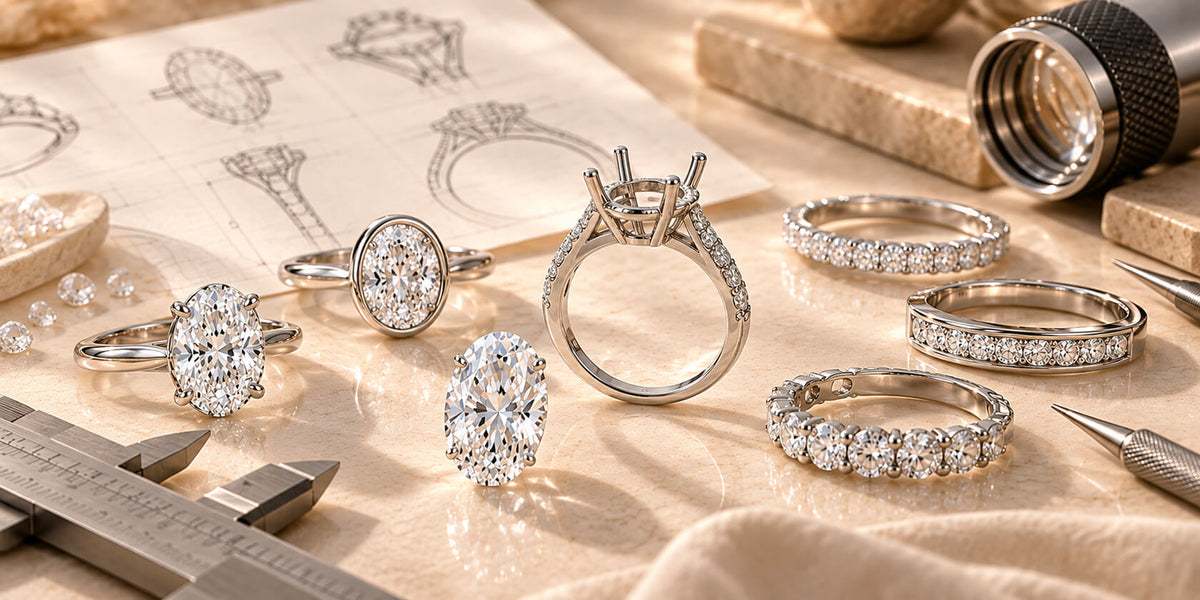
A ring setting does more than hold a gemstone in place.
It affects how much of the stone is visible, how protected its edges are, how high the ring sits on the finger, how easily it may catch on clothing, how it should be maintained, and even how well an engagement ring fits beside a wedding band.
Terms such as prong, bezel, pavé, channel, halo, cathedral, and solitaire are often grouped together as “ring settings,” but they do not all describe the same thing.
Some describe how a gemstone is physically secured. Others describe the overall arrangement and architecture of the ring.
Understanding that distinction makes it much easier to compare designs intelligently.
This guide explains the most important ring setting types, how they work, and what to consider when choosing one.
What Is a Ring Setting?
In its broadest sense, a ring setting is the metal structure that supports and secures the gemstone or gemstones.
A typical gemstone ring includes three important areas:
Head
The upper structure that holds the center gemstone.
Shoulders
The areas where the ring transitions from the shank toward the head.
Shank
The circular portion that wraps around the finger.
Within the head, the gemstone itself may be secured using prongs, a bezel, tension, or another construction.
This is different from terms such as solitaire or three-stone, which primarily describe how gemstones are arranged within the overall ring design. GIA makes the same distinction between stone-securing setting types and broader setting styles.
Ring Setting Type vs. Ring Style
Consider a simple example:
A ring may be:
Solitaire in style
+
Prong-set at the center
+
Cathedral in its shoulder architecture
Another ring could be:
Halo in style
+
Prong-set center stone
+
Pavé-set halo and band
These terms are not competing descriptions.
They describe different parts of the same ring.
Understanding this is particularly useful when designing custom jewelry because saying:
“I want a halo setting”
still leaves unanswered questions about how the center stone is secured, how the halo stones are set, how high the center sits, and how the ring is constructed underneath.
1. Prong Setting
The prong setting is one of the most familiar methods of securing a center gemstone.
Small metal supports rise from the setting and extend over the gemstone's edge, holding it in position.
Because relatively little metal covers the stone, a prong setting leaves much of the gemstone visible and allows light to reach it from multiple directions. This is one reason prongs are widely used for diamond engagement rings.
Common variations include:
- Four prongs
- Six prongs
- Rounded prongs
- Claw prongs
- V-prongs
Four Prongs vs. Six Prongs
For a round center stone, four and six prongs create noticeably different effects.
Four Prongs
Four prongs expose more of the gemstone and create a visually open appearance.
On a round stone, their positioning can also make the outline appear slightly squarer.
Six Prongs
Six prongs introduce additional points of support and tend to reinforce the circular appearance of a round gemstone.
GIA notes that a six-prong arrangement provides additional security compared with four prongs if one prong becomes compromised, while four prongs leave more of the stone exposed.
Neither is automatically the correct choice.
The appropriate construction depends on stone shape, size, design, and the desired balance between visibility and protection.
V-Prongs
V-shaped prongs are particularly useful around pointed gemstone corners.
Shapes such as:
- Pear
- Marquise
- Princess
- Heart
have vulnerable points that deserve appropriate protection. GIA likewise recommends protecting the pointed areas of fancy-shaped diamonds with suitable prongs or setting construction.
Craft Jeweler Tip
Do not select prongs based only on how they look from above.
Prong thickness, position, contact with the stone, and the supporting structure underneath all matter.
A prong should be refined enough not to overwhelm the gemstone—but substantial enough to do its actual job.

2. Bezel Setting
A bezel setting surrounds the edge of a gemstone with a rim of metal.
Rather than securing the stone at several individual contact points, the bezel supports it around much or all of its perimeter.
Full Bezel
Metal surrounds the entire gemstone.
Partial Bezel
Selected portions remain open while other sections are secured by metal.
Because the gemstone's perimeter is protected, bezel settings can provide strong protection against everyday knocks and reduce exposed edges. Their smooth profile can also be less likely to catch on clothing.
The trade-off is visual.
More metal is visible around the stone compared with an open prong setting, changing both the appearance of the gemstone and the overall design.
A bezel is therefore not simply:
“the safer version of a prong setting.”
It creates its own aesthetic—clean, structured, and often contemporary.
3. Flush Setting
In a flush setting, the gemstone is positioned within the metal so that its top sits close to the surrounding surface.
There are no prominent prongs extending above the stone.
This creates:
- a low profile;
- smooth surface;
- minimal snagging;
- substantial protection from surrounding metal.
Flush settings are particularly well suited to designs with sufficient metal thickness to accommodate the depth of the gemstone.
For this reason, they are often found in:
- wider wedding bands;
- men's rings;
- signet-style rings;
- contemporary minimalist designs.
A flush setting should not be confused with a bezel.
A bezel surrounds the edge of a stone with a metal rim.
A flush-set gemstone is embedded into the body of the ring itself.

4. Pavé Setting
Pavé comes from the idea of a surface appearing “paved” with gemstones.
Small diamonds or gemstones are placed closely together and secured using very small beads or prongs of metal, minimizing the visible metal between the stones.
Pavé is commonly used:
- along an engagement-ring band;
- around a halo;
- on wedding bands;
- across decorative surfaces.
The goal is to create a continuous field or line of brilliance rather than emphasizing each small stone individually.
GIA describes pavé as a bead-style setting in which small stones are closely arranged and secured with small amounts of metal.
Pavé Requires a Balance Between Delicacy and Structure
Very fine pavé can look beautifully delicate.
But removing metal to accommodate many small stones also affects the structure of the ring.
GIA specifically notes that pavé, bead, and channel settings require metal removal and that poor engineering can weaken a piece when too much material is removed.
This is an important point when comparing rings online.
A thinner band with more diamonds is not automatically better craftsmanship.
The design still needs enough metal to:
- support the stones;
- maintain the shank;
- resist normal deformation;
- allow appropriate maintenance.
Craft Jeweler Tip
Pay particular attention to pavé extending around the underside of a ring.
The palm side experiences considerably more contact and friction during everyday wear. GIA similarly cautions that pavé on the bottom of the shank is more exposed to wear and potential stone loss or damage.
5. Channel Setting
A channel setting secures a row of gemstones between two parallel walls of metal.
Unlike a traditional prong setting, there are no individual prongs between the stones.
The gemstones sit side by side within the channel, creating a clean, continuous line.
Channel settings are frequently used for:
- wedding bands;
- anniversary rings;
- engagement-ring side stones.
The surrounding metal protects the edges of the stones and creates a relatively smooth profile.
However, the design also requires precision.
The stones need appropriate dimensions and alignment so they fit consistently within the channel.
Another consideration is resizing.
If the channel extends far around the circumference of the ring, substantial resizing can disturb the geometry of the setting.
6. Shared-Prong Setting
A shared-prong setting is commonly seen in diamond wedding and eternity bands.
Instead of giving every stone a completely independent set of prongs, adjacent stones share metal supports.
This reduces the amount of visible metal between gemstones and allows the row of stones to become the visual focus.
Shared-prong settings can create excellent brilliance, but construction quality matters.
Look for:
- consistent stone height;
- even spacing;
- symmetrical prongs;
- secure contact;
- appropriate metal thickness.
This is especially important in eternity bands, where the setting continues around much or all of the ring.

7. Bar Setting
A bar setting positions gemstones between vertical metal bars.
Unlike a channel setting, which runs metal along the sides of an entire row, a bar setting separates stones with individual bars while leaving other edges more exposed.
This can create a structured, architectural appearance while allowing more of each gemstone to remain visible.
Bar settings are often used in:
- diamond bands;
- anniversary rings;
- side-stone designs.
They occupy a middle ground between the openness of some prong settings and the enclosed appearance of a channel.
As with channel settings, resizing can become more complicated when the stones extend significantly around the band.
8. Tension Setting
A tension setting uses carefully engineered pressure from the metal structure to hold the gemstone between two sides of the ring.
The result creates the visual impression that the gemstone is floating.
Unlike a conventional prong setting, the design depends heavily on the mechanical properties and engineering of the ring.
Tension settings are generally better suited to hard gemstones capable of tolerating the required pressure, including diamonds and sapphires.
They also require careful consideration because:
- more of the gemstone can remain exposed;
- sizing alterations may be difficult;
- the structural tension must be maintained.
This is one setting where appearance and engineering are particularly inseparable.
9. Basket Setting
A basket setting is a form of prong setting with additional horizontal supports connecting the prongs beneath the gemstone.
Viewed from the side, those supports create a basket-like structure.
The basket helps stabilize the prongs and provides additional support to the setting. GIA notes that this construction can be particularly useful for larger or deeper gemstones.
Basket settings can also be designed at different heights.
A lower basket can keep the gemstone closer to the finger.
A higher setting may create additional clearance underneath—but height should be evaluated alongside wearability and wedding-band compatibility.
10. What About Solitaire, Halo, Three-Stone and Cathedral?
This is where ring terminology often becomes confusing.
These terms generally describe ring styles or architecture, rather than the precise mechanism holding every gemstone.
Solitaire
A solitaire places one center gemstone at the visual focus of the ring.
That stone might be:
- prong-set;
- bezel-set;
- tension-set.
So “solitaire” tells you how many stones dominate the design, not necessarily how the center stone is physically secured.
Halo
A halo surrounds the center gemstone with smaller stones.
Those smaller stones might be pavé or bead set, while the center stone may be held by prongs or a bezel.
A halo can increase the overall visual footprint and add brilliance around the center stone.
Three-Stone
A three-stone ring uses a center gemstone with one prominent side stone on either side.
Each of the three stones may still be held with prongs, bezels, or another appropriate setting technique.
Again:
Three-stone = arrangement.
Prong = method of securing the stones.
Cathedral
In a cathedral setting style, the shoulders of the ring rise toward the center gemstone in sweeping arches.
This architectural feature can create a graceful transition between the shank and the center setting.
The center stone itself still requires a securing method—often prongs.

11. Low-Profile vs. High-Profile Settings
Setting height is another important decision.
Low-Profile Setting
The gemstone sits closer to the finger.
Potential advantages include:
- less projection;
- reduced likelihood of catching;
- compact appearance.
But a very low center setting can prevent a straight wedding band from sitting flush beside the engagement ring.
High-Profile Setting
The center gemstone sits higher above the finger.
This can:
- create a more prominent center stone;
- provide additional clearance beneath the head;
- sometimes make wedding-band pairing easier.
However, increased height also makes the ring more exposed to impact and catching.
GIA recommends considering lifestyle when choosing setting height, noting that lower-profile and less ornate mountings can be more practical for active wear.
Neither high nor low is automatically better.
The correct height depends on the stone, design, structure, lifestyle, and intended wedding-band pairing.
12. How Does the Setting Affect Wedding Band Fit?
This is particularly important when choosing an engagement ring.
Look at the ring from the side, not only from above.
A low basket, halo, or decorative gallery may extend outward near the finger and physically block a straight wedding band.
The result may be:
Flush Fit
The rings sit directly together.
Natural Gap
A small space remains.
Contoured Band Required
A curved wedding band follows the engagement ring.
There is nothing inherently wrong with a gap.
But it should ideally be understood before the engagement ring is made.
For custom jewelry, the engagement ring and wedding band can also be designed as a coordinated system.
13. How Should Setting Choice Change With Gemstone Shape?
Stone shape matters because not every part of a gemstone has the same vulnerability.
Round and Oval
Their curved outlines provide considerable flexibility for prong and bezel designs.
Pear and Marquise
The pointed ends deserve particular protection.
A V-prong or appropriately engineered bezel can protect these areas.
Princess
The corners are vulnerable to impact and require appropriate support.
Emerald and Radiant
Corner geometry and stone proportions need to be considered when positioning prongs.
The important principle is:
The setting should be designed around the actual gemstone—not merely the name of its shape.
Two oval stones, for example, can have different length-to-width ratios and depths and therefore require different setting dimensions.
14. How Do You Choose the Right Ring Setting?
Instead of asking:
“Which setting is best?”
ask a more useful series of questions.
How Much of the Stone Do You Want Visible?
For an open appearance:
Prong
For more perimeter coverage:
Bezel
How Much Protection Do You Want?
More exposed settings emphasize the gemstone.
More enclosed settings can provide additional edge protection.
Your lifestyle matters here.
How High Should the Ring Sit?
Consider:
- daily activities;
- gloves;
- catching;
- center-stone depth;
- wedding-band clearance.
Do You Want Accent Diamonds?
If yes, compare:
- pavé;
- channel;
- shared prong;
- bar.
They do not create the same appearance or maintenance requirements.
Might the Ring Need Resizing Later?
Plain shanks generally provide more resizing flexibility than settings that extend stones around much of the circumference.
Channel, pavé, and eternity constructions can make significant resizing more complicated.
How Will the Ring Be Maintained?
Prongs should be periodically inspected.
Small pavé stones and their settings deserve attention after impact or noticeable wear.
Intricate galleries and baskets may require more careful cleaning.
Fine jewelry is designed for wear, but it is not maintenance-free.
15. Setting Quality Matters as Much as Setting Type
Two rings can both be described as:
“Four-prong pavé engagement rings”
and still differ substantially in craftsmanship.
Look beyond the terminology.
For center settings, consider:
- prong symmetry;
- appropriate stone contact;
- stone alignment;
- setting height;
- gallery structure;
- finishing.
For pavé or side stones, consider:
- consistent stone spacing;
- consistent stone height;
- balanced beads or prongs;
- adequate supporting metal;
- clean edges.
GIA's jewelry engineering guidance similarly emphasizes the relationship between stone setting and structural integrity: removing too much metal for melee settings can weaken jewelry if the design is not properly engineered.
This is why a setting should not be judged only by how delicate it looks in a macro photograph.
The setting is part of the jewelry's structure.
Choosing a Setting for Custom Jewelry
One advantage of custom jewelry is that these decisions do not have to be treated separately.
The gemstone dimensions, setting type, band width, height, precious metal, wedding-band fit, and wearability can be considered together.
For example, a custom engagement ring might be specified as:
Oval lab-grown diamond
Four claw prongs
Basket setting
Pavé band
Approximately 2 mm shank
Raised sufficiently for a straight wedding band
18K white gold
That description communicates far more than simply:
“Oval solitaire ring.”
For custom projects that require CAD, the design can also be reviewed from the top, side, front, and underside before production.
Frequently Asked Questions
What is the most secure ring setting?
There is no single setting that is universally most secure for every gemstone and design. Bezel and flush settings provide substantial edge protection, while properly engineered prong settings can securely hold center stones while leaving more of the gemstone visible. Stone shape, dimensions, setting construction, and wear all matter.
Is a bezel setting better than a prong setting?
Neither is universally better. A bezel covers more of the gemstone's perimeter and offers greater edge protection, while prongs leave more of the gemstone visible. The appropriate choice depends on appearance, lifestyle, stone shape, and design.
Are four prongs or six prongs better?
Four prongs expose more of the stone, while six provide additional contact points and can emphasize the round outline of a round gemstone. GIA notes that six prongs can provide additional security if one prong is damaged.
Is pavé the same as a halo?
No. Pavé describes a technique for setting small gemstones closely together. A halo describes an arrangement of smaller stones surrounding a center stone. A halo may use pavé setting.
Is solitaire a setting?
In everyday jewelry terminology it is often called a setting, but more precisely, solitaire describes a ring style centered on a single primary gemstone. That gemstone can itself be secured with prongs, a bezel, tension, or another setting type.
Which setting is best for an active lifestyle?
Lower-profile designs and settings that provide greater stone protection may be worth considering. Bezel and flush settings reduce exposed edges, while high, delicate, or highly ornate settings may require more careful wear. GIA likewise recommends considering lower-profile or more protective mountings for active lifestyles.
Can the setting affect whether a wedding band sits flush?
Yes. The center setting's height, basket, halo, and gallery can determine whether a straight wedding band can pass underneath or beside it. This is best evaluated from the side profile before production.


