
Cart
0
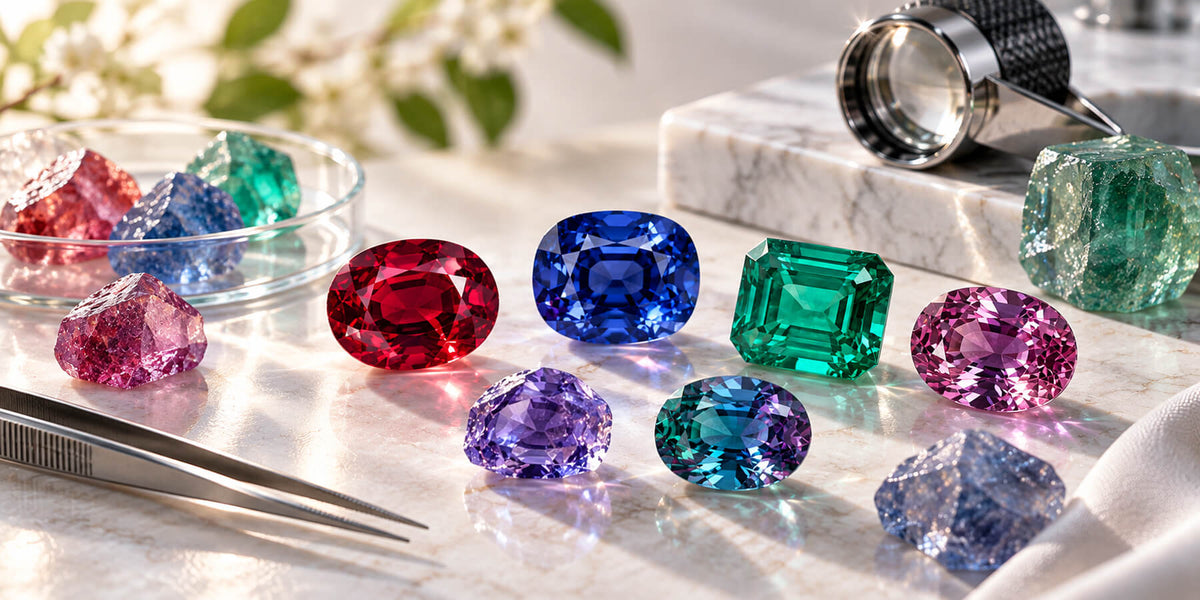
What Are Lab-Grown Gemstones?
Lab-grown gemstones are gemstones created in controlled laboratory environments using advanced crystal-growth techniques designed to reproduce the chemical composition and crystal structure of their natural counterparts.
Unlike imitation or simulated stones that simply resemble a natural gemstone, true lab-grown gemstones have essentially the same chemical, physical, and optical properties as the corresponding natural mineral. A lab-grown ruby, for example, is corundum just like a natural ruby. A lab-grown emerald is beryl just like a natural emerald. Their primary difference is where and how the crystal formed.
Laboratory crystal growth is not a single technology. Different gemstone materials require different growth environments, and methods such as the Czochralski pulled method, hydrothermal method, flux method, and flame fusion process can produce different types of gem crystals.
Understanding these growth methods—and the difference between a true lab-grown gemstone and a gemstone simulant—is an important part of choosing the right stone for fine jewelry.
Are Lab-Grown Gemstones Real Gemstones?
Yes—when the term is used correctly, a lab-grown gemstone is a laboratory-created version of the corresponding natural gemstone material.
The U.S. Federal Trade Commission states that terms such as “laboratory-grown,” “laboratory-created,” or “synthetic” should not be used with the name of a natural stone unless the product has essentially the same optical, physical, and chemical properties as the named stone.
For example:
| Gemstone | Natural Material | Lab-Grown Counterpart |
|---|---|---|
| Ruby | Corundum (Al₂O₃) | Corundum (Al₂O₃) |
| Sapphire | Corundum (Al₂O₃) | Corundum (Al₂O₃) |
| Emerald | Beryl (Be₃Al₂Si₆O₁₈) | Beryl (Be₃Al₂Si₆O₁₈) |
| Alexandrite | Chrysoberyl (BeAl₂O₄) | Chrysoberyl (BeAl₂O₄) |
This means a lab-grown ruby is not merely a red stone that looks like ruby. It is ruby material—corundum—with the appropriate coloring elements.
Likewise, a lab-grown emerald is not green glass or another green gemstone being marketed as emerald. It is laboratory-grown beryl with the properties associated with emerald.
The distinction becomes particularly important when comparing lab-grown gemstones with simulants, which we will discuss later.
How Are Lab-Grown Gemstones Made?
Natural gemstones form through geological processes involving combinations of heat, pressure, mineral-rich fluids, molten material, and extremely long periods of time.
In a laboratory, scientists and crystal growers create carefully controlled conditions that allow crystals with the desired mineral composition and structure to grow.
The exact process depends on the gemstone.
Some gemstones can crystallize from a molten material. Others grow more successfully from a chemical solution or mineral-rich fluid.
For jewelry-quality lab-grown colored gemstones, four important methods are:
- Czochralski Pulled Method
- Hydrothermal Method
- Flux Method
- Flame Fusion (Verneuil) Process
These processes are not interchangeable. Each has different equipment, temperatures, growth rates, costs, and suitable gemstone materials. GIA broadly categorizes Czochralski and flame fusion as melt-growth processes, while flux and hydrothermal are solution-growth processes.
What Is the Czochralski Pulled Method?
The Czochralski method, also known as the crystal pulling or pulled method, is an important technique for producing high-quality single crystals.
In this process, the raw chemical ingredients required for a particular gemstone are heated in a crucible until they form a molten material.
A small seed crystal is then brought into contact with the melt.
The seed is slowly rotated and pulled upward while temperature and pulling speed are precisely controlled. As material from the melt crystallizes onto the seed, a larger single crystal gradually develops.
The basic sequence is:
Raw materials → Molten material → Seed crystal → Controlled rotation and pulling → Single-crystal boule
GIA notes that gemstones synthesized by pulling include synthetic alexandrite, chrysoberyl, corundum and garnet. The method emerged as an important crystal-growth technology in the early twentieth century.
Gemstones that may be grown using the Czochralski method include:
- Lab-grown ruby
- Lab-grown sapphires
- Lab-grown Alexandrite
- Synthetic chrysoberyl
- Certain synthetic garnets and other crystalline materials
Because ruby and sapphire are both varieties of corundum, their basic crystal chemistry is closely related. Different trace elements incorporated into the growing crystal contribute to different colors.
For example, chromium is associated with the red color of ruby, while the colors of sapphire depend on different trace-element combinations.
Why Is the Czochralski Method Important?
One advantage of crystal pulling is the ability to produce relatively large, controlled single crystals with consistent material quality.
For jewelry manufacturers, that can provide rough material suitable for cutting calibrated gemstones in a wide range of shapes and sizes.
However, the fact that two stones are both Czochralski-grown does not automatically mean they have identical quality. Color, clarity, growth control, rough selection, orientation and cutting quality still matter.
What Is the Hydrothermal Method?
The hydrothermal method grows crystals from a water-based solution under elevated temperature and pressure.
The principle is particularly interesting because it resembles some of the geological environments in which natural mineral crystals form.
The process takes place inside a strong sealed pressure vessel called an autoclave.
Nutrient material is placed inside the autoclave along with water and mineralizers that help dissolve the required chemical components.
Under high temperature and pressure, the solution transports dissolved material through the vessel.
A controlled temperature gradient creates conditions in which the dissolved material crystallizes onto seed plates.
In simplified form:
Nutrient material + mineralized solution → Heat and pressure → Dissolved material transport → Seed crystal → Crystal growth
GIA explains that hydrothermal growth uses high-pressure autoclaves and temperature gradients to achieve supersaturation and crystal growth. The method can produce synthetic quartz, emerald, ruby, sapphire, spinel and other gem materials.
Gemstones that can be grown hydrothermally include:
- Lab-grown emerald
- Lab-grown aquamarine and other beryl varieties
- Synthetic quartz
- Lab-grown ruby
- Lab-grown sapphires
- Lab-grown Alexandrite
- Other suitable crystalline materials
Hydrothermal growth is especially significant for lab-grown emerald.
Emerald belongs to the beryl mineral family, and hydrothermal technology can produce beryl crystals with the chemical and structural characteristics expected of emerald.
Why Is Hydrothermal Growth More Complex?
Hydrothermal growth is generally much slower and more technically demanding than inexpensive melt-growth processes.
Precise control of:
- pressure,
- temperature,
- solution chemistry,
- mineralizers,
- seed orientation, and
- temperature gradients
can influence how the crystal develops.
This is one reason different types of lab-grown gemstone rough can vary significantly in production cost and quality.
What Is the Flux Method?
The flux method is another solution-growth technique.
Instead of melting the gemstone material itself at its normal melting temperature, a substance called a flux is used to dissolve the chemical ingredients needed to form the crystal.
A simple analogy is sugar dissolving in hot water.
As the solution is carefully cooled or otherwise becomes supersaturated, the gemstone material begins to crystallize.
The simplified process is:
Gemstone ingredients + Flux → High-temperature solution → Controlled cooling/supersaturation → Seed nucleation and growth → Gem crystal
Flux growth can be used to produce gemstones including:
- Lab-grown emerald
- Lab-grown ruby
- Lab-grown sapphires
- Lab-grown Alexandrite
- Synthetic spinel
GIA notes that flux-grown crystals can require substantial time and investment, with some growth processes taking many months.
Why Are Flux-Grown Gemstones Important?
Flux-grown gemstones can develop internal characteristics that sometimes resemble features found in natural stones.
This does not make them natural gemstones.
Instead, it illustrates an important principle of gemology:
A lab-grown gemstone can have the same basic mineral identity as its natural counterpart while showing microscopic evidence of a different growth environment.
Professional gemological laboratories can use inclusions, growth structures, spectroscopy and other analytical characteristics to help determine origin.
What Is the Flame Fusion or Verneuil Process?
The flame fusion process, also called the Verneuil process, was the first commercially successful method for producing gem-quality synthetic crystals.
In this process, finely powdered chemical ingredients pass through a very hot flame.
The powder melts into tiny droplets that fall onto a rotating support.
As the molten material cools and solidifies, a crystal boule gradually forms.
The basic process is:
Powdered ingredients → High-temperature flame → Molten droplets → Cooling and crystallization → Boule
Flame fusion remains one of the most economical methods for producing synthetic corundum and spinel.
Common materials include:
- Lab-grown ruby
- Lab-grown sapphires
- Synthetic spinel
Its relatively fast growth rate and efficient production make flame fusion significantly different from slower processes such as flux or hydrothermal growth.
For buyers, this illustrates why the broad phrase “lab-grown gemstone” does not describe one single level of production cost or rarity.
A slowly grown hydrothermal or flux crystal and a flame-fusion crystal may both qualify as synthetic versions of a natural mineral, but their manufacturing processes can be very different.

Lab-Grown Gemstone Growth Methods Compared
| Growth Method | Type | Basic Principle | Common Gem Materials |
|---|---|---|---|
| Czochralski Pulled | Melt | Seed crystal is slowly pulled from molten material | Ruby, sapphires, Alexandrite, chrysoberyl |
| Hydrothermal | Solution | Crystal grows from mineral-rich solution under heat and pressure | Emerald, quartz, ruby, sapphires, Alexandrite |
| Flux | Solution | Gem components dissolve in molten flux and crystallize gradually | Emerald, ruby, sapphires, Alexandrite, spinel |
| Flame Fusion / Verneuil | Melt | Powder is melted in a flame and crystallizes into a boule | Ruby, sapphires, spinel |
The appropriate method depends on the mineral being produced and the desired characteristics of the rough crystal. GIA documents an even broader range of experimental and commercial crystal-growth technologies, including floating-zone and other techniques.
Do Lab-Grown Gemstones Have the Same Properties as Natural Gemstones?
For a material correctly described as the lab-grown version of a named gemstone, the answer is essentially yes.
True lab-grown gemstones share essentially the same:
Chemical Properties
A natural ruby and a lab-grown ruby are both corundum.
A natural emerald and a lab-grown emerald are both beryl.
Their fundamental chemical composition corresponds to the same mineral species.
Physical Properties
Because they share the same mineral structure, natural and lab-grown counterparts have essentially the same characteristic physical properties, including properties such as hardness and density.
For example, both natural ruby and lab-grown ruby are corundum, which has a Mohs hardness of approximately 9.
Optical Properties
Lab-grown gemstones also reproduce the characteristic optical properties of the corresponding mineral, including factors such as refractive behavior and luster.
This is why a properly grown and well-cut lab-grown ruby, sapphire or emerald can display the visual characteristics expected from that gemstone material.
The FTC specifically distinguishes laboratory-created gemstones from imitation stones on this basis.
Lab-Grown Gemstones vs. Natural Gemstones
The fundamental difference is origin.
Natural gemstones crystallize through geological processes in the Earth.
Lab-grown gemstones crystallize through controlled technological processes.
| Characteristic | Natural Gemstone | Lab-Grown Gemstone |
|---|---|---|
| Formation | Geological | Controlled laboratory environment |
| Mineral identity | Natural mineral | Corresponding synthetic mineral |
| Chemical properties | Characteristic of mineral | Essentially the same |
| Physical properties | Characteristic of mineral | Essentially the same |
| Optical properties | Characteristic of mineral | Essentially the same |
| Growth features | Natural geological growth | Laboratory growth features |
| Rarity | Determined by natural occurrence | Production can be controlled |
| Origin | Earth-mined | Laboratory-grown |
The two should therefore not be marketed as having the same origin.
A lab-grown sapphire is sapphire material, but it is not a naturally mined sapphire.
That distinction should always be clearly disclosed.
Lab-Grown Gemstones vs. Simulated Gemstones
This is one of the most important distinctions for consumers.
A lab-grown gemstone and a simulated gemstone are not the same thing.
Lab-Grown Gemstone
A lab-grown gemstone has essentially the same chemical, physical and optical properties as its natural counterpart.
Examples:
Natural Ruby → Lab-Grown Ruby
Both are corundum.
Natural Emerald → Lab-Grown Emerald
Both are beryl.
Simulated Gemstone
A simulant is a different material chosen because its appearance resembles another gemstone.
For example, a green material may resemble emerald visually without actually being beryl.
Likewise, cubic zirconia can resemble diamond, but cubic zirconia is not diamond.
The FTC explicitly distinguishes imitation gemstones from laboratory-created gemstones because simulants do not have the same chemical and physical properties as the stones they imitate.
This distinction is especially important when evaluating materials such as:
- Cubic zirconia
- YAG
- GGG
- Glass
- Nano-crystal materials
- Other gemstone simulants
These materials may be attractive and useful in jewelry, but they should be identified by what they actually are rather than described as lab-grown versions of a different mineral.

Can Lab-Grown and Natural Gemstones Be Distinguished?
Yes.
Although lab-grown gemstones can share essentially the same fundamental properties as their natural counterparts, the environments in which the crystals formed are different.
Those different growth environments can leave identifiable features.
Gemologists may examine:
- Internal inclusions
- Growth zoning
- Growth structures
- Color distribution
- Fluorescence
- Trace-element chemistry
- Spectroscopic characteristics
Some stones can be identified using conventional gemological observations and instruments, while difficult cases may require advanced laboratory analysis.
This is why same mineral does not mean indistinguishable origin.
A professional gemological laboratory may be able to determine whether a gemstone formed naturally or was produced through a laboratory crystal-growth process. GIA's colored-stone research uses advanced analytical techniques to distinguish origin and treatments where conventional observation is insufficient.
What Types of Lab-Grown Gemstones Are Available?
Modern crystal-growth technology makes a wide range of gemstone materials possible.
Among the most important for fine jewelry are:
Lab-Grown Ruby
Ruby is the red variety of corundum.
Lab-grown ruby can be produced using several methods, including flame fusion, Czochralski pulling, flux growth and hydrothermal growth.
Its durability and rich red color make it suitable for rings, earrings, necklaces and other fine jewelry.
Lab-Grown Sapphires
Sapphire is also corundum and can be produced in many colors.
Depending on the chemistry and trace elements involved, lab-grown sapphire may appear:
- Blue
- Pink
- Yellow
- Orange
- Green
- Colorless
- Other colors
Several crystal-growth technologies can produce synthetic sapphire, including flame fusion, Czochralski, flux and hydrothermal processes.
Lab-Grown Emerald
Emerald is the green variety of beryl.
High-quality synthetic emerald is commonly associated with hydrothermal and flux growth.
These slower solution-growth methods are fundamentally different from the rapid flame-fusion production commonly associated with synthetic corundum.
Lab-Grown Alexandrite
Alexandrite is the color-change variety of chrysoberyl.
True synthetic alexandrite has been produced using techniques including Czochralski pulling, flux growth and floating-zone methods.
Consumers should distinguish true lab-grown alexandrite from other color-changing synthetic materials designed only to imitate Alexandrite.

Are Lab-Grown Gemstones Suitable for Fine Jewelry?
Yes.
When properly selected, cut and set, many lab-grown gemstones are excellent choices for fine jewelry.
Their suitability depends primarily on the inherent properties of the gemstone species rather than simply whether the stone is natural or laboratory-grown.
For example:
Ruby and sapphires are corundum and are exceptionally durable.
Alexandrite is chrysoberyl and is also well suited to many jewelry applications.
Emerald, whether natural or lab-grown, requires more thoughtful wear and care because beryl has different durability characteristics from corundum.
The correct question is therefore not simply:
“Is this gemstone lab-grown?”
It is also:
“What gemstone material is it, and is that material suitable for how I intend to wear it?”
Does the Growth Method Affect Gemstone Quality?
It can—but the growth method alone does not determine whether a gemstone is “good” or “bad.”
Quality should be evaluated stone by stone.
Important factors include:
- Color
- Saturation
- Tone
- Clarity
- Crystal quality
- Growth consistency
- Cut proportions
- Polish
- Symmetry
- Transparency
- Intended jewelry use
Two lab-grown sapphires produced using the same method can still differ noticeably in appearance and cutting quality.
Likewise, a technically excellent piece of rough material can lose much of its visual potential if poorly cut.
Craft Jeweler Tip
When choosing a lab-grown colored gemstone, do not evaluate the stone only by the growth method.
For finished jewelry, the appearance of the actual stone—especially its color, cut, transparency and proportions—is often more important than the name of the crystal-growth technology alone.
Why Choose Lab-Grown Gemstones?
Lab-grown gemstones offer several practical advantages for jewelry buyers.
More Control Over Color and Quality
Controlled crystal growth can produce rough material with relatively consistent color and clarity.
Greater Availability
Rare-looking colors and larger sizes can often be produced more consistently than equivalent natural gemstones.
More Design Flexibility
Lab-grown rough can be cut into many shapes, sizes and proportions, which is particularly useful for custom jewelry.
Access to Larger or Higher-Clarity Stones
Because laboratory production is not limited by geological rarity in the same way as natural mining, buyers may have access to larger or cleaner stones at different price points.
However, lab-grown gemstones should not automatically be described as “better” than natural gemstones.
Natural and lab-grown stones serve different preferences.
Some buyers value geological rarity and natural origin. Others prioritize color, size, customization and laboratory-grown origin.
The better choice depends on what matters to the individual buyer.
Lab-Grown Gemstones at Craft Jeweler
At Craft Jeweler, we focus on lab-grown gemstones selected for fine jewelry and custom designs.
Our gemstone selection includes lab-grown ruby, sapphires, emerald, Alexandrite and other carefully selected materials in a variety of colors, shapes and sizes.
Because different gemstones require different crystal-growth technologies, we consider the actual gemstone material, growth method, rough quality, color and finished cut rather than treating all lab-grown gemstones as a single category.
For custom jewelry, gemstone selection can also be coordinated with the design itself—including stone dimensions, shape, color, setting style and precious metal.
This makes lab-grown gemstones particularly versatile for engagement rings, statement rings, earrings, pendants and personalized fine jewelry.
Frequently Asked Questions About Lab-Grown Gemstones
Are lab-grown gemstones real gemstones?
Yes, when correctly described as the laboratory-grown version of a natural gemstone. They have essentially the same chemical, physical and optical properties as their corresponding natural mineral but are grown in a controlled laboratory environment rather than mined from the Earth.
Are lab-grown gemstones fake?
No. A true lab-grown ruby, sapphire or emerald should not be confused with a simulant. Lab-grown gemstones reproduce the corresponding gemstone material, while simulants are different materials designed to resemble another gem.
What is the Czochralski method?
The Czochralski method is a crystal-pulling technique in which a seed crystal is slowly pulled and rotated from molten material, allowing a larger single crystal to grow. It can be used for materials including ruby, sapphires and Alexandrite.
What is a hydrothermal gemstone?
A hydrothermal gemstone is grown from a mineral-rich solution under controlled heat and pressure inside an autoclave. Hydrothermal methods can produce materials including synthetic emerald, quartz, ruby and sapphires.
What is a flux-grown gemstone?
Flux growth uses a molten solvent to dissolve the chemical components of a gemstone. As conditions change gradually, crystals form from the solution. Flux techniques can be used for gemstones including emerald, ruby, sapphires and Alexandrite.
What is the difference between lab-grown and simulated gemstones?
A true lab-grown gemstone has essentially the same chemical, physical and optical properties as its natural counterpart. A simulated gemstone is a different material chosen to imitate another gemstone's appearance.
Can a gemologist tell if a gemstone is lab-grown?
Often, yes. Laboratory growth can produce characteristic inclusions, growth structures and chemical or spectroscopic features. Some stones require advanced laboratory testing for confident identification.
Are lab-grown gemstones good for engagement rings?
Many are. Lab-grown ruby and sapphires are particularly durable choices. Other gemstones can also be suitable, but durability, setting style and intended wear should be considered for each gemstone species.
Understanding the Gemstone Matters More Than the Label
“Lab-grown gemstone” is a broad category, not a single material or manufacturing process.
A Czochralski-grown sapphire, hydrothermal emerald and flux-grown Alexandrite may all be laboratory-grown gemstones, yet their chemistry, growth environment, rough crystal morphology and production processes are very different.
What connects true lab-grown gemstones to their natural counterparts is their mineral identity and essentially corresponding chemical, physical and optical properties—not simply their appearance.
Understanding the gemstone species, growth method, quality and proper disclosure makes it easier to distinguish genuine lab-grown gemstone materials from simulants and to choose a stone that fits both your jewelry design and your priorities.


