
Winkelwagen
0
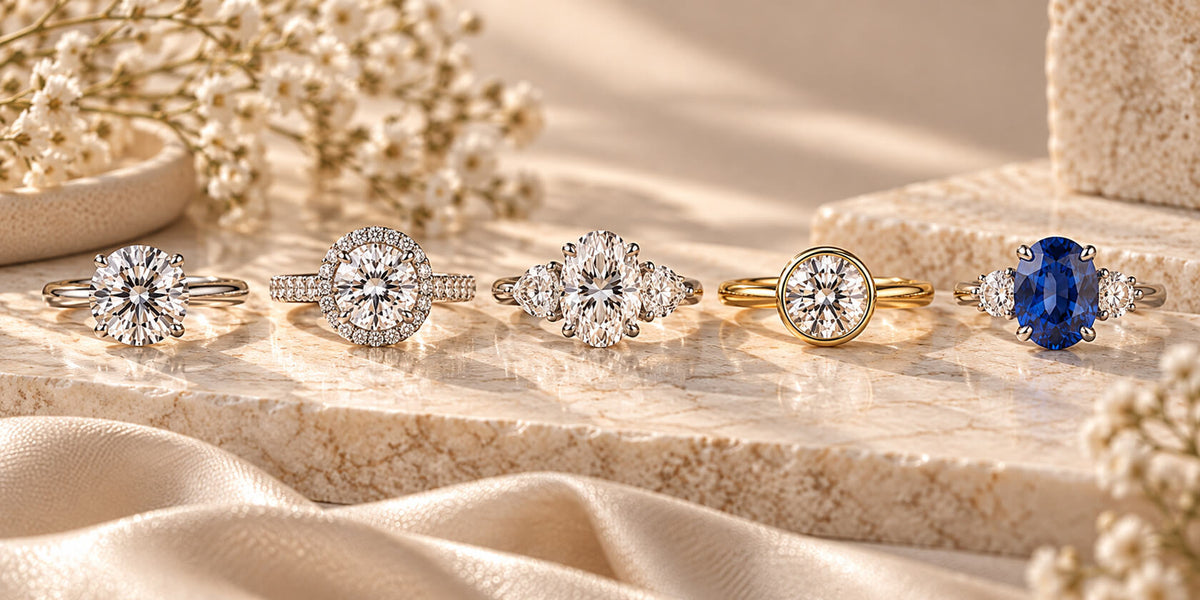
An engagement ring is more than a center stone. The setting, band, proportions, side stones, and small design details all influence how the finished ring looks and feels.
A classic solitaire can feel understated and timeless. A halo creates greater visual presence. A three-stone ring adds balance and symbolism, while a bezel setting offers a clean, contemporary profile. Even subtle details such as a hidden halo or pavé band can completely change the character of a ring.
In this guide, we explore the most popular engagement ring styles, how they differ, and what to consider when choosing a design for your personal style and everyday life.
What Defines an Engagement Ring Style?
The terms engagement ring style and engagement ring setting are often used interchangeably, but they are not exactly the same.
A setting describes how the center stone and other stones are secured within the ring. Prong, bezel, pavé, and channel settings are examples.
A style describes the overall design and visual character of the ring. Solitaire, halo, three-stone, vintage-inspired, and side-stone rings are examples of styles.
Many engagement rings combine several design elements.
For example, a ring might be:
an oval solitaire with a hidden halo, pavé band, and four-prong setting.
Understanding these individual elements makes it much easier to identify the look you actually want.
1. Solitaire Engagement Rings
The solitaire engagement ring is one of the most recognizable and enduring engagement ring styles.
A solitaire places a single center stone at the visual center of the design, with little or no additional decoration competing for attention.
This simplicity makes the center stone—whether a lab-grown diamond, moissanite, sapphire, ruby, or another gemstone—the main focus.
Why Choose a Solitaire?
A solitaire is particularly appealing if you want:
- A timeless design
- Maximum emphasis on the center stone
- A clean and elegant appearance
- Easy pairing with different wedding bands
- A style that is unlikely to feel dated
Solitaire rings can still vary considerably. Band width, prong style, stone shape, setting height, metal color, and gallery design can make two solitaire rings look completely different.
Best for: Classic, minimalist, and timeless tastes.
2. Pavé Engagement Rings
A pavé engagement ring features small diamonds or gemstones set closely along the band.
These accent stones create additional sparkle while allowing the center stone to remain dominant.
Pavé can be subtle—with a narrow row of small stones—or more dramatic depending on the width and coverage of the band.
Why Choose Pavé?
Pavé is a good choice if you want:
- More brilliance than a plain band
- A delicate fine-jewelry appearance
- Additional sparkle without a full halo
- A luxurious but balanced design
Because pavé involves many small stones and settings, craftsmanship is particularly important. Very delicate pavé rings may also require more attentive care than a plain metal band.
Best for: Buyers who want extra brilliance without visually surrounding the center stone.
3. Halo Engagement Rings
A halo engagement ring surrounds the center stone with a border of smaller diamonds or gemstones.
The halo adds sparkle and can increase the overall visual footprint of the center of the ring.
Halos can follow the outline of the center stone—round, oval, cushion, pear, emerald, or another shape—or introduce a contrasting outline.
Why Choose a Halo?
A halo can be particularly effective if you want:
- Strong visual impact
- More brilliance around the center stone
- A larger overall face-up appearance
- A detailed, glamorous design
Halo proportions matter. A refined halo should complement the center stone rather than overpower it.
Best for: Glamorous, high-sparkle designs with strong visual presence.
4. Hidden Halo Engagement Rings
A hidden halo places a row of small diamonds beneath the center stone rather than around its face-up outline.
From directly above, the ring may look similar to a solitaire. From the side, the hidden halo introduces an additional layer of sparkle and detail.
This has become especially popular in modern engagement ring design because it adds interest without substantially changing the center stone's outline.
Why Choose a Hidden Halo?
Consider a hidden halo if you like:
- A clean face-up appearance
- Subtle details
- Additional side-view sparkle
- A modern variation on the solitaire
The gallery and setting height become especially important in hidden-halo designs because the detail needs enough space to remain visible.
Best for: Someone who likes understated design with a more distinctive detail revealed from the side.
5. Three-Stone Engagement Rings
A three-stone engagement ring features a center stone accompanied by two side stones.
Traditionally, the three stones are sometimes associated with the past, present, and future, although the design can simply be chosen for its visual balance.
Side stones can match the center stone or use contrasting shapes.
Popular combinations include:
- Oval center + pear side stones
- Emerald center + tapered baguettes
- Round center + round side stones
- Cushion center + pear side stones
The proportions between the center and side stones are particularly important. Side stones should support the visual composition rather than compete unintentionally with the center.
Best for: Buyers who want more visual coverage, symmetry, and a distinctive alternative to solitaire designs.
6. Side-Stone Engagement Rings
Side-stone rings use additional diamonds or gemstones beside the center stone, but unlike the classic three-stone format, they can incorporate multiple accent stones or more decorative arrangements.
Examples include:
- Tapered baguettes
- Trapezoids
- Pear-shaped side stones
- Graduated round diamonds
- Colored gemstone accents
Side stones can make an engagement ring feel more architectural, decorative, or personalized.
They are also useful for introducing color without replacing the traditional diamond center stone.
Best for: More elaborate designs and buyers who want greater customization.
7. Bezel-Set Engagement Rings
A bezel setting surrounds all or part of the center stone's edge with precious metal.
This produces a noticeably different appearance from traditional prong settings.
Bezel-set engagement rings often have a sleek, contemporary character and can offer additional protection around the stone's perimeter.
Why Choose a Bezel?
A bezel can work particularly well for:
- Active lifestyles
- Modern or minimalist aesthetics
- Lower-profile designs
- Buyers concerned about exposed stone edges
The trade-off is visual: a bezel introduces more visible metal around the gemstone than a traditional prong setting.
That is neither better nor worse—it is a design preference.
Best for: Modern aesthetics, practical wear, and clean lines.

8. Cathedral Engagement Rings
A cathedral setting uses sweeping sections of the band that rise toward the center stone.
The name comes from the arch-like structure created by the elevated shoulders.
Cathedral settings can make the center stone appear more prominent while adding architectural detail to the ring's profile.
They can be combined with:
- Solitaire designs
- Pavé bands
- Hidden halos
- Traditional halos
Because the shoulders rise toward the stone, the overall profile can be more substantial than an extremely low-set design.
Best for: Traditional elegance with a more sculptural profile.
9. Vintage-Inspired Engagement Rings
Vintage-inspired engagement rings draw design cues from historical jewelry without necessarily being antique pieces.
Common details include:
- Milgrain
- Engraving
- Filigree
- Decorative galleries
- Geometric side stones
- Floral motifs
- Art Deco-inspired patterns
These rings often emphasize craftsmanship and decorative detail rather than minimalism.
A vintage-inspired design can also be customized with modern materials such as lab-grown diamonds and lab-grown gemstones.
Best for: Romantic, decorative, Art Deco, or old-world-inspired tastes.
10. Colored Gemstone Engagement Rings
An engagement ring does not have to feature a colorless diamond.
Colored gemstones can make the design more personal and visually distinctive.
Popular options include:
Sapphire
Known for excellent durability and available in colors beyond traditional blue, including pink and yellow.
Ruby
Ruby provides a rich red center stone and strong visual contrast with white or yellow precious metals.
Emerald
Emerald's distinctive green color creates an elegant and immediately recognizable appearance.
Alexandrite
Alexandrite is especially interesting because of its color-change behavior under different lighting conditions.
Lab-grown versions of these gemstones can offer the same essential chemical, physical, and optical properties as their corresponding natural gemstones when they are true laboratory-grown counterparts rather than simulants.
Best for: Buyers who value color, individuality, and a less conventional engagement ring.
11. Toi et Moi Engagement Rings
A Toi et Moi ring features two prominent stones positioned together.
The French phrase means “you and me,” which has made the style especially meaningful for engagement jewelry.
The two stones can differ in:
- Shape
- Size
- Color
- Gemstone type
For example, an oval lab-grown diamond might be paired with a pear-shaped sapphire, or two different diamond shapes can create an asymmetric composition.
Because the design depends heavily on proportion and positioning, thoughtful stone pairing is essential.
Best for: Distinctive, romantic, and fashion-forward designs.

12. Which Engagement Ring Style Looks Largest?
This is one of the most common practical questions.
A ring's visual size is not determined by carat weight alone.
Several design elements can increase visual presence:
Halo settings add an outer border around the center stone.
Elongated shapes, such as oval, pear, marquise, and some radiant cuts, can provide substantial face-up coverage.
Three-stone designs spread visual interest across a wider area of the finger.
Pavé bands add brilliance around the center without necessarily increasing the apparent dimensions of the center stone itself.
If visual size is important, compare actual millimeter dimensions and complete ring proportions rather than shopping only by carat weight.
13. Low-Profile vs. High-Profile Engagement Rings
Setting height is often overlooked when buyers compare engagement ring styles online.
Low-Profile Settings
The center stone sits closer to the finger.
Potential advantages include:
- Less protrusion
- Practical everyday wear
- Lower likelihood of catching on clothing
However, very low settings can sometimes make it difficult for a straight wedding band to sit flush against the engagement ring.
Higher-Profile Settings
A higher setting creates more space beneath the center stone.
This can:
- Make the center stone more visually prominent
- Allow some wedding bands to sit closer
- Create a more dramatic side profile
But a higher ring may also be more exposed during everyday activities.
The best setting height is therefore a balance between appearance, lifestyle, structural design, and wedding-band compatibility.

14. Consider Your Wedding Band at the Same Time
Your engagement ring does not exist in isolation if you plan to wear it with a wedding band.
Some engagement ring settings allow a straight wedding band to sit directly against the engagement ring.
Others create a small gap.
Certain designs may work better with a curved or contoured wedding band.
None of these arrangements is inherently incorrect.
The important question is whether you prefer:
Flush Fit
The engagement ring and wedding band sit closely together.
Small Gap
A visible space remains between the rings.
Contoured Fit
The wedding band curves around the engagement ring.
Thinking about the eventual ring stack before selecting the engagement ring can prevent compromises later.

15. Match the Ring Style to Your Lifestyle
Appearance matters, but an engagement ring is usually worn frequently.
Ask practical questions:
Do you work with your hands frequently?
A lower-profile or more protected setting may be worth considering.
Do you prefer minimal maintenance?
A simple solitaire or bezel may be easier to maintain than an intricate pavé or highly detailed vintage-inspired ring.
Do you want maximum sparkle?
Halo, pavé, and multi-stone designs can provide more brilliance.
Do you plan to stack multiple rings?
Consider the engagement ring's gallery, setting height, and band shape.
Do you prefer timeless or distinctive design?
A solitaire tends to be more restrained, while Toi et Moi, colored gemstones, elaborate halos, and vintage-inspired designs create stronger stylistic statements.
A successful engagement ring should look beautiful and work with the person wearing it.
Engagement Ring Style Comparison
| Style | Overall Look | Sparkle | Best For |
|---|---|---|---|
| Solitaire | Clean & timeless | Center-focused | Classic simplicity |
| Pavé | Refined & brilliant | High | Extra band sparkle |
| Halo | Glamorous | Very high | Greater visual presence |
| Hidden Halo | Subtle & modern | Medium–high | Understated detail |
| Three-Stone | Balanced & substantial | High | Symbolism & finger coverage |
| Side-Stone | Decorative | High | Personalization |
| Bezel | Clean & contemporary | Center-focused | Active lifestyles |
| Cathedral | Architectural & elegant | Varies | Traditional sophistication |
| Vintage-Inspired | Detailed & romantic | Varies | Decorative craftsmanship |
| Colored Gemstone | Distinctive | Varies | Color & individuality |
| Toi et Moi | Artistic & asymmetric | Varies | Statement design |
How to Choose Between Engagement Ring Styles
If several styles appeal to you, narrow the decision down using four questions:
1. What should be the visual focus?
If the answer is the center stone, start with a solitaire or bezel.
If you want sparkle throughout the ring, consider pavé or halo.
2. How much detail do you prefer?
Minimalist buyers may prefer solitaire or bezel settings.
More decorative tastes may favor halo, vintage-inspired, or side-stone designs.
3. How will the ring be worn?
Consider work, hobbies, frequency of wear, setting height, and maintenance.
4. What wedding band will accompany it?
Decide whether you prefer a flush, gapped, or contoured pairing.
Once these questions are answered, the number of genuinely suitable styles becomes much smaller.
Customizing an Engagement Ring Style
You do not have to choose every engagement ring exactly as originally designed.
A ring can often be personalized through:
- Center stone
- Stone shape
- Carat weight or dimensions
- Lab-grown diamond or gemstone
- 14K or 18K gold
- Platinum
- Metal color
- Prong style
- Band width
- Pavé
- Hidden halo
- Side stones
- Setting height
- Engraving
This means you might start with a classic solitaire but add a hidden halo, or take a three-stone design and change the side-stone shapes.
At Craft Jeweler, custom jewelry can also be developed around a particular gemstone, inspiration, or design idea when an existing style does not provide exactly what you are looking for.
Final Thoughts
There is no single best engagement ring style.
A solitaire is not inherently better than a halo, and a three-stone ring is not automatically more meaningful than a bezel or colored gemstone design.
The strongest choice is the one that balances:
Personal Style + Center Stone + Lifestyle + Craftsmanship + Wedding Band Compatibility
Start with the overall look you love, then examine the practical details behind that design.
A well-chosen engagement ring should not only make a strong first impression—it should continue to feel right years after the proposal.
Frequently Asked Questions
What is the most classic engagement ring style?
The solitaire is generally considered one of the most timeless engagement ring styles because it emphasizes a single center stone and works with many stone shapes, metals, and wedding bands.
What engagement ring setting makes a diamond look bigger?
Halo settings can increase the overall visual footprint around a center diamond. Elongated shapes such as oval, marquise, pear, and some radiant cuts can also provide greater face-up spread depending on their proportions.
What is the difference between a halo and a hidden halo?
A traditional halo surrounds the center stone when viewed from above. A hidden halo places small accent stones beneath the center stone, making the detail more visible from the side than from the top.
What engagement ring style is best for an active lifestyle?
There is no universal answer, but lower-profile settings and bezel settings may offer practical advantages because they reduce exposed edges and protrusion. The complete ring construction and the wearer's activities should also be considered.
Can I customize an engagement ring setting?
Yes. Depending on the design, the center stone, shape, metal, band width, side stones, prongs, hidden halo, setting height, engraving, and other details may be customized.
Should my engagement ring sit flush with my wedding band?
Only if that is the look you prefer. Some engagement rings accommodate a straight flush-fitting wedding band, while others naturally create a gap or pair better with a curved or contoured band.


