
Cart
0
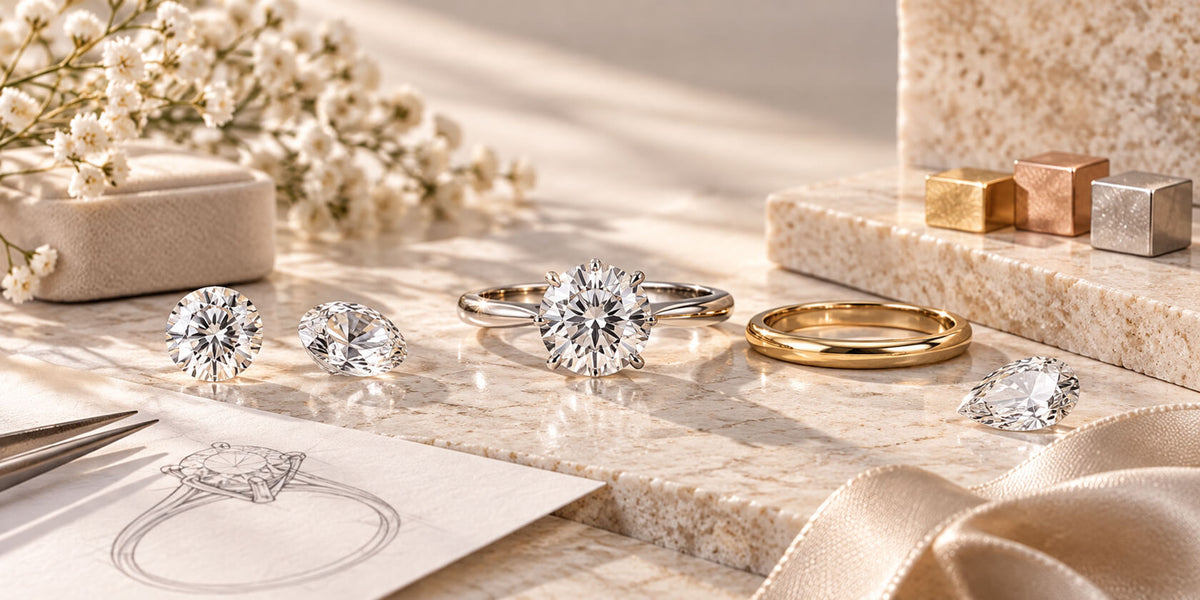
Choosing an engagement ring is a deeply personal decision, but it does not have to be overwhelming. The right ring should reflect your partner’s style, fit comfortably into everyday life, and offer the quality and craftsmanship you expect for a piece designed to last.
From selecting a center stone and diamond shape to choosing the setting, precious metal, ring size, and budget, each decision contributes to the finished piece.
This guide walks you through how to choose an engagement ring step by step, with practical considerations for lab-grown diamonds, gemstones, moissanite, settings, metals, and custom design.
1. Start With a Realistic Engagement Ring Budget
There is no universal rule for how much you should spend on an engagement ring.
Traditional ideas such as spending two or three months' salary are marketing conventions rather than meaningful purchasing rules. A better approach is to establish a budget that feels comfortable and then decide which features matter most within it.
Consider how you want to prioritize:
- Center stone size
- Diamond or gemstone quality
- Precious metal
- Setting complexity
- Accent stones
- Custom design
- Certification
For many buyers, the center stone represents the largest portion of the ring's value. Choosing a lab-grown diamond can make it possible to prioritize size, cut quality, color, or clarity while staying within a more comfortable budget.
The goal should not be to spend as much as possible. It should be to spend intelligently on the characteristics you will actually see and appreciate.

2. Choose the Center Stone
The center stone defines much of an engagement ring's appearance.
Today, buyers have more choices than the traditional mined diamond alone.
Lab-Grown Diamonds
A lab-grown diamond is a real diamond created under controlled laboratory conditions rather than extracted from the earth.
Lab-grown diamonds have essentially the same chemical composition, crystal structure, and optical and physical properties as natural diamonds. They can be produced using CVD (Chemical Vapor Deposition) or HPHT (High Pressure High Temperature) technology.
Like natural diamonds, lab-grown diamonds are evaluated according to characteristics such as cut, color, clarity, and carat weight.
For buyers who want the traditional appearance and properties of diamond while considering value and sourcing, a lab-grown diamond is an excellent option.
Lab-Grown Gemstones
Color can completely change the personality of an engagement ring.
Lab-grown gemstones can include:
- Ruby
- Sapphire
- Emerald
- Alexandrite
Properly grown laboratory-created counterparts have the same essential chemical, physical, and optical properties as their corresponding natural gemstones, although inclusions and growth features may differ.
A sapphire engagement ring, for example, can provide excellent durability while introducing blue, pink, yellow, or other colors into the design.
Emerald offers a distinctive rich green appearance, while ruby creates a stronger and more dramatic visual statement.
Moissanite
Moissanite is another popular engagement ring center stone, but it should not be confused with diamond.
Moissanite is a different gemstone material with its own chemical composition and optical properties. It is known for high brilliance, strong fire, good durability, and attractive value.
For someone who prioritizes sparkle and size rather than specifically wanting a diamond, moissanite can be a compelling choice.
3. Understand the Diamond 4Cs
If you choose a diamond, understanding the 4Cs — Cut, Color, Clarity, and Carat Weight — will help you compare stones intelligently.
Cut
Cut has a major influence on how effectively a diamond interacts with light.
A well-cut diamond can appear brighter and more lively than a poorly proportioned diamond with higher color or clarity grades.
For most buyers, cut quality should be one of the highest priorities.
Color
For white diamonds, color grades describe the degree of colorlessness.
However, you do not necessarily need the highest possible color grade. The setting metal, diamond shape, size, and personal preference all influence how noticeable subtle color differences are.
Clarity
Clarity evaluates internal characteristics and surface features.
Many inclusions cannot be seen without magnification. This means an eye-clean diamond can often provide better practical value than paying substantially more for a clarity grade whose difference is difficult to see with the naked eye.
Carat Weight
Carat measures weight, not physical dimensions.
Two diamonds with the same carat weight can appear different in size depending on their shape, proportions, and cut.
Instead of shopping by carat weight alone, consider the diamond's actual millimeter measurements as well.
Buying Tip: Balance the 4Cs rather than automatically maximizing every grade. A beautifully cut, eye-clean diamond with an attractive face-up appearance may provide better value than paying for specifications that are difficult to appreciate without laboratory equipment.
4. Choose the Right Diamond or Gemstone Shape
Shape has one of the strongest influences on the personality of an engagement ring.
Popular choices include:
Round
The round brilliant is the classic choice and is designed to maximize brilliance.
Best for: Timeless, traditional styles.
Oval
Oval stones offer brilliant sparkle with an elongated outline that can create a larger face-up appearance.
Best for: Elegant designs with a contemporary feel.
Emerald
Emerald cuts feature long step facets and a broad, open appearance rather than intense brilliant-style sparkle.
Best for: Sophisticated, architectural designs.
Cushion
Cushion cuts combine softened corners with a square or elongated outline.
Best for: Romantic and versatile designs.
Pear
Pear-shaped stones combine rounded and pointed ends to create a distinctive silhouette.
Best for: Elegant, unconventional rings.
Marquise
The elongated marquise shape can provide significant visual spread relative to its carat weight.
Best for: Dramatic, slender-looking designs.
Radiant
Radiant cuts combine a rectangular or square outline with brilliant-style faceting.
Best for: Buyers who want both geometric structure and strong sparkle.
There is no universally "best" engagement ring shape. The right choice depends on personal style, finger proportions, setting design, and the visual effect you want to create.

5. Choose an Engagement Ring Setting
The setting determines both the appearance of the ring and how the center stone is supported.
Solitaire
A solitaire places visual emphasis on one center stone.
Its simplicity makes it one of the most versatile engagement ring designs.
Halo
A halo surrounds the center stone with smaller accent stones, increasing the ring's overall visual presence.
Hidden Halo
A hidden halo places accent stones below the center stone rather than around its face-up outline.
It adds detail from the side while maintaining a cleaner top view.
Three-Stone
Three-stone engagement rings feature a center stone with two side stones.
The side stones can complement the center stone in matching or contrasting shapes.
Pavé
Small diamonds or gemstones are set along the band to add brilliance without dramatically increasing the width of the ring.
Bezel
A bezel surrounds all or part of the stone with metal.
It creates a clean contemporary appearance while offering additional protection around the stone's edge.

6. Choose the Right Precious Metal
The metal influences appearance, durability, maintenance, weight, and price.
14K Gold
14K gold contains approximately 58.3% pure gold.
Its balance of durability, appearance, and precious-metal content makes it a practical choice for everyday engagement rings.
18K Gold
18K gold contains 75% pure gold.
It offers a higher gold content and a richer appearance, particularly in yellow gold.
Platinum
Platinum is naturally white, dense, and highly suitable for fine jewelry.
It is especially attractive for buyers who prefer a naturally white precious metal without relying on rhodium plating for its basic color.
Common choices therefore include:
- 14K Yellow Gold
- 14K White Gold
- 14K Rose Gold
- 18K Yellow Gold
- 18K White Gold
- 18K Rose Gold
- Platinum
The "best" metal depends on lifestyle, color preference, budget, maintenance expectations, and the overall ring design.
For a deeper comparison, see our Jewelry Metal Guide: Gold, Platinum & More.

7. Consider Lifestyle, Not Just Appearance
A beautiful engagement ring also needs to work in everyday life.
Someone who frequently works with their hands may have different needs from someone whose daily routine involves less physical activity.
Consider:
- How high the center stone sits
- Prong exposure
- Band thickness
- Stone shape
- Setting security
- Maintenance requirements
- Frequency of wear
For example, an extremely high-profile setting may look dramatic but can catch more easily on clothing or objects.
Likewise, very thin bands can create a delicate appearance but may be less suitable for certain large center stones or demanding lifestyles.
Design should balance aesthetics with structure.
8. Get the Ring Size Right
Ring sizing deserves more attention than it usually receives.
Finger size can change with temperature, time of day, and other everyday factors. Ring width also affects how a ring feels.
Whenever possible, measure an existing ring that fits the intended finger or use a proper ring-sizing tool.
If the engagement ring will eventually be worn together with a wedding band, consider how the two rings will sit together.
Certain eternity bands, highly detailed rings, and some specialized settings can also be more difficult to resize later.
For detailed measurements, consult our Ring Size Guide.
9. Decide Whether Certification Matters
For significant lab-grown diamond purchases, an independent grading report can provide useful information about the stone's characteristics.
Organizations such as the International Gemological Institute (IGI) grade many lab-grown diamonds using recognized characteristics such as:
- Carat weight
- Color
- Clarity
- Cut information where applicable
- Measurements
- Proportions
A grading report should not replace visual evaluation, but it provides standardized information that makes comparing diamonds easier.
At Craft Jeweler, certified options are available for qualifying lab-grown diamonds.
10. Think About the Wedding Band Before Buying the Engagement Ring
This is an often-overlooked decision.
Not every engagement ring sits flush against a straight wedding band.
Large baskets, low-set center stones, halos, and certain gallery designs may create a gap between the engagement ring and wedding band.
Neither approach is inherently wrong. Some people prefer a visible gap; others want the rings to sit tightly together.
If you already know that you want a coordinated bridal set, consider the wedding band while choosing the engagement ring rather than treating it as a completely separate purchase later.

11. Consider Custom Jewelry When Standard Designs Are Not Quite Right
Sometimes the right engagement ring is not an existing design.
Custom jewelry allows you to make decisions about:
- Center stone type
- Stone shape and dimensions
- Metal
- Ring size
- Band width
- Setting style
- Side stones
- Hidden halos
- Prong style
- Engraving
- Other design details
At Craft Jeweler, the custom process can move from your initial idea through design development and CAD review before production begins.
Custom design is especially useful when you already have a specific stone, inspiration image, unusual stone dimensions, or a combination of details that is difficult to find in a standard engagement ring.
12. Do Not Choose an Engagement Ring From Specifications Alone
Specifications matter, but jewelry is visual.
Two stones with similar grading information can look different because of proportions, facet patterns, light performance, or color distribution.
Two rings using the same center stone can also feel completely different because of band width, setting height, prong design, metal color, or side stones.
When making the final decision, consider three things together:
Technical Quality + Visual Appearance + Personal Preference
A grading report can describe a diamond.
It cannot decide which ring your partner will love.
Engagement Ring Buying Checklist
Before placing an order, confirm:
- Your budget
- Center stone type
- Diamond or gemstone shape
- Stone dimensions or carat weight
- Setting style
- Metal and color
- Ring size
- Lifestyle considerations
- Certification, where applicable
- Wedding band compatibility
- Production time
- Shipping time
- Return eligibility
- Warranty and aftercare
- Any customization requirements
Taking a few extra minutes to confirm these details can prevent many of the most common engagement ring purchasing mistakes.
Final Thoughts
The best engagement ring is not necessarily the largest diamond, the highest clarity grade, or the most expensive setting.
It is the ring that brings together beauty, quality, wearability, personal meaning, and budget in the right proportions.
Start with the person who will wear it. Understand their style and lifestyle, establish a comfortable budget, and then work through the center stone, shape, setting, metal, and size one decision at a time.
Whether you choose a lab-grown diamond, lab-grown gemstone, moissanite, a made-to-order design, or a fully custom engagement ring, an informed decision will help you choose a piece that feels personal rather than simply impressive.
FAQ
How much should I spend on an engagement ring?
There is no required amount. Choose a budget that is financially comfortable and prioritize the characteristics that matter most to you, such as center stone quality, size, setting, metal, and craftsmanship.
What is the best diamond shape for an engagement ring?
There is no single best shape. Round diamonds offer a classic brilliant appearance, while oval, cushion, emerald, pear, radiant, and other shapes provide different proportions and styles. Personal preference should be the deciding factor.
Is a lab-grown diamond suitable for an engagement ring?
Yes. Lab-grown diamonds have essentially the same chemical composition, crystal structure, and optical and physical properties as natural diamonds and are suitable for everyday fine jewelry when properly cut and set.
Is 14K or 18K gold better for an engagement ring?
Neither is universally better. 14K gold offers an excellent balance of durability and gold content, while 18K contains more pure gold and offers a richer precious-metal composition. Lifestyle, color preference, and budget should guide the choice.
Is platinum good for an engagement ring?
Yes. Platinum is naturally white, dense, and widely used in fine jewelry. It is particularly suitable for buyers who prefer a substantial, naturally white precious metal.
Can an engagement ring be customized?
Yes. Depending on the design, elements such as the center stone, gemstone size, metal, setting, side stones, ring size, band proportions, and other details can be customized.


