
Chariot
0
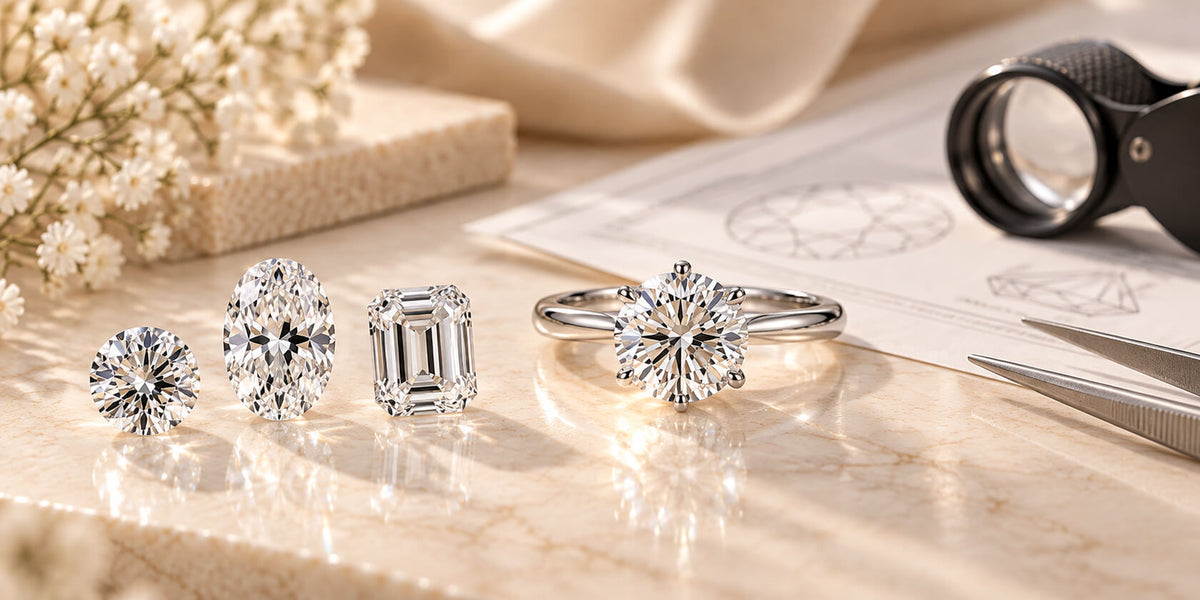
A lab-grown diamond engagement ring uses a diamond created in a controlled laboratory environment rather than mined from the earth.
True lab-grown diamonds are diamonds. They have essentially the same chemical composition, crystal structure, and optical and physical properties as natural diamonds.
They should not be confused with diamond simulants such as cubic zirconia or moissanite.
The two principal technologies used to grow gem-quality laboratory diamonds are:
- CVD — Chemical Vapor Deposition
- HPHT — High Pressure High Temperature
A CVD diamond or HPHT diamond can be cut, polished, graded, and set into fine jewelry just like a natural diamond.
For a deeper introduction to the material itself, see our What Are Lab-Grown Diamonds? guide.
1. Start With the Diamond — But Don't Buy by Carat Weight Alone
Carat is a measure of weight, not physical dimensions.
This distinction matters.
Two lab-grown diamonds weighing exactly 2.00 carats can have noticeably different face-up dimensions because of differences in:
- Shape
- Cut proportions
- Depth
- Girdle thickness
- Length-to-width ratio
A diamond carrying more of its weight deep below the girdle may appear smaller from above than another diamond of the same carat weight with more efficient proportions.
For engagement rings, therefore, always evaluate:
Carat Weight + Measurements + Proportions + Cut Appearance
rather than carat weight alone.
For example, when comparing two oval lab-grown diamonds of similar weight, look at their millimeter dimensions and length-to-width ratios in addition to the carat number.
This gives you a much more realistic idea of how large the diamond will actually appear on the finger.

2. Understand the 4Cs — But Don't Automatically Buy the Highest Grades
The traditional 4Cs remain fundamental when evaluating a lab-grown diamond:
- Cut
- Color
- Clarity
- Carat
But a common buying mistake is assuming that every grade should be pushed as high as the budget allows.
That is not necessarily the most efficient way to buy a beautiful engagement diamond.
Cut
For brilliance and visual performance, cut quality deserves particular attention.
A beautifully cut diamond can appear lively, bright, and balanced, while poor proportions can compromise light performance even when the diamond has impressive color and clarity grades.
For round brilliant diamonds, laboratory cut grades provide useful guidance.
Fancy shapes such as oval, radiant, cushion, pear, emerald, and marquise require more nuanced visual evaluation because their appearance cannot always be reduced to a single cut grade.
Color
Diamond color is graded on a scale beginning with D for colorless diamonds.
The practical question is not simply:
"What is the highest color grade?"
It is:
"At what grade does the diamond look appropriately colorless for this particular ring?"
Shape, diamond size, setting, metal color, and personal sensitivity to color can all influence that decision.
Clarity
Clarity describes internal and external characteristics visible under standardized grading conditions.
Higher clarity grades can command higher prices, but microscopic differences do not always produce meaningful visual differences when the diamond is viewed normally.
For an engagement ring, an eye-clean diamond can often be more important than paying for a clarity distinction that is difficult to appreciate without magnification.
Carat
Carat influences both physical size and price, but should be considered alongside actual measurements and proportions.
The best-value combination is therefore not necessarily:
Highest Color + Highest Clarity + Largest Carat.
A more intelligent approach is to balance all four characteristics around visible beauty and the finished ring design.

3. Prioritize Cut Quality and Light Performance
This point deserves its own section because many buyers focus too heavily on carat, color, and clarity.
The reason a diamond attracts attention is largely how it interacts with light.
A well-cut diamond should display an appealing balance of:
- Brightness
- Fire
- Scintillation
- Contrast
- Symmetry
With round brilliant diamonds, established proportion and cut-grading systems make comparison relatively straightforward.
Fancy-shaped diamonds require more visual judgment.
For example:
Oval
Look at overall outline, length-to-width ratio, symmetry, and the appearance of the bow-tie area.
Radiant
Evaluate brightness distribution, corner shape, proportions, and whether the facet pattern produces the appearance you prefer.
Emerald Cut
Because emerald cuts use broad step facets rather than brilliant-style faceting, clarity, symmetry, transparency, and facet pattern become especially noticeable.
Cushion
Cushion cuts can have very different facet structures—from more traditional brilliant patterns to modified or crushed-ice appearances.
This is why two lab-grown diamonds with apparently similar grading reports can still look very different in person or on high-quality video.
4. CVD vs. HPHT: Which Is Better for an Engagement Ring?
This is one of the most misunderstood questions in the lab-grown diamond market.
The short answer is:
Neither CVD nor HPHT should automatically be considered superior simply because of the growth method.
HPHT Diamonds
HPHT — High Pressure High Temperature recreates conditions involving very high pressure and temperature to grow diamond crystals.
CVD Diamonds
CVD — Chemical Vapor Deposition grows diamond material from carbon-containing gas in a controlled chamber, typically layer by layer on a diamond seed.
Both processes can produce high-quality gem diamonds.
And both processes can produce diamonds of varying quality.
Therefore:
Growth method is information—not a quality grade.
When comparing a CVD diamond and an HPHT diamond, evaluate the actual finished stones:
- Cut
- Color
- Clarity
- Proportions
- Transparency
- Optical appearance
- Certification
- Treatments, when disclosed
- Overall visual performance
Do not reject an otherwise excellent diamond simply because it was grown by one method rather than the other.
For a detailed explanation of these technologies, see How Are Lab-Grown Diamonds Made?

5. Check the Diamond's Actual Measurements
Measurements are especially useful when shopping online.
A grading report typically provides physical dimensions in millimeters.
For a round diamond, this generally includes minimum diameter, maximum diameter, and depth.
For fancy shapes, measurements normally include:
Length × Width × Depth
These numbers help answer practical questions such as:
- How large will the diamond look?
- Is the stone unusually deep?
- Is the shape elongated or broad?
- Will it fit the intended setting?
- How does it compare with another diamond of similar carat weight?
For fancy shapes, the length-to-width ratio is also important.
For example, two 2-carat oval diamonds can have distinctly different personalities:
One may be shorter and broader.
Another may be longer and more elongated.
Neither is automatically better. The right proportion depends partly on personal preference and the intended ring design.
6. Choose the Diamond Shape Based on More Than Appearance
Shape strongly influences the personality of an engagement ring.
Popular lab-grown diamond shapes include:
Round
Known for classic proportions and strong brilliance.
Oval
Offers an elongated outline and can create greater visual length on the finger.
Radiant
Combines a rectangular or square outline with brilliant-style faceting.
Emerald
Uses step-cut faceting for a cleaner, architectural appearance.
Cushion
Known for softened corners and a wide range of facet patterns.
Pear
Combines rounded and pointed elements for an asymmetric teardrop silhouette.
Marquise
Its elongated pointed outline creates strong finger coverage.
Princess
A square brilliant-style shape with sharp corners.
The choice should consider:
Appearance + Face-Up Dimensions + Setting + Finger Proportions + Lifestyle
For detailed shape comparisons, use our Diamond Shapes Guide rather than relying on carat weight alone.
7. Understand What the Diamond Certificate Actually Tells You
Independent grading documentation is particularly useful when buying a lab-grown diamond online.
Craft Jeweler offers IGI-certified options for lab-grown diamonds.
A grading report may provide information including:
- Laboratory-grown identification
- Carat weight
- Color grade
- Clarity grade
- Measurements
- Proportions
- Polish
- Symmetry
- Fluorescence, where applicable
- Growth process
- Treatment disclosures, where applicable
- Report number
The certificate is important—but it should not be treated as a photograph of the diamond.
Two diamonds with similar grading information can still look different.
Think of the grading report as:
Objective technical information
and photographs/video as:
Visual evaluation
Ideally, use both.

8. Don't Overpay for Grades You Cannot Appreciate
One advantage of lab-grown diamonds is that buyers may have greater flexibility in allocating their engagement-ring budget.
But that does not mean every dollar should be spent increasing specifications.
Suppose your budget allows you to choose between:
Option A
A larger, beautifully cut diamond with an eye-clean clarity grade.
and
Option B
A smaller diamond with extremely high color and clarity grades whose differences are difficult to perceive without controlled comparison or magnification.
Option B is not automatically the better purchase.
Ask:
Where will the additional spending produce a visible improvement?
For many engagement-ring buyers, the priority order may be closer to:
Cut / Visual Performance → Shape & Dimensions → Carat → Appropriate Color → Eye-Clean Clarity
rather than simply maximizing every number on the certificate.
The exact balance depends on the diamond and buyer.
9. Match the Diamond to the Setting
A diamond should not be selected independently from the ring design.
The same 2-carat lab-grown diamond can look dramatically different in:
- Solitaire
- Halo
- Hidden halo
- Three-stone
- Pavé
- Bezel
- Cathedral
Setting design affects:
- Visual size
- Side profile
- Protection
- Amount of visible metal
- Wedding-band compatibility
- Overall style
For example, an elongated oval in a delicate solitaire produces a very different visual effect from the same diamond surrounded by a halo.
Before purchasing the center stone, know at least approximately what type of setting you intend to use.
For a detailed comparison, see our Engagement Ring Styles Guide.
10. Consider Setting Height and Everyday Wear
Engagement ring photographs are often taken primarily from above.
But you will wear the ring in three dimensions.
Always consider the side profile.
A higher setting may:
- Give the center stone more prominence
- Allow certain straight wedding bands to sit closer
- Create a more dramatic profile
A lower setting may:
- Sit closer to the finger
- Be less prominent during everyday activities
- Reduce snagging in some designs
However, very low settings can sometimes prevent a straight wedding band from sitting flush.
The best choice depends on:
Design + Lifestyle + Center Stone + Wedding Band
not setting height alone.
11. Choose 14K Gold, 18K Gold, or Platinum
The precious metal is both an aesthetic and structural part of the engagement ring.
14K Gold
Contains approximately 58.3% pure gold.
It offers a practical combination of precious-metal content and everyday durability.
18K Gold
Contains 75% pure gold.
It offers higher gold content and, particularly in yellow gold, a richer gold appearance.
Platinum
Platinum is naturally white, dense, and substantial.
It is especially attractive for buyers who prefer a naturally white precious metal.
Your choice should consider:
- Metal color
- Weight
- Maintenance
- Design
- Setting construction
- Budget
- Personal preference
For a more complete comparison, see Jewelry Metal Guide: Gold, Platinum & More.

12. Think About the Wedding Band Before Finalizing the Engagement Ring
This is one of the easiest details to overlook.
If you plan to wear a wedding band beside your engagement ring, decide whether you prefer:
Flush Fit
The rings sit closely together.
Small Gap
A deliberate or structural gap remains between them.
Curved / Contoured Fit
The wedding band curves around the engagement-ring setting.
The engagement ring's basket, center-stone size, setting height, and gallery can all influence compatibility.
Thinking about both rings during the engagement-ring design stage gives you more control over the eventual bridal set.

13. Ready-to-Ship vs. Made-to-Order vs. Custom Engagement Rings
Not every buyer needs the same purchasing route.
At Craft Jeweler, it is useful to think about engagement rings in three broad categories.
Ready-to-Ship
Best when:
- You like the existing design
- The available specifications suit you
- Faster processing is important
Ready-to-ship jewelry typically requires significantly less preparation before dispatch than made-to-order jewelry.
Made-to-Order
Best when:
- You like an existing Craft Jeweler design
- You need a particular ring size
- You want to choose precious metal or certain stone specifications
- You are comfortable allowing time for production
Our made-to-order gold jewelry generally requires approximately 10–15 business days of production before shipping.
Custom Jewelry
Best when:
- You have a specific design idea
- You want unusual proportions or stone combinations
- You need a wedding band designed around an engagement ring
- Existing designs do not meet your requirements
- Personal design details are important
A custom project can involve gemstone selection, design development, CAD review, final confirmation, production, and finishing.
This route offers the greatest flexibility, but the design and specifications should be confirmed carefully before production begins.
14. Understand Production Time vs. Shipping Time
These are not the same thing.
Production time is the time required to prepare or manufacture the jewelry.
Shipping time begins after the finished order is dispatched.
For Craft Jeweler, processing varies by product type. For example:
- Ready-to-Ship Jewelry: approximately 1–2 business days
- Made-to-Order Jewelry: approximately 10–15 business days
- In-Stock Loose Stones: usually within 1 business day
- Custom-Cut Loose Stones: approximately 5 business days
- Ring Resizing: approximately 3 additional business days
Custom jewelry timelines depend on the complexity of the project and should be confirmed before production.
This distinction matters when purchasing an engagement ring for a planned proposal date.
Do not count backward only from shipping time.
15. Check Return Eligibility Before Ordering
This is particularly important with made-to-order and customized engagement rings.
A ready-to-ship ring and a customized ring may not have identical return eligibility.
Products that have been:
- Custom designed
- Engraved
- Resized
- Modified
- Produced to specific customer requirements
may be subject to different return conditions.
Always review the applicable Return & Refund Policy before confirming a customized order.
This is not just a store-policy detail. It should be part of an informed high-value jewelry purchase.
16. Understand Warranty and Aftercare
Fine jewelry requires appropriate long-term care.
Craft Jeweler provides a 1-year craftsmanship warranty covering eligible manufacturing defects.
Normal wear, accidental damage, misuse, loss, and unauthorized repairs are not manufacturing defects.
We also provide complimentary eligible minor repairs during the first year and offer ongoing aftercare support beyond the warranty period.
For an engagement ring intended for frequent wear, periodic inspection is sensible—particularly for prongs, pavé settings, and other stone-setting components.
17. Lab-Grown Diamond Engagement Ring Buying Checklist
Before placing an order, confirm the following:
Diamond
- Lab-grown diamond identification
- CVD or HPHT growth method
- Certificate/report
- Carat weight
- Actual measurements
- Cut / proportions
- Color
- Clarity
- Shape
- Length-to-width ratio where relevant
- Visual appearance
Ring
- Setting style
- Precious metal
- Metal color
- Ring size
- Band width
- Setting height
- Prong style
- Side stones
- Wedding-band compatibility
Order
- Ready-to-ship, made-to-order, or custom
- Production time
- Shipping time
- Return eligibility
- Warranty
- Aftercare
- Final design/specification confirmation
If you cannot confidently answer these questions, you are probably not ready to place the order yet.
That is particularly true for custom engagement rings.
Lab-Grown Diamond Engagement Ring: Where Should You Spend Your Budget?
A useful way to think about the purchase is:
| Priority | What to Evaluate |
|---|---|
| 1. Visual Performance | Cut, proportions, brightness and overall appearance |
| 2. Shape & Dimensions | Outline, face-up size and proportions |
| 3. Center Stone Size | Carat combined with actual measurements |
| 4. Color | Appropriate grade for stone, metal and preference |
| 5. Clarity | Eye-clean appearance rather than grade alone |
| 6. Setting | Construction, protection, style and profile |
| 7. Metal | 14K, 18K or platinum based on preference and design |
| 8. Craftsmanship | Setting quality, finishing and long-term wearability |
This is not a rigid ranking for every buyer.
But it is generally a better starting point than:
Buy the biggest diamond with the highest grades your budget allows.
Frequently Asked Questions
Are lab-grown diamonds real diamonds?
Yes. Lab-grown diamonds are diamonds created in controlled laboratory environments. They have essentially the same chemical composition, crystal structure, and optical and physical properties as natural diamonds. They are different from simulants such as cubic zirconia and moissanite.
Is CVD or HPHT better for an engagement ring?
Neither growth method is automatically better. Both CVD and HPHT can produce high-quality diamonds. Evaluate the individual diamond's cut, color, clarity, proportions, certification, treatments where disclosed, and visual appearance.
What clarity should I choose for a lab-grown diamond engagement ring?
There is no single clarity grade that is best for every diamond. For many buyers, an eye-clean diamond provides a better balance than paying substantially more for microscopic clarity differences that are difficult to see without magnification.
What color grade should I choose?
The appropriate color grade depends on diamond shape, size, metal color, setting, and personal preference. The highest available grade is not automatically necessary for a beautiful engagement ring.
Is a larger carat lab-grown diamond always better?
No. Carat measures weight, not beauty or physical diameter. Cut quality, proportions, actual dimensions, color, clarity, and overall visual appearance should all be considered.
Should my lab-grown diamond have a certificate?
Independent grading documentation provides useful verification of characteristics such as carat weight, color, clarity, measurements, growth method, and other grading information. Craft Jeweler offers IGI-certified options for lab-grown diamonds.
Can I customize a lab-grown diamond engagement ring?
Yes. Depending on the design, you can customize elements such as the center diamond, shape, size, precious metal, setting, band dimensions, side stones, prongs, hidden halo, engraving, and wedding-band compatibility.
Final Thoughts
Buying a lab-grown diamond engagement ring should not be a race toward the largest carat weight or highest numbers on a grading report.
The best diamond is the one whose cut, proportions, dimensions, color, clarity, and visual character work together, and whose specifications make sense for the engagement ring you actually want to wear.
CVD and HPHT describe how the diamond was grown—not whether the finished diamond is beautiful.
A grading report provides important technical information—but does not replace visual evaluation.
And a beautiful loose diamond still needs an appropriately designed and well-crafted setting.
A better buying formula is therefore:
Diamond Quality + Visual Performance + Ring Design + Craftsmanship + Wearability
Choose those elements together, and the result is much more likely to be an engagement ring that looks beautiful not only on a product page, but on the hand and over years of wear.


